Department of Oncology, the Second Affiliated Hospital of Chongqing Medical University, Chongqing, China.
Department of Oncology, People's Hospital of Xiushan Tujia and Miao Autonomous County, Chongqing, China.
Sci Rep. 2024 Sep 12;14(1):21315. doi: 10.1038/s41598-024-71943-w.
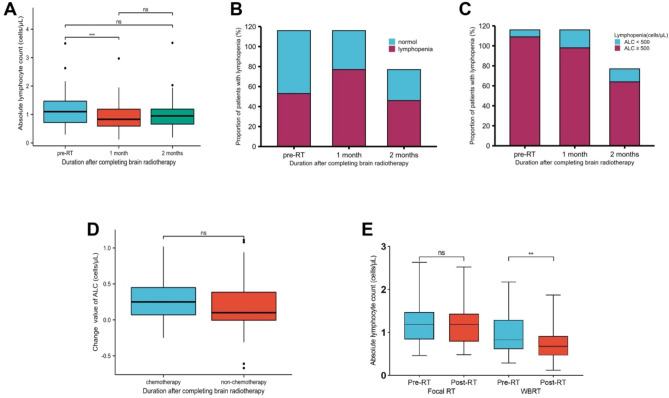
There is increasing awareness of radiotherapy's potential side effects, such as lymphopenia. Therefore, this study aimed to establish the association between WBRT and the development of lymphopenia in patients with brain metastases undergoing brain radiotherapy (RT), along with evaluating the corresponding clinical outcomes. Including 116 patients with brain metastases undergoing brain radiotherapy, the study collected the absolute lymphocyte counts (ALC) within 2 weeks before brain radiotherapy (pre-radiotherapy, pre-RT), as well as ones at 1 and 2 months after completing RT (post-RT). Univariate and multivariate analyses were performed to identify associations between radiation modality and post-RT ALC. The relationships between post-RT ALC and overall survival were evaluated with Kaplan-Meier analysis and a multivariate Cox regression model. The median ALC definitely decreased at 1 month post-RT, but at 2 months post-RT, gradually rose but not to the pre-RT ALC. The multivariate analysis identified WBRT and lower pre-RT ALC as independent risk factors associated with the decrease in post-RT ALC at 1 month. It also revealed more than 4 brain metastases, G3-4 lymphopenia at 1 month and lower post-RT ALC at 2 months exhibited significantly worse prognosis regardless of the radiation modality. However, there was indeed an independent correlation between radiation modality and the outcome of intracranial progression-free survival (PFS). To approach the feasibility and reasonableness of treatment, clinicians should carefully consider various factors to achieve long-term survival of patients.
人们越来越意识到放疗的潜在副作用,如淋巴细胞减少症。因此,本研究旨在建立全脑放疗(WBRT)与脑转移瘤患者行脑放疗(RT)后淋巴细胞减少症发展之间的关联,并评估相应的临床结果。该研究纳入了 116 例接受脑放疗的脑转移瘤患者,收集了放疗前 2 周内(放疗前,pre-RT)、放疗后 1 个月和 2 个月的绝对淋巴细胞计数(ALC)。采用单因素和多因素分析来确定放疗方式与放疗后 ALC 之间的关系。采用 Kaplan-Meier 分析和多因素 Cox 回归模型评估放疗后 ALC 与总生存期之间的关系。放疗后 1 个月时,ALC 中位数明显下降,但在放疗后 2 个月时逐渐升高,但未恢复到放疗前水平。多因素分析确定 WBRT 和较低的放疗前 ALC 是与放疗后 1 个月时 ALC 下降相关的独立危险因素。此外,1 个月时出现超过 4 个脑转移灶、G3-4 级淋巴细胞减少症和放疗后 2 个月时较低的 ALC 与无论放疗方式如何预后均显著较差有关。然而,放疗方式与颅内无进展生存期(PFS)的结果之间确实存在独立相关性。为了探讨治疗的可行性和合理性,临床医生应仔细考虑各种因素,以实现患者的长期生存。