Department of Radiation Oncology, 92323Zhongshan Hospital, Fudan University, Shanghai, China.
Technol Cancer Res Treat. 2022 Jan-Dec;21:15330338221112287. doi: 10.1177/15330338221112287.
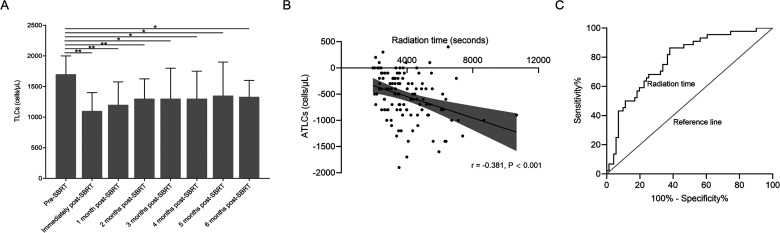
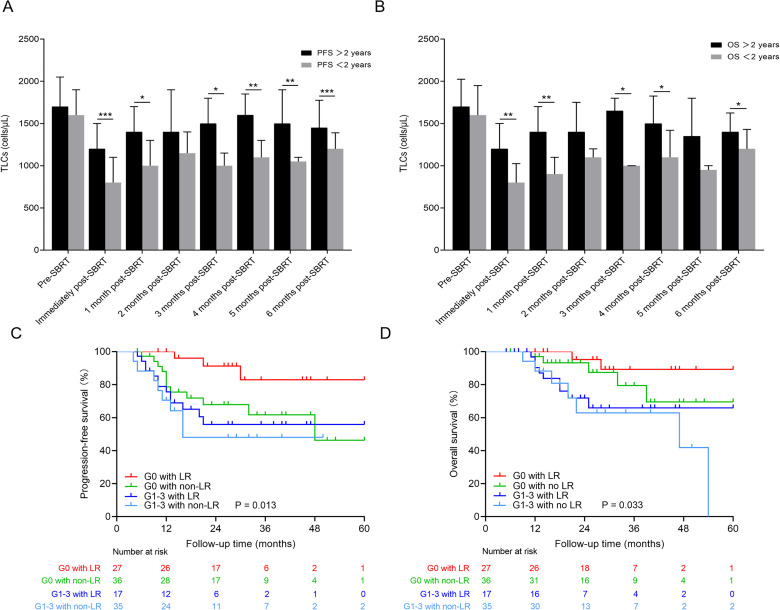
To evaluate the potential impact of radiation time on radiation-induced lymphopenia (RIL) and subsequently recovery after stereotactic body radiation therapy (SBRT) and to examine the associations between radiation time and with patient outcomes in early-stage non-small cell lung cancer (NSCLC). Clinical and laboratory records of subjects consisted of 115 patients who had received SBRT for early-stage NSCLC. Clinical and laboratory records were retrospective reviewed to assess the changes in total lymphocyte counts (TLCs) following SBRT. Associations of TLCs kinetics with the clinical and treatment features, and outcomes were analyzed. Most patients (100/115, 86.96%) experienced significantly decreased median TLCs following SBRT (1700 vs 1100 cells/µL; < .001), and 52 patients (45.21%) met the criteria for lymphopenia. Six months after SBRT, 44 patients (38.26%) had recovered. A negative correlation between TLCs reduction and radiation time was observed ( = -0.381, < .001). According to the receiver-operating characteristic curve analysis, the optimal cut-off value for radiation time to was 3950 s to predict lymphocyte count recovery (LR) following RIL was 3950 s ( < .001). Multivariate analyses demonstrated that radiation time was significantly associated with LR (odds ratio [OR], 0.113; 95% confidence interval [CI], 0.029-0.432; = .001) but not TLCs reduction ( = .575). LR within 6 months after SBRT was associated with improved progression-free survival in patients without non-lymphopenia ( = .034), but had little effect in patients with lymphopenia ( = .405). A longer radiation time was associated with a lower rate of LR within 6 months after SBRT in patients with early-stage NSCLC. Given the association of severe and persistent RIL with survival in NSCLC, further study of the effect of radiation time on immune status is warranted.
评估放疗时间对放射性淋巴细胞减少症(RIL)的潜在影响,以及随后立体定向体部放疗(SBRT)后恢复情况,并探讨放疗时间与早期非小细胞肺癌(NSCLC)患者结局之间的关系。 对 115 例接受 SBRT 治疗早期 NSCLC 的患者的临床和实验室记录进行了回顾性分析,以评估 SBRT 后总淋巴细胞计数(TLCs)的变化。分析了 TLCs 动力学与临床和治疗特征及结局的相关性。 大多数患者(100/115,86.96%)在 SBRT 后出现明显的中位数 TLCs 下降(1700 与 1100 细胞/μL; < .001),52 例(45.21%)符合淋巴细胞减少症标准。SBRT 后 6 个月,44 例(38.26%)患者恢复。TLCs 减少与放疗时间呈负相关( = -0.381, < .001)。根据受试者工作特征曲线分析,预测 RIL 后淋巴细胞计数恢复(LR)的最佳放疗时间截止值为 3950 s( < .001)。多变量分析表明,放疗时间与 LR 显著相关(优势比 [OR],0.113;95%置信区间 [CI],0.029-0.432; = .001),但与 TLCs 减少无关( = .575)。SBRT 后 6 个月内的 LR 与非淋巴细胞减少患者的无进展生存期改善相关( = .034),但在淋巴细胞减少患者中影响较小( = .405)。 在早期 NSCLC 患者中,放疗时间较长与 SBRT 后 6 个月内 LR 率较低相关。鉴于 NSCLC 中严重和持续的 RIL 与生存相关,有必要进一步研究放疗时间对免疫状态的影响。