Department of Psychology, Università Cattolica del Sacro Cuore, Largo A. Gemelli, 1, 20123, Milan, Italy.
Department of Diagnostics and Technology, Fondazione IRCCS Istituto Neurologico Carlo Besta, Milan, Italy.
Cogn Affect Behav Neurosci. 2024 Dec;24(6):1167-1185. doi: 10.3758/s13415-024-01211-x. Epub 2024 Sep 12.
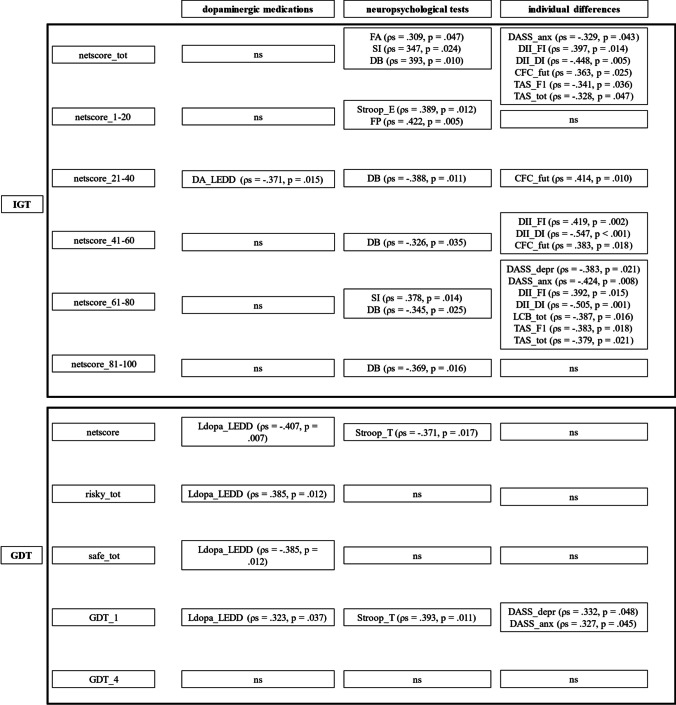
Patients affected by Parkinson's disease (PD) display a tendency toward making risky choices in value-based conditions. Possible causes may encompass the pathophysiologic characteristics of PD that affect neural structures pivotal for decision making (DM) and the dopaminergic medications that may bias choices. Nevertheless, excluding patients with concurrent impulse control disorders, results are few and mixed. Conversely, other factors, such as individual differences (e.g., emotional state, impulsivity, consideration for future consequences) and cognitive functioning, in particular executive functions (EFs), are involved, even though few studies investigated their possible role. The present study investigated (1) the differences in value-based DM between 33 patients with PD without impulse control disorders and 33 matched healthy controls, and (2) the relationships among decisional performances, EFs, and individual differences in a group of 42 patients with PD who regularly undertake dopaminergic medications. All participants underwent an individual assessment to investigate value-based DM, cognitive abilities, and individual differences associated with DM. Nonparametric analyses showed the presence of riskier decisions in patients compared with healthy controls, depending on the characteristics of the decisional situation. Moreover, parameters of the decisional tasks involving the number of risky choices were significantly related to the posology of dopaminergic medications, EFs, and individual differences. Findings were discussed, highlighting possible clinical implications.
帕金森病 (PD) 患者在基于价值的条件下表现出冒险选择的倾向。可能的原因包括影响决策 (DM) 关键神经结构的 PD 病理生理特征和可能影响选择的多巴胺能药物。然而,排除伴有冲动控制障碍的患者后,结果很少且不一致。相反,其他因素,如个体差异(例如情绪状态、冲动性、对未来后果的考虑)和认知功能,特别是执行功能 (EFs),也会产生影响,尽管很少有研究调查它们的可能作用。本研究调查了 (1) 33 名无冲动控制障碍的 PD 患者和 33 名匹配的健康对照组之间基于价值的 DM 的差异,以及 (2) 在一组定期接受多巴胺能药物治疗的 42 名 PD 患者中,决策表现、EFs 和与 DM 相关的个体差异之间的关系。所有参与者都接受了个体评估,以调查基于价值的 DM、认知能力和与 DM 相关的个体差异。非参数分析显示,与健康对照组相比,患者的决策更具风险,这取决于决策情况的特点。此外,涉及风险选择数量的决策任务的参数与多巴胺能药物的用量、EFs 和个体差异显著相关。讨论了研究结果,强调了可能的临床意义。