Finnish Institute for Health and Welfare, Helsinki, Finland.
Department of Health and Social Management, University of Eastern Finland, Kuopio, Finland.
BMC Geriatr. 2024 Sep 12;24(1):754. doi: 10.1186/s12877-024-05355-w.
Ageing populations and care workforce shortages across Europe are causing challenges for care services for older people. Therefore, it is paramount that limited care resources are allocated optimally, based on the clients' care needs. Multiple functioning-related factors have been identified that determine the amount of care time clients receive, while organizational and other factors remain largely unexplored. The aim was to examine how various individual and organizational factors are associated with clients' received care time in different care settings.
Cross-sectional observational study design with data from time and motion study, registers, and surveys was used. In total, 1477 home care clients and 1538 residents from assisted living facilities with 24/7 service participated, from 61 Finnish care units. Linear mixed-effect modeling was used to examine the association between individual and organizational-level variables and received care time.
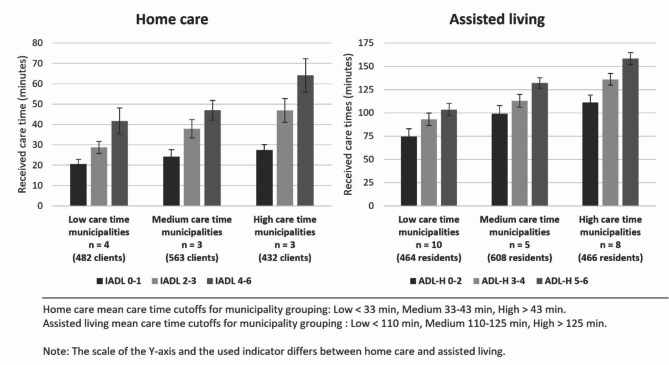
Physical functioning was the strongest predictor of received care time in both care settings. In home care, greater pain, more unstable health, and higher team autonomy were associated with increased care time. In assisted living, depressive mood and higher staffing level of the organization were associated with care time. Clients who received informal care also received significantly more care time from nurses in both care settings.
Physical functioning was the main driver of received care time. Interventions that maintain or improve physical functioning can help restrain the growing need of care resources, although it is important to ensure that each client receives care according to their holistic care needs.
欧洲人口老龄化和护理人员短缺给老年人护理服务带来了挑战。因此,根据客户的护理需求,最优地分配有限的护理资源至关重要。已经确定了多个与功能相关的因素,这些因素决定了客户接受的护理时间,而组织和其他因素在很大程度上仍未得到探索。本研究旨在探讨各种个人和组织因素与不同护理环境中客户接受的护理时间之间的关系。
采用横断面观察性研究设计,数据来自时间和运动研究、登记册和调查。共有 1477 名居家护理客户和 1538 名 24/7 服务的辅助生活设施居民,来自芬兰 61 个护理单位。使用线性混合效应模型来检验个人和组织层面变量与接受的护理时间之间的关系。
身体功能是两种护理环境中接受护理时间的最强预测因素。在居家护理中,更大的疼痛、更不稳定的健康状况和更高的团队自主权与护理时间的增加有关。在辅助生活中,抑郁情绪和组织更高的人员配备水平与护理时间有关。在两种护理环境中,接受非正式护理的客户也从护士那里获得了显著更多的护理时间。
身体功能是接受护理时间的主要驱动因素。维持或改善身体功能的干预措施可以帮助控制护理资源的增长需求,尽管确保每个客户都根据其整体护理需求接受护理非常重要。