USAID Program for Accelerated Control of TB in Karamoja Region (PACT- Karamoja), Moroto City, Uganda.
Infectious Diseases Institute (IDI)-College of Health Sciences, Makerere University, Kampala City, Uganda.
BMC Public Health. 2024 Sep 12;24(1):2489. doi: 10.1186/s12889-024-19986-6.
The Karamoja subregion in north-eastern Uganda has very high Tuberculosis (TB)case notification rates and, until recently, had suboptimal treatment completion rates among patients diagnosed with TB. We evaluated community knowledge, attitudes and practices towards Tuberculosis in order to identify barriers to TB control in this region.
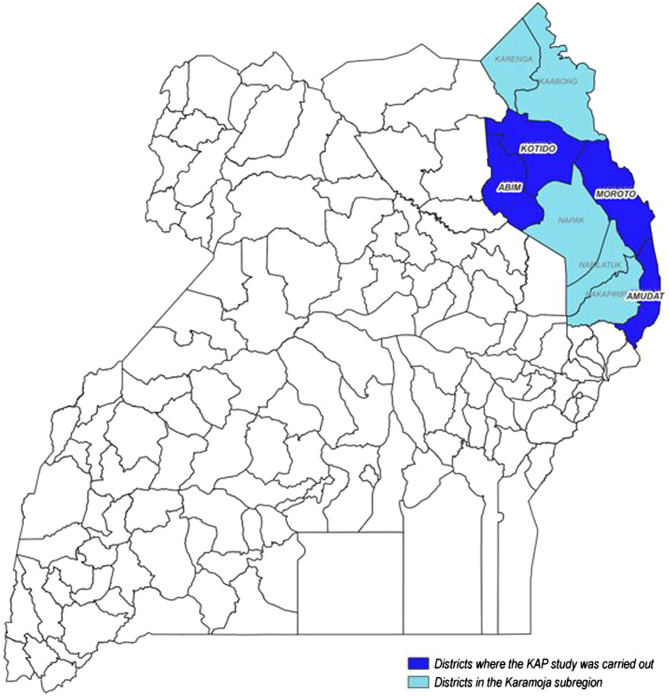
From September to October 2022, we conducted a community-based survey in four districts in the Karamoja subregion. We collected data on TB knowledge, attitudes, and practices using a structured electronic questionnaire. We generated knowledge, attitude and practice scores. We used a survey-weighted zero-truncated modified Poisson model to assess the association between knowledge/attitude scores and respondents' characteristics and a complementary log-log model to assess the association between practice scores and respondents' characteristics. Data analysis was carried out using STATA version 14.
A total of 1927 respondents were interviewed. Of these, 55.5% were female, and 1320 (68.6%) had no formal education. Overall, 68.5% 95% CI (59.6-76.7%) had knowledge scores of ≥ 60%. Higher TB knowledge scores were associated with being employed (adjusted prevalence ratio, aPR = 1.22, 95% CI 1.04-1.42, p = 0.01) while being a wife in a household was associated with lower TB knowledge (aPR = 0.90, 95% CI 0.82-0.99, p = 0.03). Being 25-34 years old was associated with a positive attitude towards TB (PR = 1.06, 1.01-1.11, p = 0.01). Over 85% of respondents would go to the health facility immediately if they had TB signs and symptoms. Almost all respondents (98.6%) would start TB treatment immediately if diagnosed with the disease.
More than two thirds of patients had good knowledge and practices towards TB which can be leveraged to improve uptake of TB control interventions in the region. Additional interventions to improve TB knowledge and practice should focus on specific segments within the communities e.g., older women in the households.
乌干达东北部的卡拉莫贾地区结核病(TB)病例报告率非常高,而且最近该地区结核病患者的治疗完成率一直不理想。为了确定该地区结核病控制的障碍,我们评估了社区对结核病的知识、态度和做法。
2022 年 9 月至 10 月,我们在卡拉莫贾地区的四个区进行了一项基于社区的调查。我们使用结构化电子问卷收集了有关结核病知识、态度和做法的数据。我们生成了知识、态度和实践分数。我们使用加权零截断修正泊松模型评估了知识/态度得分与受访者特征之间的关联,以及互补对数-log 模型评估了实践得分与受访者特征之间的关联。数据分析使用 STATA 版本 14 进行。
共采访了 1927 名受访者。其中,55.5%为女性,1320 名(68.6%)没有接受过正规教育。总体而言,68.5%(95%CI(59.6-76.7%))的受访者知识得分≥60%。较高的结核病知识得分与就业有关(调整后的患病率比,aPR=1.22,95%CI 1.04-1.42,p=0.01),而作为家庭中的妻子与结核病知识较低有关(aPR=0.90,95%CI 0.82-0.99,p=0.03)。25-34 岁与对结核病的积极态度有关(PR=1.06,1.01-1.11,p=0.01)。超过 85%的受访者如果出现结核病症状,会立即去医疗机构。几乎所有受访者(98.6%)如果被诊断患有该病,会立即开始结核病治疗。
超过三分之二的患者对结核病有良好的知识和实践,可以利用这些知识和实践来提高该地区结核病控制干预措施的接受率。提高结核病知识和实践的额外干预措施应针对社区内的特定群体,例如家庭中的老年妇女。