Department of Internal Medicine and Liver Research Institute, Seoul National University College of Medicine, 101 Daehak-no, Jongno-gu, Seoul, 03080, Republic of Korea.
Department of Internal Medicine and Healthcare Research Institute, Seoul National University Hospital Healthcare System Gangnam Center, Seoul, Republic of Korea.
Cardiovasc Diabetol. 2024 Sep 12;23(1):340. doi: 10.1186/s12933-024-02408-7.
The association between nonalcoholic fatty liver disease (NAFLD) and atrial fibrillation (AF) has been inconsistent, and the impact of hepatic fibrosis on this relationship remains uncertain. We investigated the association between NAFLD and the risk of new-onset AF across different age groups.
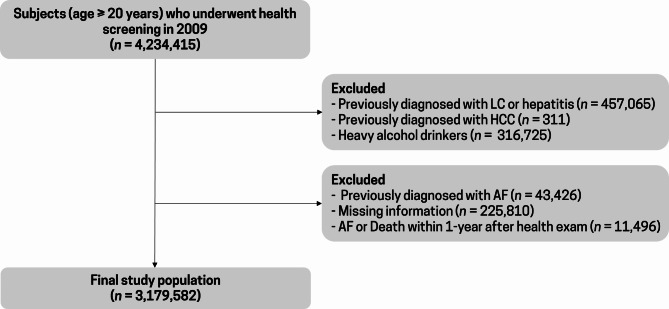
A total of 3,179,582 participants from the 2009 Korean National Health Screening Program were divided into five groups based on NAFLD status: no NAFLD (fatty liver index [FLI] < 30); grade 1 NAFLD without advanced fibrosis (FLI 30-59 & BARD < 2); grade 1 NAFLD with advanced fibrosis (FLI 30-59 & BARD ≥ 2); grade 2 NAFLD without advanced fibrosis (FLI ≥ 60 & BARD < 2); and grade 2 NAFLD with advanced fibrosis (FLI ≥ 60 & BARD ≥ 2). The primary outcome was incident AF.
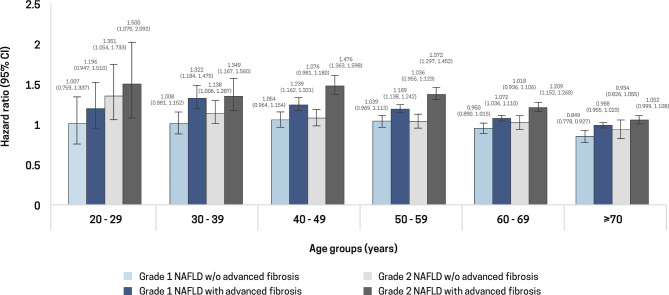
During the median follow-up of 9.3 years, 62,542 patients were diagnosed with new-onset AF. In the age- and sex-adjusted model, the risk of new-onset AF increased across NAFLD grades and fibrosis categories: grade 1 NAFLD without advanced fibrosis (hazard ratio [HR] 1.120, 95% confidence interval [CI]: 1.081-1.161); grade 1 NAFLD with advanced fibrosis (HR 1.275, 95% CI 1.251-1.300); grade 2 NAFLD without advanced fibrosis (HR 1.305, 95% CI: 1.252-1.360); and grade 2 NAFLD with advanced fibrosis (HR 1.627, 95% CI: 1.586-1.670). In the multivariate model, the excess risk of AF in patients with NAFLD and advanced fibrosis remained significant, even in participants aged 20-39 years.
Patients with NAFLD had a higher risk of new-onset AF, which increased progressively with NAFLD severity, particularly in those aged 20-29 years.
非酒精性脂肪性肝病(NAFLD)与心房颤动(AF)之间的关联并不一致,而肝纤维化对这种关系的影响尚不确定。我们研究了不同年龄组中 NAFLD 与新发 AF 风险之间的关系。
共有 3179582 名来自 2009 年韩国国家健康筛查计划的参与者根据 NAFLD 状态分为五组:无 NAFLD(脂肪性肝指数[FLI]<30);无晚期纤维化的 1 级 NAFLD(FLI30-59 和 BARD<2);有晚期纤维化的 1 级 NAFLD(FLI30-59 和 BARD≥2);无晚期纤维化的 2 级 NAFLD(FLI≥60 和 BARD<2);有晚期纤维化的 2 级 NAFLD(FLI≥60 和 BARD≥2)。主要结局是新发 AF。
在中位随访 9.3 年期间,有 62542 名患者被诊断为新发 AF。在年龄和性别调整模型中,新发 AF 的风险随着 NAFLD 分级和纤维化程度的增加而增加:无晚期纤维化的 1 级 NAFLD(危险比[HR]1.120,95%置信区间[CI]:1.081-1.161);有晚期纤维化的 1 级 NAFLD(HR 1.275,95%CI1.251-1.300);无晚期纤维化的 2 级 NAFLD(HR 1.305,95%CI:1.252-1.360);有晚期纤维化的 2 级 NAFLD(HR 1.627,95%CI:1.586-1.670)。在多变量模型中,即使在 20-39 岁的患者中,NAFLD 合并晚期纤维化患者的 AF 风险增加仍具有显著意义。
NAFLD 患者新发 AF 的风险较高,且随着 NAFLD 严重程度的增加而逐渐增加,尤其是在 20-29 岁的患者中。