Division of Endocrinology and Metabolism, Department of Medicine, Samsung Medical Center, Sungkyunkwan University School of Medicine, 81, Irwon-ro, Gangnam-gu, Seoul, 06351, Republic of Korea.
Department of Statistics and Actuarial Science, Soongsil University, 369 Sangdo-ro, Dongjak-gu, Seoul, 06978, Republic of Korea.
Cardiovasc Diabetol. 2022 Apr 16;21(1):53. doi: 10.1186/s12933-022-01483-y.
Although both type 2 diabetes mellitus (T2DM) and nonalcoholic fatty liver disease (NAFLD) are associated with increased risk of cardiovascular disease (CVD), evidence is lacking as to whether the presence of NAFLD confers an additional risk of CVD in patients with T2DM. We investigated the associations between hepatic steatosis and/or fibrosis and risk of myocardial infarction (MI), stroke, heart failure (HF), and mortality in patients with new-onset T2DM.
Using the Korean National Health Insurance dataset, we included 139,633 patients diagnosed with new-onset T2DM who underwent a national health screening from January 2009 to December 2012. Hepatic steatosis and advanced hepatic fibrosis were determined using cutoff values for fatty liver index (FLI) and BARD score. Hazard ratios (HRs) and 95% confidence intervals (CIs) were estimated using multivariable Cox proportional hazards regression models.
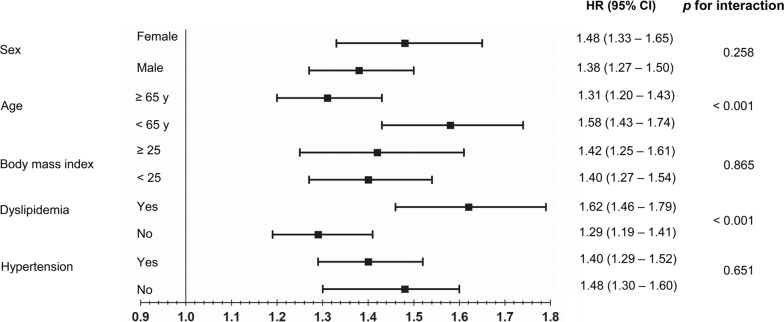
During the median follow-up of 7.7 years, there were 3,079 (2.2%) cases of MI, 4,238 (3.0%) cases of ischemic stroke, 4,303 (3.1%) cases of HF, and 8,465 (6.1%) all-cause deaths. Hepatic steatosis defined as FLI ≥ 60 was associated with increased risk for MI (HR [95% CI], 1.28 [1.14-1.44]), stroke (1.41 [1.25-1.56]), HF (1.17 [1.07-1.26]), and mortality (1.41 [1.32-1.51]) after adjusting for well-known risk factors. Compared to the group without steatosis, the group with steatosis and without fibrosis (BARD < 2) and the group with both steatosis and fibrosis (BARD ≥ 2) showed gradual increased risk for MI, stroke, HF, and mortality (all p for trends < 0.001).
Hepatic steatosis and/or advanced fibrosis as assessed by FLI or BARD score were significantly associated with risk of CVD and mortality in new-onset T2DM.
2 型糖尿病(T2DM)和非酒精性脂肪性肝病(NAFLD)均与心血管疾病(CVD)风险增加相关,但目前尚不清楚 NAFLD 是否会增加 T2DM 患者 CVD 的风险。我们研究了新诊断的 T2DM 患者中肝脂肪变性和/或纤维化与心肌梗死(MI)、卒中和心力衰竭(HF)以及死亡率之间的关系。
我们使用韩国国家健康保险数据集,纳入了 139633 例于 2009 年 1 月至 2012 年 12 月期间接受国家健康筛查且新诊断为 T2DM 的患者。通过肝脂肪指数(FLI)和 BARD 评分的临界值来确定肝脂肪变性和进展性肝纤维化。使用多变量 Cox 比例风险回归模型估计危险比(HR)和 95%置信区间(CI)。
在中位随访 7.7 年期间,发生了 3079 例(2.2%)MI、4238 例(3.0%)缺血性卒中和 4303 例(3.1%)HF 以及 8465 例(6.1%)全因死亡。FLI≥60 定义的肝脂肪变性与 MI(HR [95%CI],1.28 [1.14-1.44])、卒中和 HF(1.41 [1.25-1.56])以及死亡率(1.41 [1.32-1.51])风险增加相关,在调整了已知的危险因素后仍具有统计学意义。与无脂肪变性组相比,脂肪变性而无纤维化(BARD<2)和脂肪变性且纤维化(BARD≥2)组的 MI、卒中和 HF 以及死亡率的风险逐渐增加(所有趋势 p 值均<0.001)。
通过 FLI 或 BARD 评分评估的肝脂肪变性和/或进展性纤维化与新诊断的 T2DM 患者的 CVD 和死亡率显著相关。