Domasevitch Kostiantyn V, Senchyk Ganna A, Ponomarova Vira V, Lysenko Andrey B, Krautscheid Harald
Inorganic Chemistry Department National Taras Shevchenko University of Kyiv Volodymyrska Str 64/13 01601 Kyiv Ukraine.
Institute of Inorganic Chemistry, Leipzig University, Johannisallee 29, D-04103 Leipzig, Germany.
Acta Crystallogr E Crystallogr Commun. 2024 Aug 30;80(Pt 9):986-992. doi: 10.1107/S2056989024008375. eCollection 2024 Sep 1.
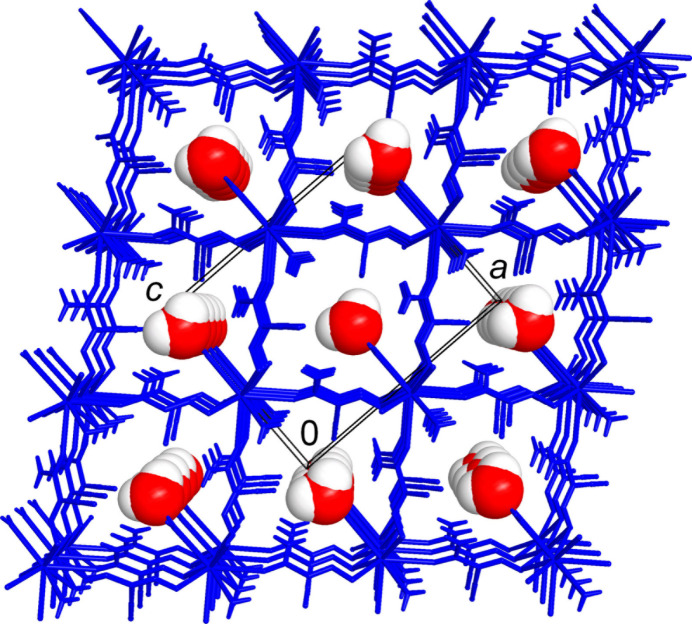
In the structure of the title salt, {[Ba(μ-CHNO)(μ-HO)(HO)]·HO} , the barium ion and all three oxygen atoms of the water mol-ecules reside on a mirror plane. The hydrogen atoms of the bridging water and the solvate water mol-ecules are arranged across a mirror plane whereas all atoms of the monodentate aqua ligand are situated on this mirror plane. The distorted ninefold coord-ination of the Ba ions is completed with four nitroso-, two carbonyl- and three aqua-O atoms at the distances of 2.763 (3)-2.961 (4) Å and it is best described as tricapped trigonal prism. The three-dimensional framework structure is formed by face-sharing of the trigonal prisms, μ-nitroso- and μ-aqua-O atoms, and also by the bridging coordination of the anions carbonyl-O atoms occupying two out of the three cap positions. The solvate water mol-ecules populate the crystal channels and facilitate a set of four directional hydrogen bonds. The principal Ba-carbamoyl-cyano-nitro-somethanido linkage reveals a rare example of the inherently polar binodal six- and three-coordinated bipartite topology (three-letter notation ). It suggests that small resonance-stabilized cyano-nitroso anions can be utilized as bridging ligands for the supra-molecular synthesis of MOF solids. Such an outcome may be anti-cipated for a broader range of hard Lewis acidic alkaline earth metal ions, which perfectly match the coordination preferences of highly nucleophilic nitroso-O atoms. Thermal analysis reveals two-stage dehydration of the title compound (383 and 473 K) followed by decomposition with release of CO, HCN and HO at 558 K.
在标题盐{[Ba(μ-CHNO)(μ-HO)(HO)]·HO}的结构中,钡离子和水分子的所有三个氧原子位于一个镜面上。桥连水和溶剂化水分子的氢原子跨镜面排列,而单齿水合配体的所有原子位于该镜面上。钡离子的扭曲九配位由四个亚硝基、两个羰基和三个水合氧原子完成,距离为2.763(3)-2.961(4)Å,最好描述为三帽三棱柱。三维骨架结构由三棱柱、μ-亚硝基和μ-水合氧原子的面共享形成,也由占据三个帽位中两个的阴离子羰基氧原子的桥连配位形成。溶剂化水分子填充晶体通道并促进一组四个方向的氢键。主要的Ba-氨基甲酰基-氰基-亚硝基甲烷键揭示了固有极性双节点六配位和三配位二分拓扑(三字母表示法)的一个罕见例子。这表明小的共振稳定的氰基亚硝基阴离子可以用作MOF固体超分子合成的桥连配体。对于更广泛的硬路易斯酸性碱土金属离子,可能会有这样的结果,它们与高亲核性亚硝基氧原子的配位偏好完美匹配。热分析表明标题化合物经历两阶段脱水(383和473K),随后在558K分解并释放出CO、HCN和HO。