Umakanthan Srikanth, Katwaroo Arun Rabindra, Bukelo Maryann, Bg Shashidhar, Boralingaiah Prashanth, Ranade Anu V, Rangan Pallavi, Shashidhar Shabnam, Kini Jyoti Ramanath, Kini Gayathri
Department of Paraclinical Sciences, Faculty of Medical Sciences, The University of the West Indies, St. Augustine, Trinidad and Tobago.
Trinidad Institute of Medical Technology, Department of Medicine, St. Augustine, Trinidad and Tobago.
Am J Med Open. 2024 Jun 8;12:100071. doi: 10.1016/j.ajmo.2024.100071. eCollection 2024 Dec.
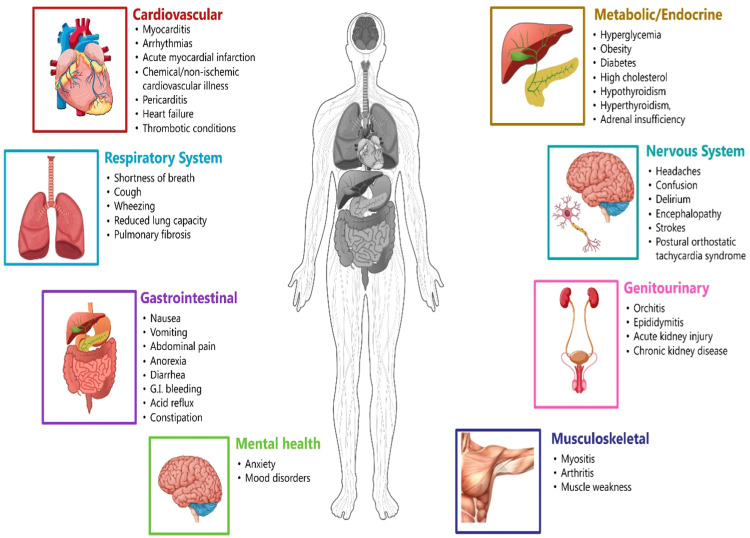
The SARS-CoV-2 virus responsible for the COVID-19 pandemic has profoundly impacted global health, economics, and society. This review seeks to encompass an overview of current knowledge on COVID-19, including its transmission, pathogenesis, and clinical presentation related to various systems within the human body. COVID-19 is a highly contagious illness that has rapidly spread worldwide. As of August 4, 2023, the WHO reported over 570 million confirmed cases of COVID-19 and over 6.3 million deaths. Although the virus is most common in adults, children can also be infected. Respiratory droplets that are produced when an infected person coughs or sneezes are the primary transmission mode for COVID-19. Additionally, the virus can be disseminated via contact with contaminated surfaces or objects, as it can remain viable for several hours or days. SARS-CoV-2 is a respiratory virus that enters cells by bonding with the angiotensin-converting enzyme 2 (ACE2) receptor. Once inside the cell, the virus replicates and produces new particles that can infect other cells. Interestingly, the effects of post-acute sequelae of SARS-CoV-2 infection (PASC) encompass more than just respiratory system. The findings presented in the data suggest that PASC significantly impacts multiple organs and their respective physiological processes. In light of these observations, we aim to provide a detailed discussion of the relevant findings in this paper. Through our review, we hope to provide healthcare professionals with a deeper understanding of the effects of PASC on the human body, which could ultimately lead to improved patient outcomes and treatment strategies.
引发新冠疫情的严重急性呼吸综合征冠状病毒2(SARS-CoV-2)对全球健康、经济和社会产生了深远影响。本综述旨在概述当前关于新冠病毒病(COVID-19)的知识,包括其传播、发病机制以及与人体各个系统相关的临床表现。COVID-19是一种极具传染性的疾病,已在全球迅速传播。截至2023年8月4日,世界卫生组织报告的COVID-19确诊病例超过5.7亿例,死亡人数超过630万。虽然该病毒在成年人中最为常见,但儿童也可能被感染。COVID-19的主要传播方式是感染者咳嗽或打喷嚏时产生的呼吸道飞沫。此外,该病毒可通过接触受污染的表面或物体传播,因为它可以在数小时或数天内保持活性。SARS-CoV-2是一种呼吸道病毒,通过与血管紧张素转换酶2(ACE2)受体结合进入细胞。一旦进入细胞,病毒就会复制并产生可感染其他细胞的新颗粒。有趣的是,SARS-CoV-2感染后急性后遗症(PASC)的影响不仅仅局限于呼吸系统。数据中的研究结果表明,PASC会对多个器官及其各自的生理过程产生重大影响。鉴于这些观察结果,我们旨在对本文中的相关研究结果进行详细讨论。通过我们的综述,我们希望能让医疗保健专业人员更深入地了解PASC对人体的影响,这最终可能会改善患者的治疗效果和治疗策略。