Division of Cardiovascular Medicine, Department of Medicine, University of California San Diego, San Diego, California; Division of Intramural Research, National Institute on Minority Health and Health Disparities, National Institutes of Health, Bethesda, Maryland.
Division of Cardiovascular Medicine, Department of Medicine, University of California San Diego, San Diego, California; Department of Cardiology and Internal Medicine, Nicolaus Copernicus University Torun, Collegium Medicum in Bydgoszcz, Bydgoszcz, Poland.
Heart Rhythm. 2022 Nov;19(11):1880-1889. doi: 10.1016/j.hrthm.2022.07.014. Epub 2022 Jul 16.
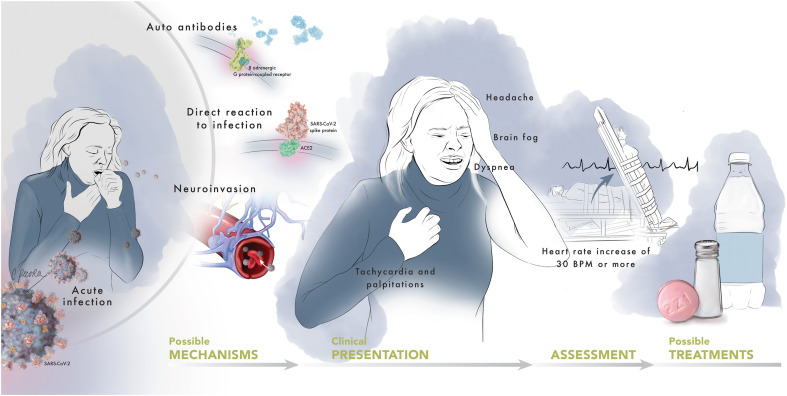
Postural orthostatic tachycardia syndrome (POTS) is a complex multisystem disorder characterized by orthostatic intolerance and tachycardia and may be triggered by viral infection. Recent reports indicate that 2%-14% of coronavirus disease 2019 (COVID-19) survivors develop POTS and 9%-61% experience POTS-like symptoms, such as tachycardia, orthostatic intolerance, fatigue, and cognitive impairment within 6-8 months of severe acute respiratory syndrome coronavirus 2 (SARS-CoV-2) infection. Pathophysiological mechanisms of post-COVID-19 POTS are not well understood. Current hypotheses include autoimmunity related to SARS-CoV-2 infection, autonomic dysfunction, direct toxic injury by SARS-CoV-2 to the autonomic nervous system, and invasion of the central nervous system by SARS-CoV-2. Practitioners should actively assess POTS in patients with post-acute COVID-19 syndrome symptoms. Given that the symptoms of post-COVID-19 POTS are predominantly chronic orthostatic tachycardia, lifestyle modifications in combination with the use of heart rate-lowering medications along with other pharmacotherapies should be considered. For example, ivabradine or β-blockers in combination with compression stockings and increasing salt and fluid intake has shown potential. Treatment teams should be multidisciplinary, including physicians of various specialties, nurses, psychologists, and physiotherapists. Additionally, more resources to adequately care for this patient population are urgently needed given the increased demand for autonomic specialists and clinics since the start of the COVID-19 pandemic. Considering our limited understanding of post-COVID-19 POTS, further research on topics such as its natural history, pathophysiological mechanisms, and ideal treatment is warranted. This review evaluates the current literature available on the associations between COVID-19 and POTS, possible mechanisms, patient assessment, treatments, and future directions to improving our understanding of post-COVID-19 POTS.
体位性心动过速综合征(POTS)是一种以直立不耐受和心动过速为特征的复杂多系统疾病,可能由病毒感染引发。最近的报告表明,2%-14%的 2019 冠状病毒病(COVID-19)幸存者会出现 POTS,9%-61%的患者在严重急性呼吸综合征冠状病毒 2(SARS-CoV-2)感染后 6-8 个月内会出现类似 POTS 的症状,如心动过速、直立不耐受、疲劳和认知障碍。COVID-19 后 POTS 的病理生理机制尚不清楚。目前的假设包括与 SARS-CoV-2 感染相关的自身免疫、自主神经功能障碍、SARS-CoV-2 对自主神经系统的直接毒性损伤以及 SARS-CoV-2 对中枢神经系统的侵犯。临床医生应积极评估急性 COVID-19 后综合征患者的 POTS。鉴于 COVID-19 后 POTS 的症状主要为慢性直立性心动过速,应考虑生活方式改变结合使用降低心率的药物以及其他药物治疗。例如,伊伐布雷定或β受体阻滞剂联合压缩袜、增加盐和液体摄入已显示出潜力。治疗团队应多学科,包括各种专业的医生、护士、心理学家和物理治疗师。此外,鉴于 COVID-19 大流行以来对自主神经专家和诊所的需求增加,迫切需要更多资源来充分照顾这一患者群体。鉴于我们对 COVID-19 后 POTS 的了解有限,有必要对其自然史、病理生理机制和理想治疗等主题进行进一步研究。本综述评估了 COVID-19 与 POTS 之间关联的现有文献、可能的机制、患者评估、治疗方法以及改善对 COVID-19 后 POTS 认识的未来方向。