Department of Clinical Science, Bergen Integrated Diagnostic Stewardship Cluster, University of Bergen, Bergen, Norway.
Department of Infectious Diseases, Oslo University Hospital, Oslo, Norway.
Microbiol Spectr. 2024 Oct 3;12(10):e0283123. doi: 10.1128/spectrum.02831-23. Epub 2024 Sep 13.
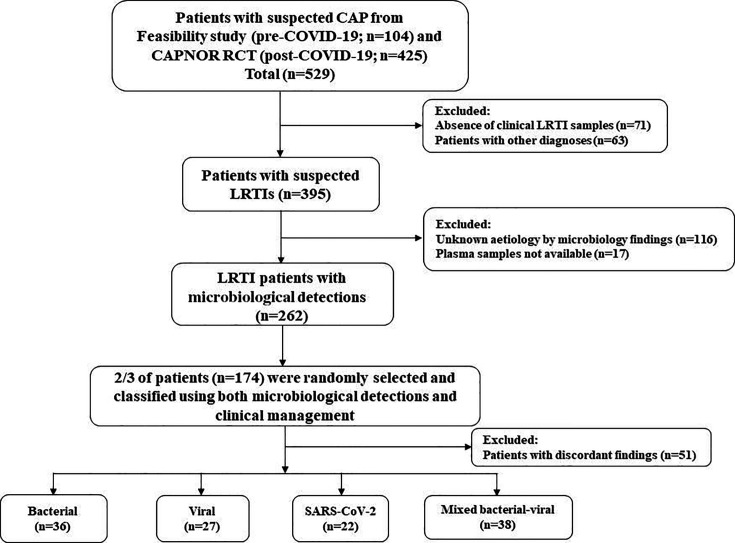
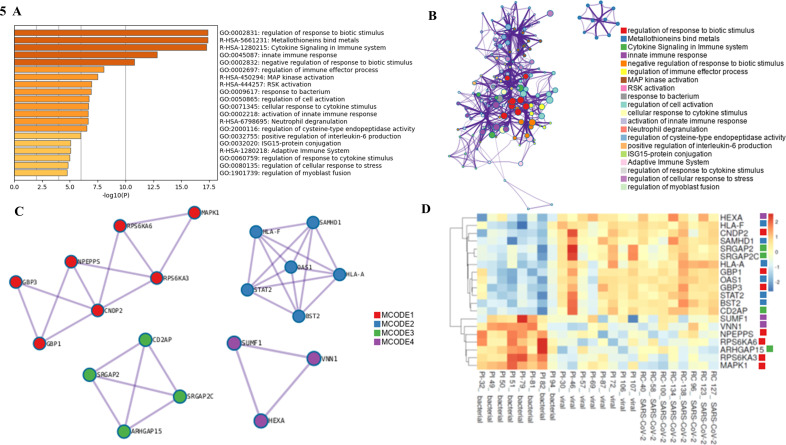
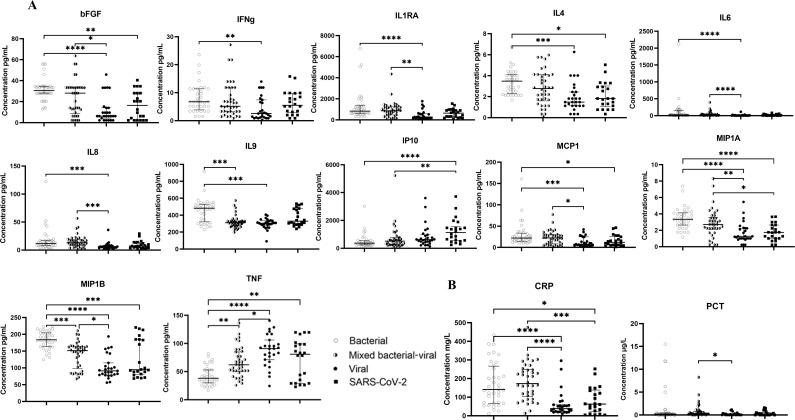
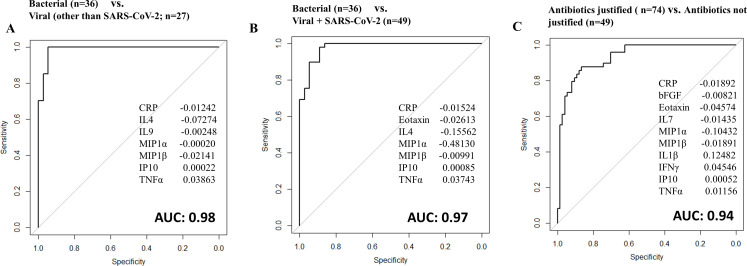
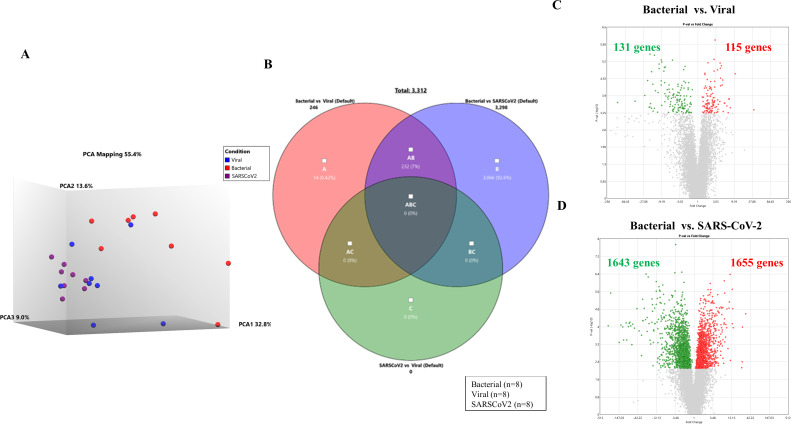
Lower respiratory tract infections (LRTIs) remain a significant global cause of infectious disease-related mortality. Accurate discrimination between acute bacterial and viral LRTIs is crucial for optimal patient care, prevention of unnecessary antibiotic prescriptions, and resource allocation. Plasma samples from LRTI patients with bacterial ( = 36), viral ( = 27; excluding SARS-CoV-2), SARS-CoV-2 ( = 22), and mixed bacterial-viral ( = 38) etiology were analyzed for protein profiling. Whole-blood RNA samples from a subset of patients (bacterial, = 8; viral, = 8; and SARS-CoV-2, = 8) were analyzed for transcriptional profiling. Lasso regression modeling identified a seven-protein signature (CRP, IL4, IL9, IP10, MIP1α, MIP1β, and TNFα) that discriminated between patients with bacterial ( = 36) vs viral ( = 27) infections with an area under the curve (AUC) of 0.98. When comparing patients with bacterial and mixed bacterial-viral infections (antibiotics clinically justified; = 74) vs patients with viral and SARS-CoV-2 infections (antibiotics clinically not justified; = 49), a 10-protein signature (CRP, bFGF, eotaxin, IFNγ, IL1β, IL7, IP10, MIP1α, MIP1β, and TNFα) with an AUC of 0.94 was identified. The transcriptional profiling analysis identified 232 differentially expressed genes distinguishing bacterial ( = 8) from viral and SARS-CoV-2 ( = 16) etiology. Protein-protein interaction enrichment analysis identified 20 genes that could be useful in the differentiation between bacterial and viral infections. Finally, we examined the performance of selected published gene signatures for bacterial-viral differentiation in our gene set, yielding promising results. Further validation of both protein and gene signatures in diverse clinical settings is warranted to establish their potential to guide the treatment of acute LRTIs.
Accurate differentiation between bacterial and viral lower respiratory tract infections (LRTIs) is vital for effective patient care and resource allocation. This study investigated specific protein signatures and gene expression patterns in plasma and blood samples from LRTI patients that distinguished bacterial and viral infections. The identified signatures can inform the design of point-of-care tests that can aid healthcare providers in making informed decisions about antibiotic prescriptions in order to reduce unnecessary use, thereby contributing to reduced side effects and antibiotic resistance. Furthermore, the potential for faster and more accurate diagnoses for improved patient management in acute LRTIs is compelling.
准确区分细菌性和病毒性下呼吸道感染(LRTIs)对于有效的患者护理和资源分配至关重要。本研究旨在探讨 LRTI 患者血浆和血液样本中特定的蛋白质特征和基因表达模式,以区分细菌性和病毒性感染。
对细菌性(=36)、病毒性(=27;排除 SARS-CoV-2)、SARS-CoV-2(=22)和混合细菌性-病毒性(=38)病因的 LRTI 患者的血浆样本进行蛋白质谱分析。对一部分患者的全血 RNA 样本进行转录谱分析(细菌性,=8;病毒性,=8;SARS-CoV-2,=8)。通过lasso 回归模型,确定了一个由 7 种蛋白(CRP、IL4、IL9、IP10、MIP1α、MIP1β 和 TNFα)组成的特征性签名,用于区分细菌性(=36)和病毒性(=27)感染,曲线下面积(AUC)为 0.98。比较细菌性和混合细菌性-病毒性感染(抗生素临床合理;=74)与病毒性和 SARS-CoV-2 感染(抗生素临床不合理;=49)的患者,确定了一个由 10 种蛋白(CRP、bFGF、eotaxin、IFNγ、IL1β、IL7、IP10、MIP1α、MIP1β 和 TNFα)组成的特征性签名,AUC 为 0.94。转录谱分析确定了 232 个区分细菌性(=8)和病毒性及 SARS-CoV-2(=16)病因的差异表达基因。蛋白质-蛋白质相互作用富集分析确定了 20 个可用于区分细菌性和病毒性感染的基因。最后,我们检查了选定的已发表的用于区分细菌和病毒的基因特征在我们的基因集中的性能,结果令人鼓舞。需要在不同的临床环境中进一步验证蛋白质和基因特征,以确定它们在指导急性 LRTI 治疗方面的潜力。
与病毒性 LRTIs 相比,细菌性 LRTIs 仍然是全球传染性疾病相关死亡率的重要原因。准确区分急性细菌性和病毒性下呼吸道感染对于最佳患者护理、预防不必要的抗生素处方和资源分配至关重要。本研究分析了细菌性(=36)、病毒性(=27;不包括 SARS-CoV-2)、SARS-CoV-2(=22)和混合细菌性-病毒性(=38)病因的 LRTI 患者的血浆样本,以进行蛋白质谱分析。从一部分患者的全血 RNA 样本(细菌性,=8;病毒性,=8;SARS-CoV-2,=8)进行转录谱分析。Lasso 回归模型确定了一个由 7 种蛋白(CRP、IL4、IL9、IP10、MIP1α、MIP1β 和 TNFα)组成的特征性签名,可区分细菌性(=36)和病毒性(=27)感染,曲线下面积(AUC)为 0.98。比较细菌性和混合细菌性-病毒性感染(抗生素临床合理;=74)与病毒性和 SARS-CoV-2 感染(抗生素临床不合理;=49)的患者,确定了一个由 10 种蛋白(CRP、bFGF、eotaxin、IFNγ、IL1β、IL7、IP10、MIP1α、MIP1β 和 TNFα)组成的特征性签名,AUC 为 0.94。转录谱分析确定了 232 个区分细菌性(=8)和病毒性及 SARS-CoV-2(=16)病因的差异表达基因。蛋白质-蛋白质相互作用富集分析确定了 20 个可用于区分细菌性和病毒性感染的基因。最后,我们检查了选定的已发表的用于区分细菌和病毒的基因特征在我们的基因集中的性能,结果令人鼓舞。需要在不同的临床环境中进一步验证蛋白质和基因特征,以确定它们在指导急性 LRTI 治疗方面的潜力。
准确区分细菌性和病毒性下呼吸道感染(LRTIs)对于有效的患者护理和资源分配至关重要。本研究探讨了 LRTI 患者血浆和血液样本中特定的蛋白质特征和基因表达模式,以区分细菌性和病毒性感染。确定的特征可以为设计即时护理测试提供信息,帮助医疗保健提供者做出关于抗生素处方的明智决策,以减少不必要的使用,从而有助于减少副作用和抗生素耐药性。此外,对于改善急性 LRTI 患者的管理,更快和更准确的诊断潜力令人信服。