Grupo Integrado de Pesquisas em Biomarcadores, Instituto René Rachou (FIOCRUZ-Minas), Belo Horizonte, Brazil.
Faculdade de Medicina, Universidade Federal de Minas Gerais (UFMG), Belo Horizonte, Brazil.
PLoS Negl Trop Dis. 2024 Sep 13;18(9):e0012487. doi: 10.1371/journal.pntd.0012487. eCollection 2024 Sep.
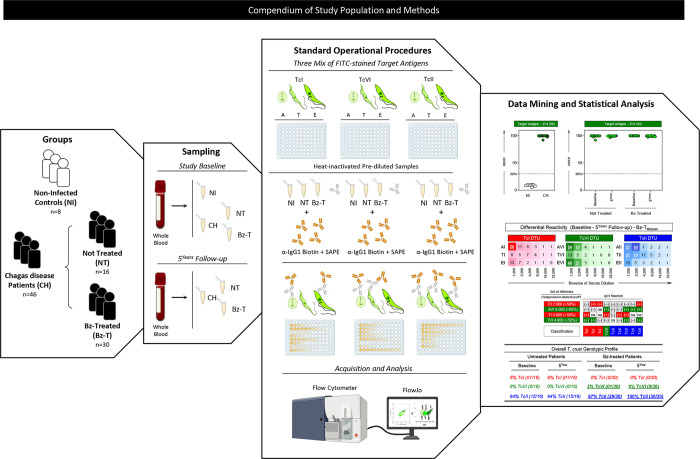
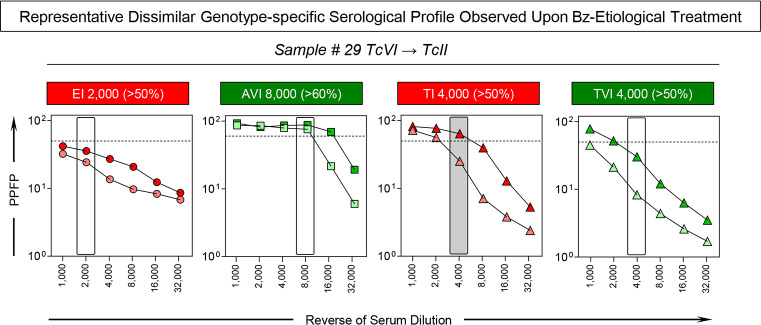
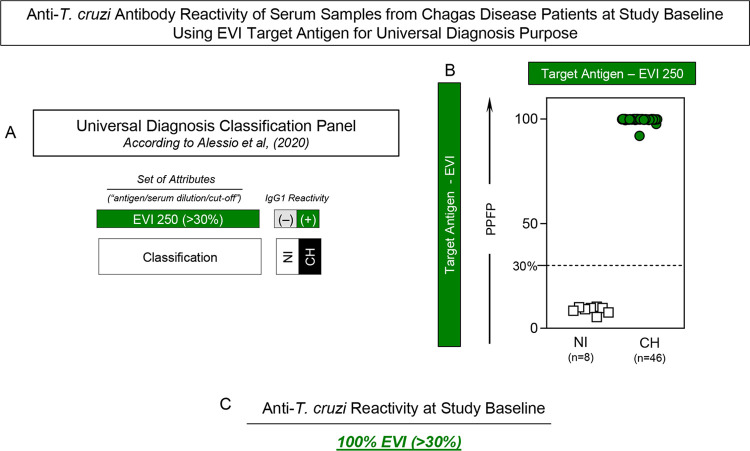
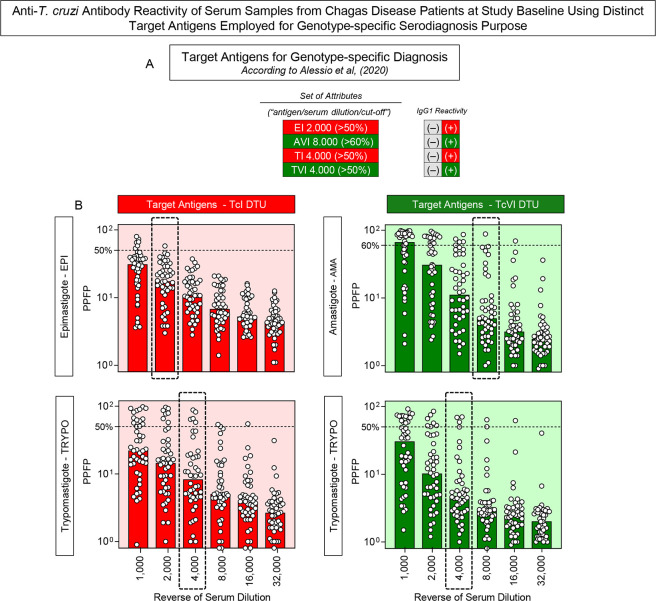
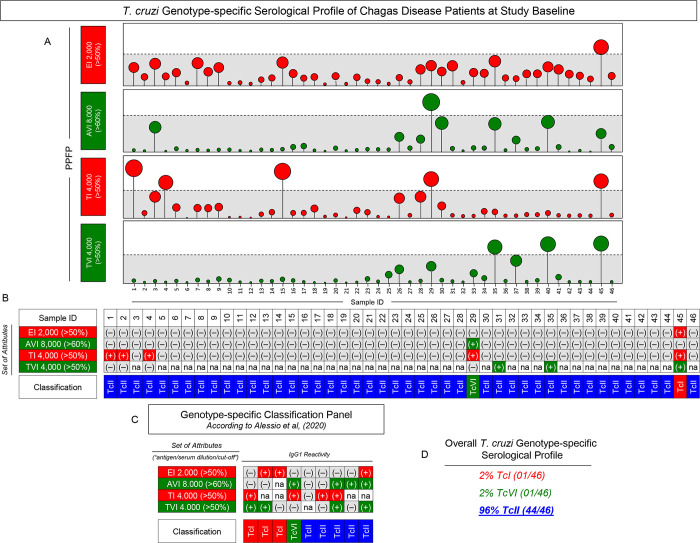
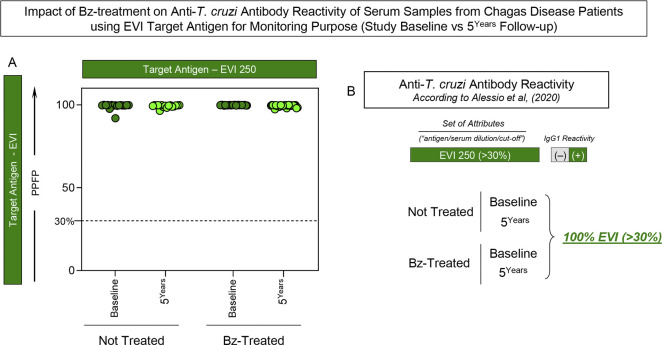
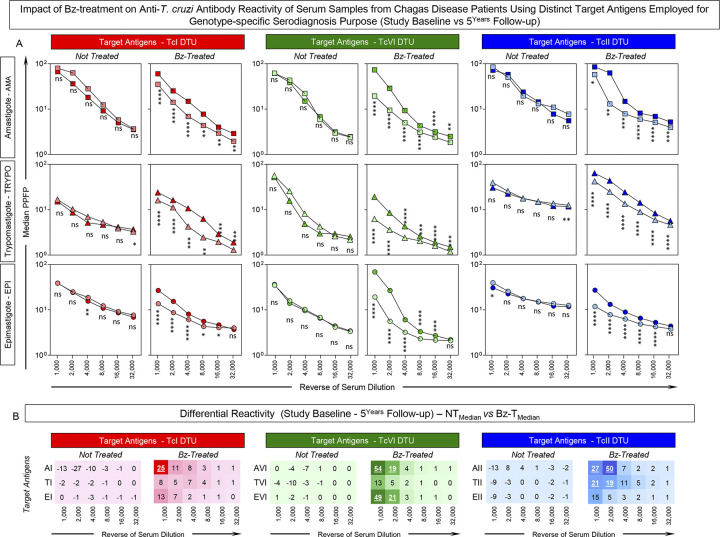
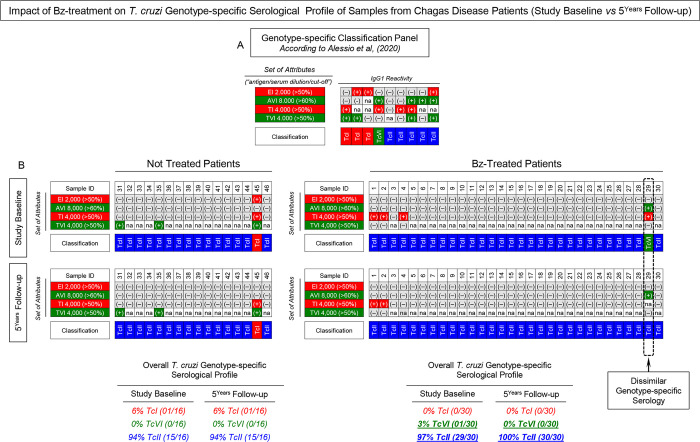
The present study aimed to verify the impact of etiological treatment on the genotype-specific serological diagnosis of chronic Chagas disease patients (CH), using the Chagas-Flow ATE IgG1 methodology. For this purpose, a total of 92 serum samples from CH, categorized as Not Treated (NT, n = 32) and Benznidazole-Treated (Bz-T, n = 60), were tested at Study Baseline and 5Years Follow-up. At Study Baseline, all patients have the diagnosis of Chagas disease confirmed by Chagas-Flow ATE IgG1, using the set of attributes ("antigen/serum dilution/cut-off"; "EVI/250/30%"). The genotype-specific serodiagnosis at Study Baseline demonstrated that 96% of patients (44/46) presented a serological profile compatible with TcII genotype infection. At 5Years Follow-up monitoring, NT and Bz-T presented no changes in anti-EVI IgG1 reactivity. However, significant differences were detected in the genotype-specific IgG1 reactivity for Bz-T. The most outstanding shift comprised the anti-amastigote TcVI/(AVI), anti-amastigote TcII/(AII) and anti-epimastigote TcVI/(EVI) reactivities. Regardless no changes in the genotype-specific serology of NT (TcI = 6%; TcII = 94%), distinct T. cruzi genotype-specific sero-classification was detected for Bz-T samples at 5Years Follow-up (TcII = 100%) as compared to Baseline (TcII = 97%; TcVI = 3%). The anti-trypomastigote TcI/(TI) was the attribute accountable for the change in genotype-specific sero-classification. In conclusion, our findings of dissimilar T. cruzi genotype-specific serology upon Bz-treatment re-emphasize the relevance of accomplishing the genotype-specific serodiagnosis during clinical pos-therapeutic management of chronic Chagas disease patients.
本研究旨在使用 Chagas-Flow ATE IgG1 方法验证病因治疗对慢性恰加斯病患者(CH)基因型特异性血清学诊断的影响。为此,共检测了 92 例 CH 患者的血清样本,分为未治疗(NT,n=32)和苯达唑治疗(Bz-T,n=60)。在基线研究和 5 年随访时进行检测。在基线研究中,所有患者均通过 Chagas-Flow ATE IgG1 使用属性集(“抗原/血清稀释/截断值”;“EVI/250/30%”)确诊为恰加斯病。基线研究的基因型特异性血清学诊断表明,96%的患者(44/46)呈现与 TcII 基因型感染一致的血清学特征。在 5 年随访监测中,NT 和 Bz-T 的抗-EVI IgG1 反应性没有变化。然而,在 Bz-T 的基因型特异性 IgG1 反应性方面检测到了显著差异。最显著的变化包括抗阿米巴样虫 TcVI/(AVI)、抗阿米巴样虫 TcII/(AII)和抗肠上皮样虫 TcVI/(EVI)反应性。尽管 NT 的基因型特异性血清学没有变化(TcI=6%;TcII=94%),但在 5 年随访时检测到 Bz-T 样本的 T. cruzi 基因型特异性血清分类明显不同(TcII=100%,基线时为 97%;TcVI=3%)。抗锥虫 TcI/(TI)是导致基因型特异性血清学分类变化的属性。总之,我们发现 Bz 治疗后 T. cruzi 基因型特异性血清学不同,这再次强调了在慢性恰加斯病患者临床治疗后管理中进行基因型特异性血清学诊断的重要性。