Human Technopole, V.le Rita Levi-Montalcini 1, Milan 20157, Italy.
Max Planck Institute of Molecular Cell Biology and Genetics, Pfotenhauerstraße 108, Dresden 01307, Germany.
Curr Biol. 2024 Oct 7;34(19):4464-4475.e9. doi: 10.1016/j.cub.2024.08.021. Epub 2024 Sep 12.
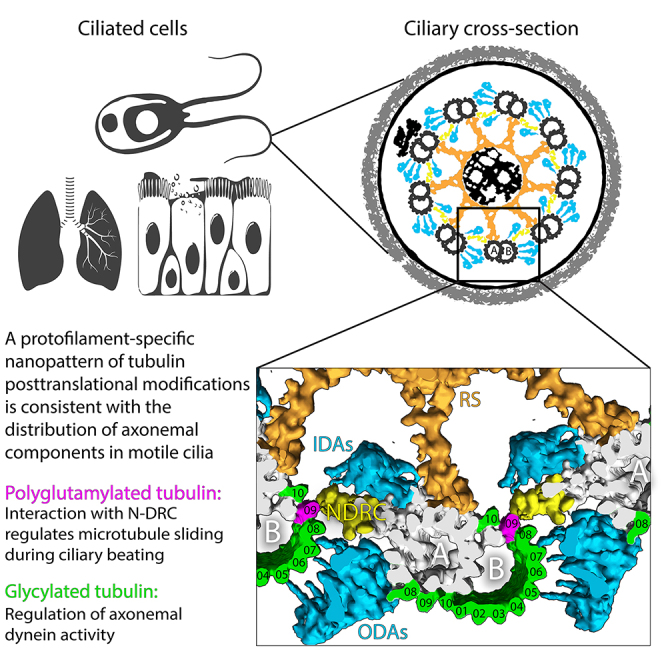
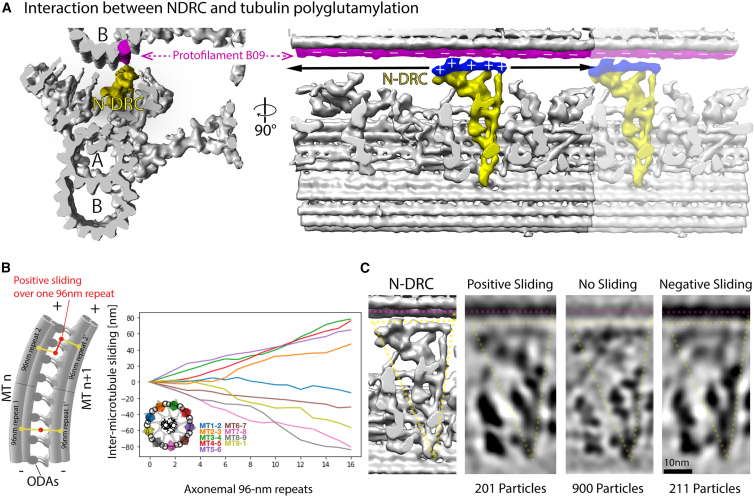
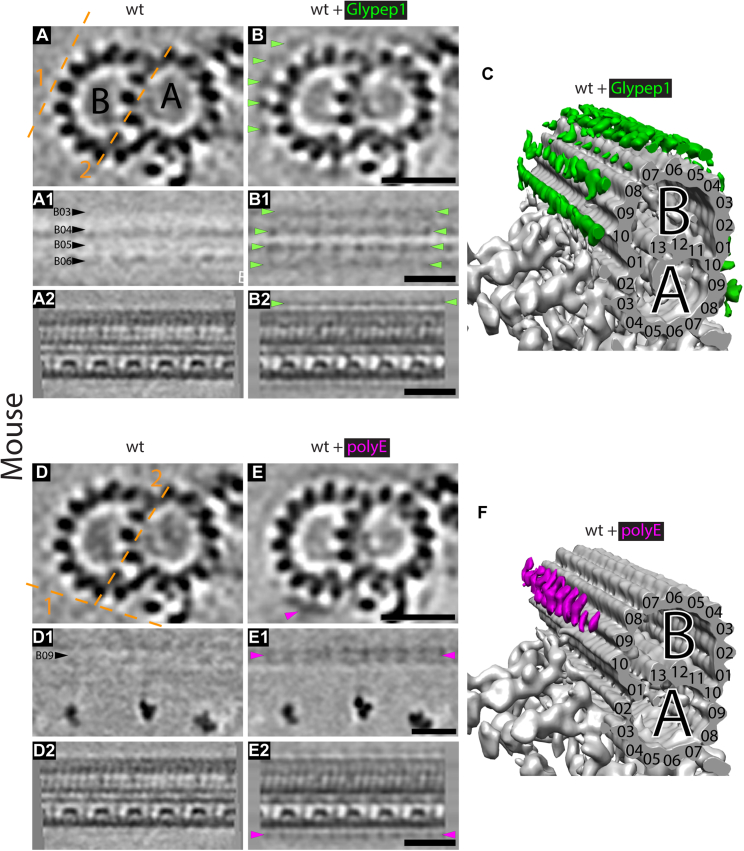
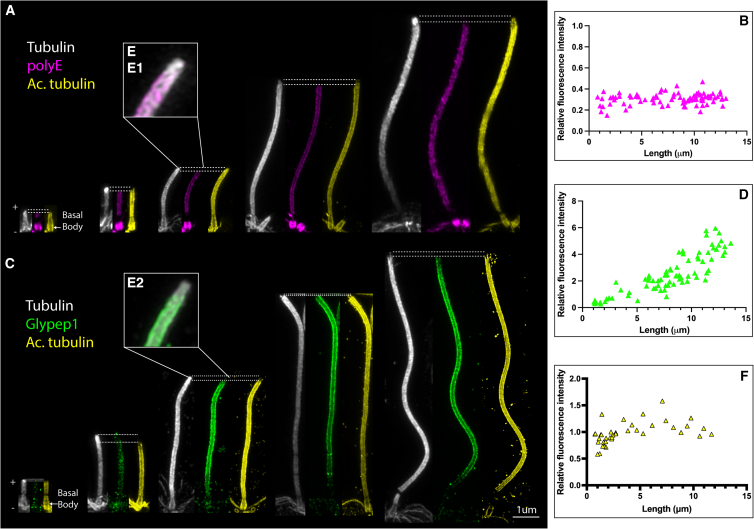
Controlling ciliary beating is essential for motility and signaling in eukaryotes. This process relies on the regulation of various axonemal proteins that assemble in stereotyped patterns onto individual microtubules of the ciliary structure. Additionally, each axonemal protein interacts exclusively with determined tubulin protofilaments of the neighboring microtubule to carry out its function. While it is known that tubulin post-translational modifications (PTMs) are important for proper ciliary motility, the mode and extent to which they contribute to these interactions remain poorly understood. Currently, the prevailing understanding is that PTMs can confer functional specialization at the level of individual microtubules. However, this paradigm falls short of explaining how the tubulin code can manage the complexity of the axonemal structure where functional interactions happen in defined patterns at the sub-microtubular scale. Here, we combine immuno-cryo-electron tomography (cryo-ET), expansion microscopy, and mutant analysis to show that, in motile cilia, tubulin glycylation and polyglutamylation form mutually exclusive protofilament-specific nanopatterns at a sub-microtubular scale. These nanopatterns are consistent with the distributions of axonemal dyneins and nexin-dynein regulatory complexes, respectively, and are indispensable for their regulation during ciliary beating. Our findings offer a new paradigm for understanding how different tubulin PTMs, such as glycylation, glutamylation, acetylation, tyrosination, and detyrosination, can coexist within the ciliary structure and specialize individual protofilaments for the regulation of diverse protein complexes. The identification of a ciliary tubulin nanocode by cryo-ET suggests the need for high-resolution studies to better understand the molecular role of PTMs in other cellular compartments beyond the cilium.
纤毛的摆动对于真核生物的运动和信号转导至关重要。该过程依赖于各种轴丝蛋白的调控,这些蛋白以定型模式组装到纤毛结构的单个微管上。此外,每个轴丝蛋白仅与相邻微管中确定的微管蛋白原纤维相互作用,以执行其功能。虽然已知微管蛋白翻译后修饰(PTMs)对于正常的纤毛运动很重要,但它们对这些相互作用的作用方式和程度仍知之甚少。目前,普遍的观点是 PTM 可以赋予单个微管的功能特化。然而,这种模式无法解释微管密码如何管理轴丝结构的复杂性,在该结构中,功能相互作用以亚微管尺度的特定模式发生。在这里,我们结合免疫-冷冻电子断层扫描(cryo-ET)、扩展显微镜和突变分析表明,在运动纤毛中,微管糖基化和多聚谷氨酸化在亚微管尺度上形成相互排斥的原纤维特异性纳米图案。这些纳米图案分别与轴丝动力蛋白和连接蛋白-动力蛋白调节复合物的分布一致,对于纤毛摆动过程中它们的调节是不可或缺的。我们的发现为理解不同的微管 PTM 如何共存于纤毛结构中,并为不同蛋白复合物的调节特异性单个原纤维提供了一个新的模式,例如糖基化、谷氨酸化、乙酰化、酪氨酸化和脱酪氨酸化。 cryo-ET 鉴定的纤毛微管纳米密码表明需要进行高分辨率研究,以更好地理解 PTM 在纤毛以外的其他细胞区室中的分子作用。