Vincent Center for Reproductive Biology, Vincent Department of Obstetrics and Gynecology, Massachusetts General Hospital, Harvard Medical School, Boston, MA, 02114, USA.
Olson Center for Women's Health, Department of Obstetrics & Gynecology, University of Nebraska Medical Center, Omaha, NE, 68198, USA.
EMBO Rep. 2024 Oct;25(10):4542-4569. doi: 10.1038/s44319-024-00233-3. Epub 2024 Sep 13.
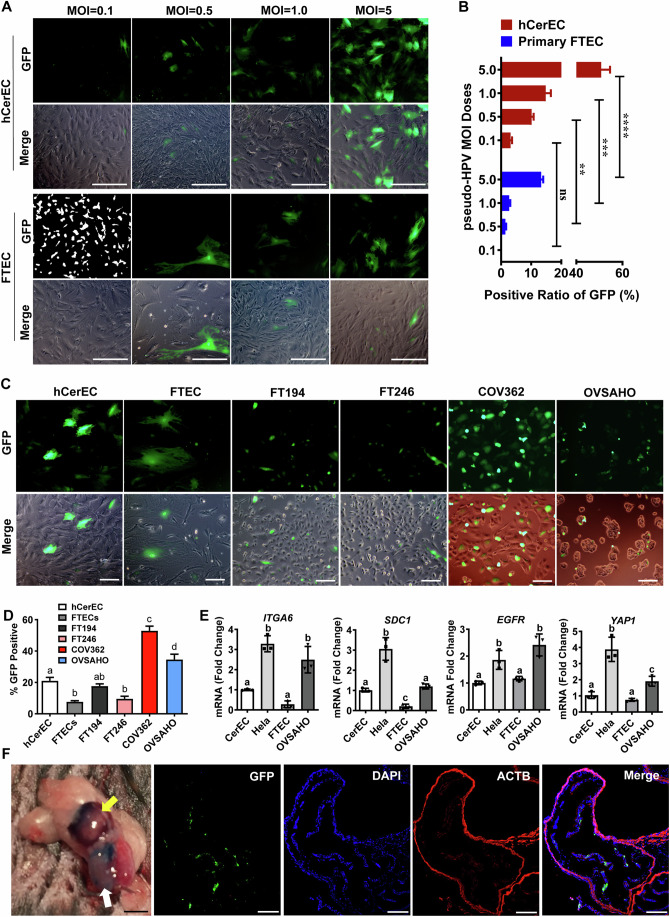
High grade serous ovarian carcinoma (HGSOC) is the most common and aggressive ovarian malignancy. Accumulating evidence indicates that HGSOC may originate from human fallopian tube epithelial cells (FTECs), although the exact pathogen(s) and/or molecular mechanism underlying the malignant transformation of FTECs is unclear. Here we show that human papillomavirus (HPV), which could reach FTECs via retrograde menstruation or sperm-carrying, interacts with the yes-associated protein 1 (YAP1) to drive the malignant transformation of FTECs. HPV prevents FTECs from natural replicative and YAP1-induced senescence, thereby promoting YAP1-induced malignant transformation of FTECs. HPV also stimulates proliferation and drives metastasis of YAP1-transformed FTECs. YAP1, in turn, stimulates the expression of the putative HPV receptors and suppresses the innate immune system to facilitate HPV acquisition. These findings provide critical clues for developing new strategies to prevent and treat HGSOC.
高级别浆液性卵巢癌(HGSOC)是最常见且侵袭性最强的卵巢恶性肿瘤。越来越多的证据表明,HGSOC 可能起源于人类输卵管上皮细胞(FTECs),尽管导致 FTECs 恶性转化的确切病原体(和/或)分子机制尚不清楚。在这里,我们表明,可通过逆行性月经或精子携带而到达 FTECs 的人乳头瘤病毒(HPV)与 yes 相关蛋白 1(YAP1)相互作用,从而驱动 FTECs 的恶性转化。HPV 可防止 FTECs 发生自然复制和 YAP1 诱导的衰老,从而促进 YAP1 诱导的 FTECs 恶性转化。HPV 还刺激增殖并驱动 YAP1 转化的 FTECs 转移。反过来,YAP1 刺激推测的 HPV 受体的表达并抑制先天免疫系统以促进 HPV 的获得。这些发现为开发预防和治疗 HGSOC 的新策略提供了关键线索。