Goode Emily Archer, Orozco-Moreno Margarita, Hodgson Kirsty, Nabilah Amirah, Murali Meera, Peng Ziqian, Merx Jona, Rossing Emiel, Pijnenborg Johan F A, Boltje Thomas J, Wang Ning, Elliott David J, Munkley Jennifer
Newcastle University Centre for Cancer, Newcastle University Institute of Biosciences, Newcastle NE1 3BZ, UK.
Synthetic Organic Chemistry, Institute for Molecules and Materials, Radboud University, 6525 XZ Nijmegen, The Netherlands.
Cancers (Basel). 2024 Aug 24;16(17):2953. doi: 10.3390/cancers16172953.
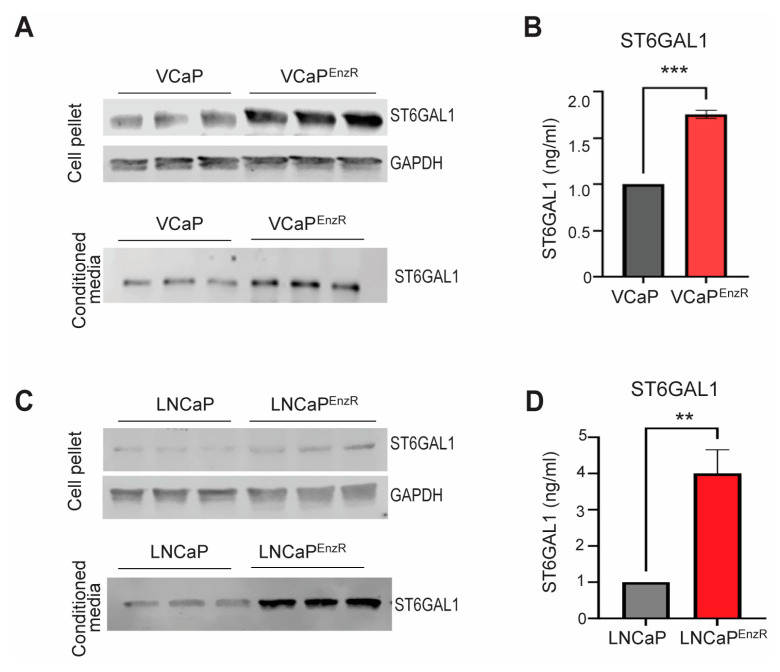
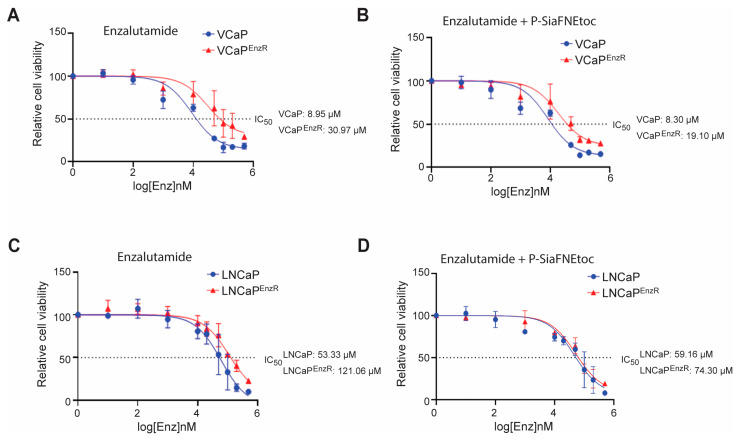
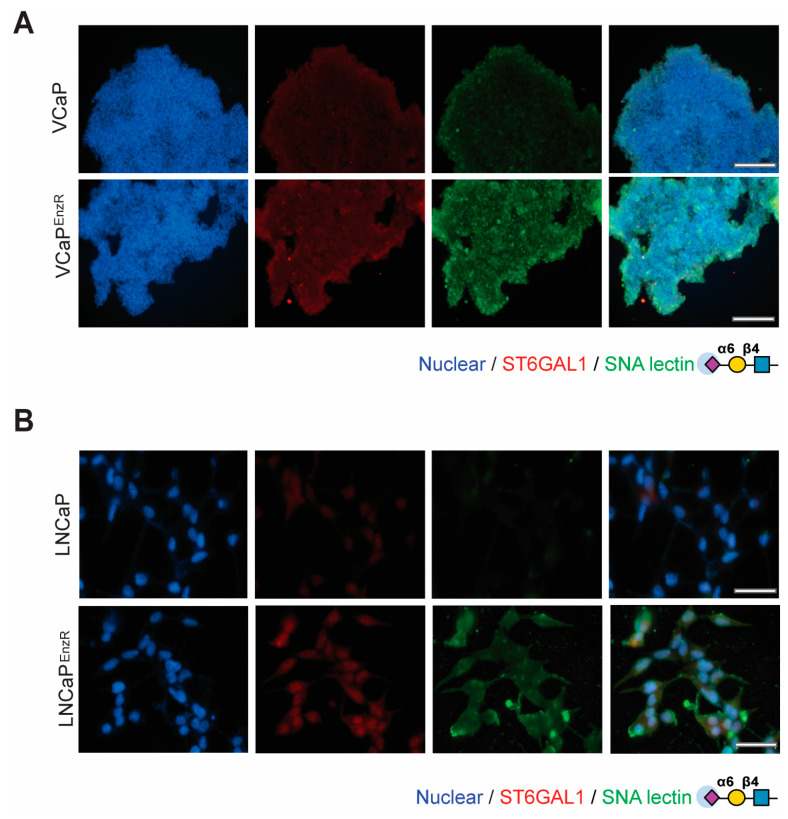
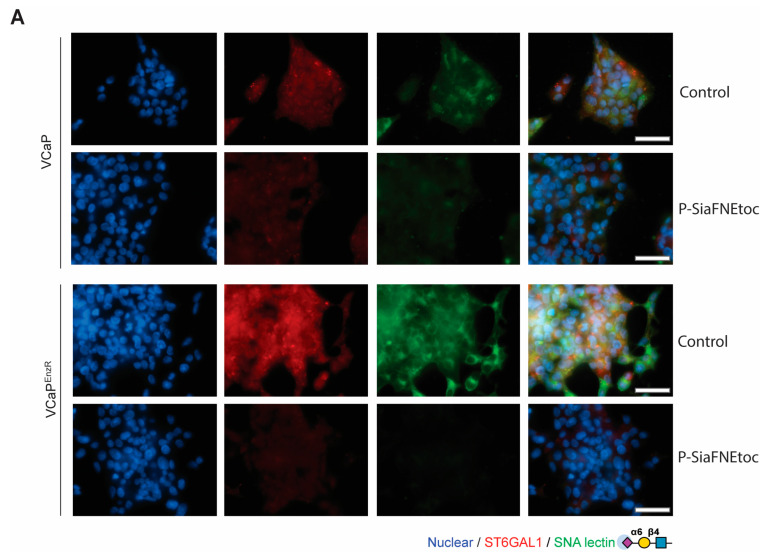
Prostate cancer is a lethal solid malignancy and a leading cause of cancer-related deaths in males worldwide. Treatments, including radical prostatectomy, radiotherapy, and hormone therapy, are available and have improved patient survival; however, recurrence remains a huge clinical challenge. Enzalutamide is a second-generation androgen receptor antagonist that is used to treat castrate-resistant prostate cancer. Among patients who initially respond to enzalutamide, virtually all acquire secondary resistance, and an improved understanding of the mechanisms involved is urgently needed. Aberrant glycosylation, and, in particular, alterations to sialylated glycans, have been reported as mediators of therapy resistance in cancer, but a link between tumour-associated glycans and resistance to therapy in prostate cancer has not yet been investigated. Here, using cell line models, we show that prostate cancer cells with acquired resistance to enzalutamide therapy have an upregulation of the sialyltransferase ST6 beta-galactoside alpha-2,6-sialyltransferase 1 (ST6GAL1) and increased levels of α2,6-sialylated -glycans. Furthermore, using the sialyltransferase inhibitor P-SiaFNEtoc, we discover that acquired resistance to enzalutamide can be partially reversed by combining enzalutamide therapy with sialic acid blockade. Our findings identify a potential role for ST6GAL1-mediated aberrant sialylation in acquired resistance to enzalutamide therapy for prostate cancer and suggest that sialic acid blockade in combination with enzalutamide may represent a novel therapeutic approach in patients with advanced disease. Our study also highlights the potential to bridge the fields of cancer biology and glycobiology to develop novel combination therapies for prostate cancer.
前列腺癌是一种致命的实体恶性肿瘤,也是全球男性癌症相关死亡的主要原因。包括根治性前列腺切除术、放疗和激素治疗在内的治疗方法已经存在,并且提高了患者的生存率;然而,复发仍然是一个巨大的临床挑战。恩杂鲁胺是一种第二代雄激素受体拮抗剂,用于治疗去势抵抗性前列腺癌。在最初对恩杂鲁胺有反应的患者中,几乎所有人都会产生继发性耐药,因此迫切需要更好地了解其中涉及的机制。异常糖基化,特别是唾液酸化聚糖的改变,已被报道为癌症治疗耐药的介导因素,但肿瘤相关聚糖与前列腺癌治疗耐药之间的联系尚未得到研究。在这里,我们使用细胞系模型表明,对恩杂鲁胺治疗产生获得性耐药的前列腺癌细胞中,唾液酸转移酶ST6 β-半乳糖苷α-2,6-唾液酸转移酶1(ST6GAL1)上调,α2,6-唾液酸化聚糖水平增加。此外,使用唾液酸转移酶抑制剂P-SiaFNEtoc,我们发现将恩杂鲁胺治疗与唾液酸阻断相结合可以部分逆转对恩杂鲁胺的获得性耐药。我们的研究结果确定了ST6GAL1介导的异常唾液酸化在前列腺癌对恩杂鲁胺治疗的获得性耐药中的潜在作用,并表明唾液酸阻断与恩杂鲁胺联合使用可能代表一种针对晚期疾病患者的新型治疗方法。我们的研究还强调了将癌症生物学和糖生物学领域联系起来以开发前列腺癌新型联合疗法的潜力。