Bastian Kayla, Orozco-Moreno Margarita, Thomas Huw, Hodgson Kirsty, Visser Eline A, Rossing Emiel, Pijnenborg Johan F A, Eerden Nienke, Wilson Laura, Saravannan Hasvini, Hanley Oliver, Grimsley Grace, Frame Fiona, Peng Ziqian, Knight Bridget, McCullagh Paul, McGrath John, Crundwell Malcolm, Harries Lorna, Maitland Norman J, Heer Rakesh, Wang Ning, Goddard-Borger Ethan D, Guerrero Ramon Hurtado, Boltje Thomas J, Drake Richard R, Scott Emma, Elliott David J, Munkley Jennifer
Newcastle University Centre for Cancer, Newcastle University Institute of Biosciences, Newcastle, UK.
Newcastle University Centre for Cancer, Translational and Clinical Research Institute, Paul O'gorman Building, Newcastle University, Newcastle upon Tyne, UK.
Cancer Med. 2025 May;14(10):e70959. doi: 10.1002/cam4.70959.
An unmet clinical need requires the discovery of new treatments for men facing advanced prostate cancer. Aberrant glycosylation is a universal feature of cancer cells and plays a key role in tumour growth, immune evasion and metastasis. Alterations in tumour glycosylation are closely associated with prostate cancer progression, making glycans promising therapeutic targets. Fucosyltransferase 8 (FUT8) drives core fucosylation by adding α1,6-fucose to the innermost GlcNAc residue on N-glycans. While FUT8 is recognised as a crucial factor in cancer progression, its role in prostate cancer remains poorly understood.
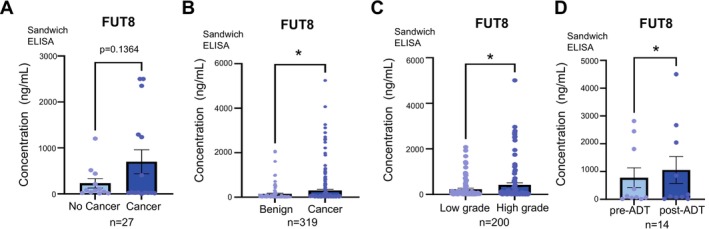
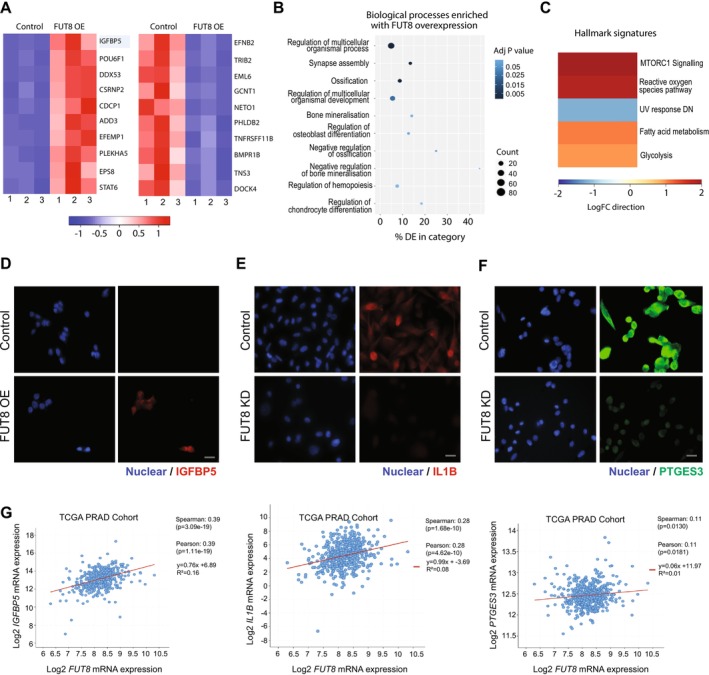
METHODS & RESULTS: Here, we demonstrate using multiple independent clinical cohorts that FUT8 is upregulated in high grade and metastatic prostate tumours, and in the blood of prostate cancer patients with aggressive disease. Using novel tools, including PhosL lectin immunofluorescence and N-glycan MALDI mass spectrometry imaging (MALDI-MSI), we find FUT8 underpins the biosynthesis of malignant core fucosylated N-glycans in prostate cancer cells and using both in vitro and in vivo models, we find FUT8 promotes prostate tumour growth, cell motility and invasion. Mechanistically we show FUT8 regulates the expression of genes and signalling pathways linked to prostate cancer progression. Furthermore, we find that fucosylation inhibitors can inhibit the activity of FUT8 in prostate cancer to suppress the growth of prostate tumours.
Our study cements FUT8-mediated core fucosylation as an important driver of prostate cancer progression and suggests targeting FUT8 activity for prostate cancer therapy as an exciting area to explore.
未满足的临床需求促使人们去发现针对晚期前列腺癌男性患者的新治疗方法。异常糖基化是癌细胞的一个普遍特征,在肿瘤生长、免疫逃逸和转移中起关键作用。肿瘤糖基化的改变与前列腺癌进展密切相关,使聚糖成为有前景的治疗靶点。岩藻糖基转移酶8(FUT8)通过将α1,6-岩藻糖添加到N-聚糖最内层的N-乙酰葡糖胺残基上来驱动核心岩藻糖基化。虽然FUT8被认为是癌症进展中的一个关键因素,但其在前列腺癌中的作用仍知之甚少。
在此,我们使用多个独立的临床队列证明,FUT8在高级别和转移性前列腺肿瘤以及患有侵袭性疾病的前列腺癌患者血液中上调。使用包括PhosL凝集素免疫荧光和N-聚糖基质辅助激光解吸电离质谱成像(MALDI-MSI)在内的新型工具,我们发现FUT8是前列腺癌细胞中恶性核心岩藻糖基化N-聚糖生物合成的基础,并且使用体外和体内模型,我们发现FUT8促进前列腺肿瘤生长、细胞运动和侵袭。从机制上我们表明FUT8调节与前列腺癌进展相关的基因表达和信号通路。此外,我们发现岩藻糖基化抑制剂可以抑制FUT8在前列腺癌中的活性,从而抑制前列腺肿瘤的生长。
我们的研究确定FUT8介导的核心岩藻糖基化是前列腺癌进展的一个重要驱动因素,并表明将FUT8活性作为前列腺癌治疗靶点是一个值得探索的令人兴奋的领域。