Department of Orthopedics and Trauma Surgery, University Hospital Bonn, 53127 Bonn, Germany.
Int J Mol Sci. 2024 Aug 23;25(17):9136. doi: 10.3390/ijms25179136.
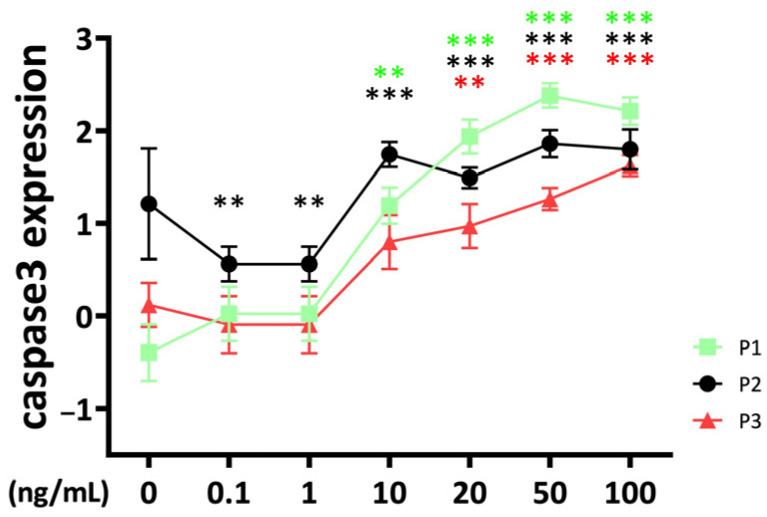
Inflammation models are widely used in the in vitro investigation of new therapeutic approaches for osteoarthritis. TNFα (tumor necrosis factor alpha) plays an important role in the inflammatory process. Current inflammation models lack uniformity and make comparisons difficult. Therefore, this study aimed to systematically investigate whether the effects of TNFα are concentration-dependent and whether chondrocyte expansion has an effect on the inflammatory model. Bovine chondrocytes were enzymatically isolated, expanded to passages 1-3, and transferred into a 3D pellet culture. Chondrocyte pellets were stimulated with recombinant bovine TNFα at different concentrations for 48 h to induce inflammation. Gene expression of anabolic (, , ()), catabolic (matrix metalloproteinases (, )), dedifferentiation () markers, inflammation markers ( (), (), (), ()), and the apoptosis marker was determined. At the protein level, concentrations of IL-6, nitric oxide (NO), and sulfated glycosaminoglycans (GAG) were evaluated. Statistical analysis was performed using the independent t-test, and significance was defined as < 0.05. In general, TNFα caused a decrease in anabolic markers and an increase in the expression of catabolic and inflammatory markers. There was a concentration-dependent threshold of 10 ng/mL to induce significant inflammatory effects. Most of the markers analyzed showed TNFα concentration-dependent effects (, , , , , and ). There was a statistical influence of selected gene expression markers from different passages on the TNFα chondrocyte inflammation model, including , , , , and . Considering the expression of and , passage 3 chondrocytes showed a higher sensitivity to TNFα stimulation compared to passages 1 and 2. On the other hand, , , and gene expression were lower in P3 chondrocytes compared to the other passages. On the protein level, inflammatory effects showed a similar pattern, with cytokine effects starting at 10 ng/mL and differences between the passages. TNFα had a detrimental effect on cartilage, with a clear threshold observed at 10 ng/mL. Although TNFα effects showed concentration-dependent patterns, this was not consistent for all markers. The selected passage showed a clear influence, especially on inflammation markers. Further experiments were warranted to explore the effects of TNFα concentration and passage in long-term stimulation.
炎症模型广泛应用于骨关节炎新治疗方法的体外研究。TNFα(肿瘤坏死因子-α)在炎症过程中起着重要作用。目前的炎症模型缺乏一致性,使得比较变得困难。因此,本研究旨在系统研究 TNFα 的作用是否具有浓度依赖性,以及软骨细胞扩增是否对炎症模型有影响。牛软骨细胞通过酶解分离,扩增至第 1-3 代,并转移到 3D 微球培养中。用不同浓度的重组牛 TNFα 刺激软骨细胞微球 48 小时以诱导炎症。测定合成代谢(、、())、分解代谢(基质金属蛋白酶(、))、去分化()标志物、炎症标志物(()、()、()、())和凋亡标志物的基因表达。在蛋白质水平上,评估白细胞介素 6(IL-6)、一氧化氮(NO)和硫酸化糖胺聚糖(GAG)的浓度。使用独立 t 检验进行统计分析,显著性定义为 < 0.05。总的来说,TNFα 导致合成代谢标志物减少,分解代谢和炎症标志物表达增加。10ng/mL 的浓度诱导显著的炎症效应存在浓度依赖性阈值。分析的大多数标志物显示 TNFα 浓度依赖性效应(、、、、和)。来自不同代的选定基因表达标志物对 TNFα 软骨细胞炎症模型有统计学影响,包括、、、、和。考虑到和的表达,第 3 代软骨细胞对 TNFα 刺激的敏感性高于第 1 代和第 2 代。另一方面,与其他代相比,P3 软骨细胞的、、和基因表达较低。在蛋白质水平上,炎症效应也呈现出相似的模式,细胞因子效应在 10ng/mL 时开始出现,各代之间存在差异。TNFα 对软骨有损害作用,在 10ng/mL 时观察到明显的阈值。尽管 TNFα 作用表现出浓度依赖性模式,但并非所有标志物都如此。所选的代显示出明显的影响,尤其是在炎症标志物方面。有必要进行进一步的实验来探索 TNFα 浓度和代在长期刺激中的影响。