Obuchowicz Rafal, Obuchowicz Barbara, Nurzynska Karolina, Urbanik Andrzej, Pihut Malgorzata
Department of Diagnostic Imaging, Jagiellonian University Medical College, 30-663 Krakow, Poland.
Department of Conservative Dentistry with Endodontics, Jagiellonian University Collegium Medicum, Montelupich 4, 31-155 Cracow, Poland.
J Clin Med. 2024 Sep 5;13(17):5259. doi: 10.3390/jcm13175259.
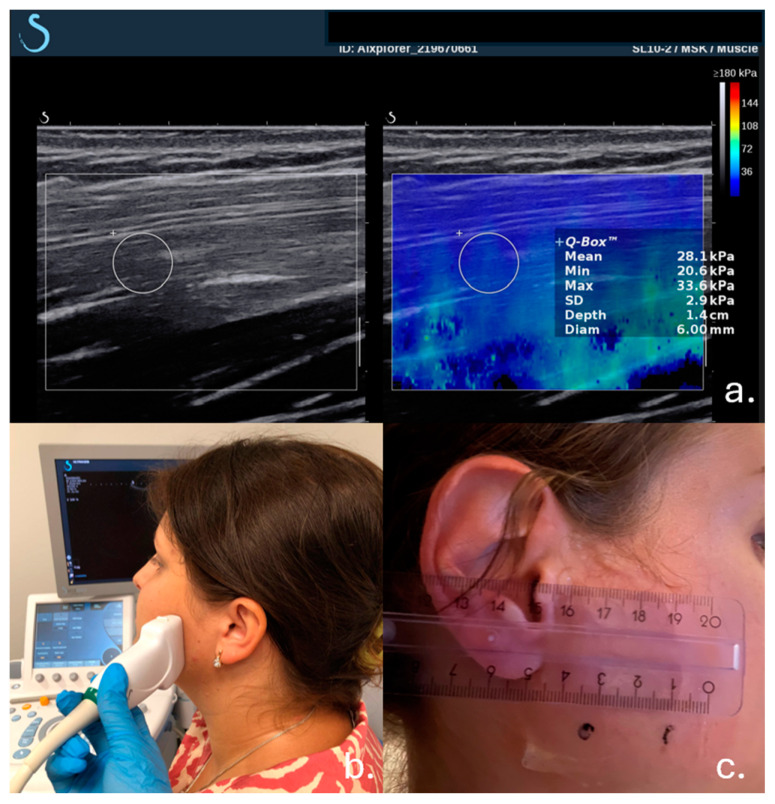
This study aimed to evaluate the distribution and trends of masseter muscle tension in patients with temporomandibular joint (TMJ) pain, examining gender-specific differences and the impact of various TMJ disorders. From January 2020 to June 2024, a total of 734 patients presenting with facial pain radiating to the head and neck, localized around and extending from the TMJ, were referred for ultrasonographic examination. After applying exclusion criteria, 535 patients (72.9%) were included in the study. The patient cohort consisted of 343 females (64.1%) and 192 males (35.9%), with muscle tension measured using the Aixplorer ultrasound system equipped with a shear wave device. Data were collected and analyzed across different age groups and TMJ conditions, including "no changes", "exudate", "arthrosis", and "disc displacement". The study found that males exhibited higher muscle tension across all conditions, particularly in the "no changes" (40.4 kPa vs. 32.1 kPa, 25.9% higher) and "exudate" (38.5 kPa vs. 29.7 kPa, 29.6% higher) categories, indicating increased muscle strain and inflammation during middle age. In females, a trend of decreasing muscle tension with age was observed, with a significant reduction from 36.2 kPa in the 20-30 age group to 24.3 kPa in the 60-70 age group (32.9% reduction), suggesting a reduction in muscle mass or strength due to aging. Both genders showed high muscle tension in the presence of exudate, with females peaking in the 40-50 age group at 37.1 kPa and males peaking earlier in the 20-30 age group at 41.2 kPa (10.9% higher in males), highlighting potential gender differences in inflammatory response. In the arthrosis group, males displayed a consistent increase in muscle tension with age, peaking at 37.5 kPa in the 50-60 age group (50.7% increase from the 20-30 age group), while females showed high tension, particularly in the 40-50 age group at 31.0 kPa (82.4% higher compared to the 20-30 age group), indicating the need for targeted joint health interventions in middle-aged women. This study reveals significant gender-specific differences in masseter muscle tension among patients with TMJ pain. Males were found to be more affected by muscle strain and inflammation during middle age, whereas females showed a significant decrease in muscle tension with age. The presence of exudate significantly impacted muscle tension across all age groups for both genders. These findings underscore the importance of tailored clinical interventions and preventive strategies to manage TMJ disorders effectively.
本研究旨在评估颞下颌关节(TMJ)疼痛患者咬肌张力的分布及趋势,研究性别差异以及各种颞下颌关节疾病的影响。2020年1月至2024年6月,共有734例出现放射至头颈部的面部疼痛、疼痛局限于颞下颌关节周围并从该关节延伸的患者被转诊进行超声检查。应用排除标准后,535例患者(72.9%)被纳入研究。患者队列包括343名女性(64.1%)和192名男性(35.9%),使用配备剪切波装置的Aixplorer超声系统测量肌肉张力。针对不同年龄组和颞下颌关节状况收集并分析数据,这些状况包括“无变化”“渗出液”“关节病”和“盘移位”。研究发现,在所有状况下男性的肌肉张力均较高,尤其是在“无变化”(40.4千帕对32.1千帕,高25.9%)和“渗出液”(38.5千帕对29.7千帕,高29.6%)类别中,表明中年时期肌肉应变和炎症增加。在女性中,观察到肌肉张力随年龄降低的趋势,从20 - 30岁年龄组的36.2千帕显著降至60 - 70岁年龄组的24.3千帕(降低32.9%),提示因衰老导致肌肉质量或力量下降。在有渗出液的情况下,两性的肌肉张力均较高,女性在40 - 50岁年龄组达到峰值37.1千帕,男性在20 - 30岁年龄组更早达到峰值41.2千帕(男性高10.9%),突出了炎症反应中潜在的性别差异。在关节病组中,男性肌肉张力随年龄持续增加,在50 - 60岁年龄组达到峰值37.5千帕(比20 - 30岁年龄组增加50.7%),而女性肌肉张力较高,尤其是在40 - 50岁年龄组为31.0千帕(比20 - 30岁年龄组高82.4%),表明中年女性需要针对性的关节健康干预。本研究揭示了颞下颌关节疼痛患者咬肌张力存在显著的性别差异。发现男性在中年时期更易受肌肉应变和炎症影响,而女性肌肉张力随年龄显著降低。渗出液的存在对所有年龄组两性的肌肉张力均有显著影响。这些发现强调了采取针对性临床干预和预防策略以有效管理颞下颌关节疾病的重要性。