Unidad de Investigación y Desarrollo en Tecnología Farmacéutica (UNITEFA-CONICET), Facultad de Ciencias Químicas, Universidad Nacional de Córdoba (FCQ-UNC), Haya de la Torre y Medina Allende, Córdoba 5000, Argentina.
Sustainable Chemistry for Metals and Molecules, Department of Chemistry, KU Leuven, Celestijnenlaan 200F, 3001 Leuven, Belgium.
Molecules. 2024 Sep 5;29(17):4224. doi: 10.3390/molecules29174224.
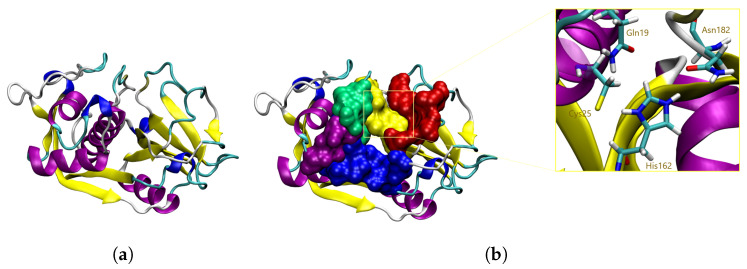
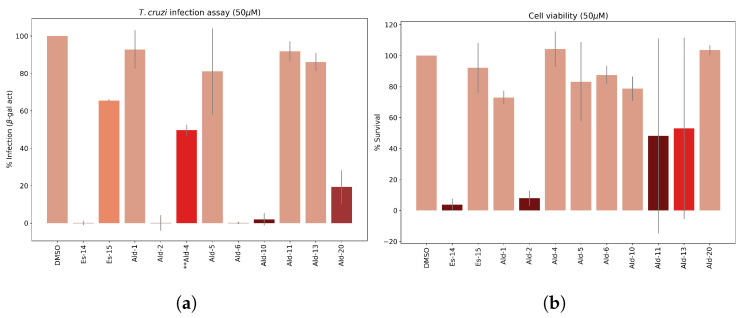
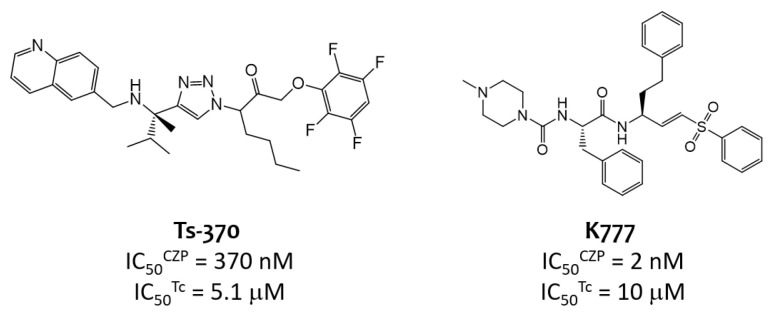
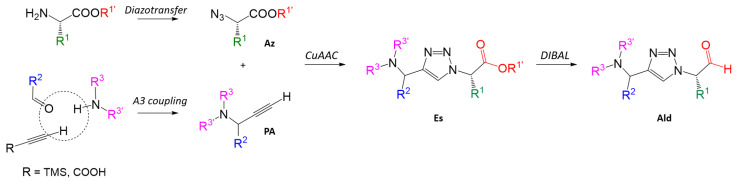
Cruzipain (CZP), the major cysteine protease present in , the ethiological agent of Chagas disease, has attracted particular attention as a therapeutic target for the development of targeted covalent inhibitors (TCI). The vast chemical space associated with the enormous molecular diversity feasible to explore by means of modern synthetic approaches allows the design of CZP inhibitors capable of exhibiting not only an efficient enzyme inhibition but also an adequate translation to anti- activity. In this work, a computer-aided design strategy was developed to combinatorially construct and screen large libraries of 1,4-disubstituted 1,2,3-triazole analogues, further identifying a selected set of candidates for advancement towards synthetic and biological activity evaluation stages. In this way, a virtual molecular library comprising more than 75 thousand diverse and synthetically feasible analogues was studied by means of molecular docking and molecular dynamic simulations in the search of potential TCI of CZP, guiding the synthetic efforts towards a subset of 48 candidates. These were synthesized by applying a Cu(I)-catalyzed azide-alkyne cycloaddition (CuAAC) centered synthetic scheme, resulting in moderate to good yields and leading to the identification of 12 hits selectively inhibiting CZP activity with IC in the low micromolar range. Furthermore, four triazole derivatives showed good anti- inhibition when studied at 50 μM; and excelled for its high antitrypanocidal activity and low cytotoxicity, exhibiting complete in vitro biological activity translation from CZP to . Overall, not only merits further advancement to preclinical in vivo studies, but these findings also shed light on a valuable chemical space where molecular diversity might be explored in the search for efficient triazole-based antichagasic agents.
克氏锥虫(CZP)是恰加斯病的病原体,是一种主要的半胱氨酸蛋白酶,作为靶向共价抑制剂(TCI)的开发治疗靶点,引起了特别关注。通过现代合成方法探索的巨大分子多样性允许设计不仅具有高效酶抑制作用,而且具有足够的抗活性转化的 CZP 抑制剂。在这项工作中,开发了一种计算机辅助设计策略,用于组合构建和筛选 1,4-取代的 1,2,3-三唑类似物的大型文库,进一步鉴定出一组有希望进一步合成和生物活性评估阶段的候选物。通过分子对接和分子动力学模拟,对包含超过 75,000 种不同和合成可行类似物的虚拟分子文库进行了研究,寻找 CZP 的潜在 TCI,指导合成工作集中在 48 个候选物上。这些候选物通过应用 Cu(I)催化的叠氮-炔环加成(CuAAC)为中心的合成方案合成,得到中等至良好的产率,并鉴定出 12 个对 CZP 活性具有选择性抑制作用的命中物,IC 值在低微摩尔范围内。此外,当在 50 μM 下研究时,四个三唑衍生物显示出良好的抗抑制活性;在抗锥虫活性和低细胞毒性方面表现出色,其体外生物学活性完全从 CZP 转化为 ,表现出很高的抗锥虫活性和低细胞毒性。总的来说,不仅 值得进一步推进到临床前体内研究,而且这些发现还揭示了一个有价值的化学空间,可以在其中探索基于三唑的高效抗恰加斯病药物。