ESHRE, Central Office, Strombeek-Bever, Belgium.
Faculty of Medicine, University of Lisbon, Lisbon, Portugal.
Hum Reprod. 2024 Nov 1;39(11):2379-2386. doi: 10.1093/humrep/deae209.
What are the current national medically assisted reproduction (MAR) data collection systems across EU Member States, and how can these countries contribute to a unique, cycle-by-cycle registry for the European Monitoring of Medically Assisted Reproduction (EuMAR) project?
The study identified significant variation in MAR data collection practices across Member States, with differences in data types, collection methods, and reporting requirements; the EuMAR project emerges as an opportunity to enhance data standardization and improve MAR data collection in the EU.
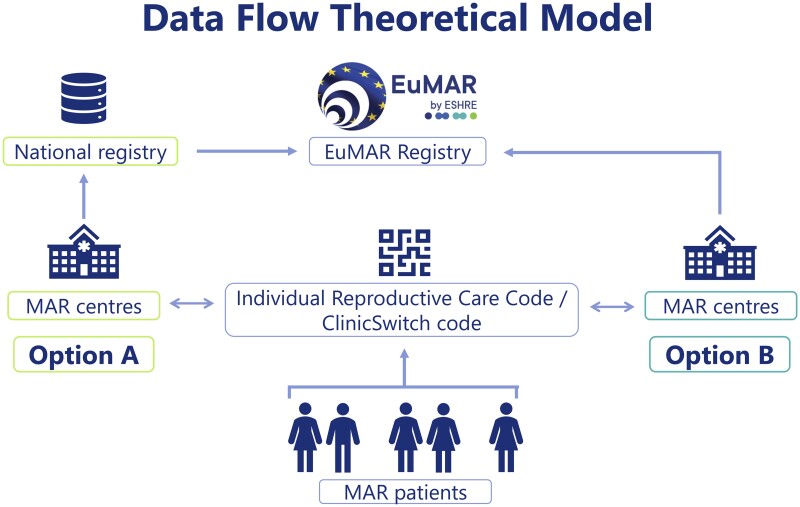
There is a need for new approaches in MAR data collection that include long-term and cross border follow-up. The EuMAR project intends to establish a unified, cycle-by-cycle registry of data on MAR treatments in EU countries, from which accurate cumulative outcomes can be calculated.
STUDY DESIGN, SIZE, DURATION: This cross-sectional study involved a survey and interviews with stakeholders from 26 EU Member States conducted in 2023 over a period of seven months.
PARTICIPANTS/MATERIALS, SETTING, METHODS: Representatives from national competent authorities and professional associations involved in MAR data collection in EU countries were invited to complete the survey and interviewed to assess current data flows, information requirements, and their interest in the EuMAR project.
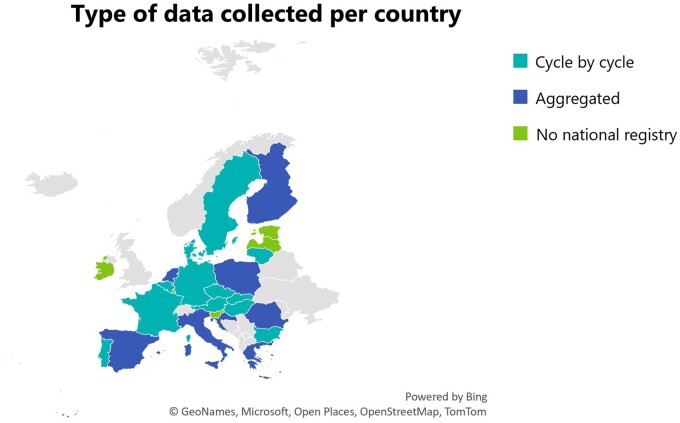
Half of the participating countries reported having a national MAR registry with cycle-by-cycle data (n = 13), while 31% reported having a national registry with aggregated data (n = 8) and 19% reported having no national registry (n = 5). Of the countries with a national cycle-by-cycle registry, eight countries collect identifiable data, five countries collect pseudonymized data, and one country collects fully anonymized data. Informed consent is required in 10 countries. The main advantages that participants expected from a European registry like EuMAR were the possibility of obtaining national statistics in the absence of a national registry and improving the calculation of cumulative outcomes.
LIMITATIONS, REASONS FOR CAUTION: The results of the study are based on self-reported data, which may be subject to bias, however, the validity of the collected information was verified with different means, including follow-up calls for clarifications and sharing final transcript reports. The feasibility of the proposed data flow models will be tested in a pilot study.
Despite the heterogeneity of data collection practices across EU countries, the results show that stakeholders have high expectations of the benefits that the EuMAR registry can bring, namely the improvement of data consistency, cross-border comparability, and cumulative live birth rates, leading to better information for patients, health care providers and policy makers.
STUDY FUNDING/COMPETING INTEREST(S): The EuMAR project was co-founded by ESHRE and the European Commission (101079865-EuMAR-EU4H-2021-PJ2). No competing interests were declared.
N/A.
欧盟成员国目前有哪些国家医学辅助生殖(MAR)数据收集系统,这些国家如何为欧洲医学辅助生殖监测(EuMAR)项目的独特、周期到周期的登记做出贡献?
该研究确定了成员国在 MAR 数据收集实践方面存在显著差异,数据类型、收集方法和报告要求存在差异;EuMAR 项目是加强数据标准化和改善欧盟 MAR 数据收集的机会。
MAR 数据收集需要新的方法,包括长期和跨境随访。EuMAR 项目旨在建立一个欧盟国家 MAR 治疗周期到周期数据的统一登记册,从中可以计算出准确的累积结果。
研究设计、规模、持续时间:这是一项 2023 年进行的横断面研究,涉及欧盟 26 个成员国的调查和利益相关者访谈,历时七个月。
参与者/材料、设置、方法:邀请来自参与 MAR 数据收集的欧盟国家的国家主管当局和专业协会的代表完成调查并接受采访,以评估当前的数据流向、信息需求以及他们对 EuMAR 项目的兴趣。
参与调查的一半国家报告说拥有具有周期到周期数据的国家 MAR 登记册(n=13),31%的国家报告说拥有具有汇总数据的国家登记册(n=8),19%的国家报告说没有国家登记册(n=5)。在拥有国家周期到周期登记册的国家中,有八个国家收集可识别数据,五个国家收集化名数据,一个国家收集完全匿名数据。有 10 个国家需要知情同意。参与者期望欧洲登记册(如 EuMAR)带来的主要好处是在没有国家登记册的情况下获得国家统计数据和改善累积结果的计算。
局限性、谨慎的原因:研究结果基于自我报告的数据,可能存在偏差,但是通过不同的方式验证了收集信息的有效性,包括澄清问题的后续电话和共享最终报告记录。拟议的数据流转模型的可行性将在试点研究中进行测试。
尽管欧盟国家的数据收集实践存在异质性,但结果表明,利益相关者对 EuMAR 登记册可能带来的好处寄予厚望,即改善数据一致性、跨境可比性和累积活产率,从而为患者、医疗保健提供者和政策制定者提供更好的信息。
研究资金/利益冲突:EuMAR 项目由 ESHRE 和欧盟委员会共同资助(101079865-EuMAR-EU4H-2021-PJ2)。没有利益冲突申报。
无。