Nichkaode Prabhat Bhaskarrao, Sharma Bijay, Reddy Sreemanth, Inturi Ramteja, Patil Aditya
Department of General Surgery, Dr. D. Y. Patil Vidyapeeth, Pune, Maharashtra, India.
Ann Afr Med. 2024 Oct 1;23(4):656-662. doi: 10.4103/aam.aam_164_22. Epub 2024 Sep 14.
To evaluate the role of early prophylactic inguinal node dissection in patients with squamous cell cancer and melanoma of lower limb.
From 2008 to 2018, a Tertiary Care Hospital connected to a teaching institute served as the site of this retrospective observational study. Patient records were gathered with the purpose of gathering clinical, investigative, surgical, pathological and follow-up information.
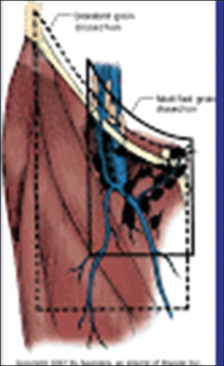
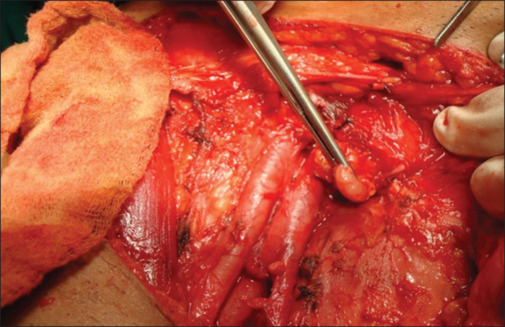
We included 33 patients in this analysis out of the 47 patients we treated ourselves between 2008 and 2018; among these 33 patients, 21 (63.63%) had palpable inguinal nodes at the time of primary presentation. All 21 patients' FNAC tests were positive for metastases, in 16 patients (76.19%). 5 patients on FNAC (23.80%) exhibited not metastases. The remaining 12 patients did not have enlarged lymph nodes at the time of their initial presentation. Patients who did not have palpable lymph node were given the option of having a modified inguinal block dissection. 8 patients with metastatic disease have nodes that are positive in histology. In addition, out of 5 patients with negative nodes 4 (80%) showed evidence of metastasis.
The conclusion of this retrospective observational study is that although palpable lymph nodes in groin are unquestionably a sign that inguinal nodes should be dissected, prophylactic lymph node dissection should be still done even if nodes are not palpable or provide a negative FNAC result. Given that delayed lymphadenectomy has a significant effect on survival, delaying inguinal lymphadenectomy in non-palpable nodes could cause you to lose the battle against cancer in your lower limb. The related surgical morbidity is the only downside to prophylactic lymph node dissection. This can, however, be effectively decreased with a modified inguinal lymphadenectomy operation.
评估早期预防性腹股沟淋巴结清扫术在下肢鳞状细胞癌和黑色素瘤患者中的作用。
2008年至2018年,一家与教学机构相关的三级护理医院作为这项回顾性观察研究的地点。收集患者记录以获取临床、检查、手术、病理和随访信息。
在我们2008年至2018年自行治疗的47例患者中,本分析纳入了33例;在这33例患者中,21例(63.63%)在初次就诊时可触及腹股沟淋巴结。所有21例患者的细针穿刺抽吸活检(FNAC)检查结果显示转移阳性,其中16例(76.19%)。5例患者的FNAC检查(23.80%)显示无转移。其余12例患者在初次就诊时无淋巴结肿大。未触及淋巴结的患者可选择进行改良腹股沟淋巴结清扫术。8例转移性疾病患者的淋巴结组织学检查呈阳性。此外,在5例淋巴结阴性的患者中,4例(80%)显示有转移迹象。
这项回顾性观察研究的结论是,虽然腹股沟可触及淋巴结无疑是应进行腹股沟淋巴结清扫的标志,但即使淋巴结未触及或FNAC检查结果为阴性,仍应进行预防性淋巴结清扫。鉴于延迟淋巴结切除术对生存率有显著影响,在不可触及的淋巴结中延迟腹股沟淋巴结切除术可能会使你输掉下肢癌症的战斗。预防性淋巴结清扫的唯一不利之处是相关的手术发病率。然而,通过改良腹股沟淋巴结清扫术可以有效降低这一发病率。