Bruhn Helena, Tavelin Björn, Rosenlund Lena, Henriksson Roger
Department of Biomedical and Clinical Sciences, Linköping University, Linköping, Sweden.
Clinical Research Unit, Cancercentrum, Region Vasterbotten, Umea University Hospital, Umea, Sweden.
Neurooncol Pract. 2024 Apr 23;11(5):652-659. doi: 10.1093/nop/npae036. eCollection 2024 Oct.
Glioblastoma is the most common malignant brain tumor in adults. Non-invasive clinical parameters could play a crucial role in treatment planning and serve as predictors of patient survival. Our register-based real-life study aimed to investigate the prognostic value of presenting symptoms.
Data on presenting symptoms and survival, as well as known prognostic factors, were retrieved for all glioblastoma patients in Sweden registered in the Swedish Brain Tumor Registry between 2018 and 2021. The prognostic impact of different presenting symptoms was calculated using the Cox proportional hazard model.
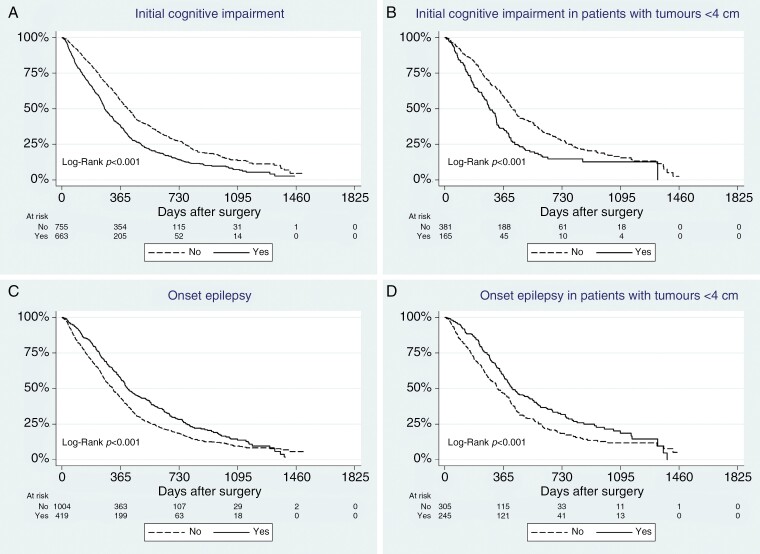
Data from 1458 adults with pathologically verified IDH wild-type glioblastoma were analyzed. Median survival time was 345 days. The 2-year survival rate was 21.5%. Registered presenting symptoms were focal neurological deficits, cognitive dysfunction, headache, epilepsy, signs of raised intracranial pressure, and cranial nerve symptoms, with some patients having multiple symptoms. Patients with initial cognitive dysfunction had significantly shorter survival than patients without; 265 days (245-285) vs. 409 days (365-453; < .001). The reduced survival remained after Cox regression adjusting for known prognostic factors. Patients presenting with seizures and patients with headaches had significantly longer overall survival compared to patients without these symptoms, but the difference was not retained in multivariate analysis. Patients with cognitive deficits were less likely to have radical surgery and to receive extensive anti-neoplastic nonsurgical treatment.
This extensive real-life study reveals that initial cognitive impairment acts as an independent negative predictive factor for treatment decisions and adversely affects survival outcomes in glioblastoma patients.
胶质母细胞瘤是成人中最常见的恶性脑肿瘤。非侵入性临床参数在治疗规划中可能发挥关键作用,并可作为患者生存的预测指标。我们基于登记的真实世界研究旨在调查首发症状的预后价值。
检索了2018年至2021年在瑞典脑肿瘤登记处登记的所有瑞典胶质母细胞瘤患者的首发症状、生存数据以及已知的预后因素。使用Cox比例风险模型计算不同首发症状的预后影响。
分析了1458例经病理证实为异柠檬酸脱氢酶(IDH)野生型胶质母细胞瘤的成人患者的数据。中位生存时间为345天。2年生存率为21.5%。登记的首发症状包括局灶性神经功能缺损、认知功能障碍、头痛、癫痫、颅内压升高体征和颅神经症状,一些患者有多种症状。初始有认知功能障碍的患者的生存期明显短于无认知功能障碍的患者;分别为265天(245 - 285天)和409天(365 - 453天;P <.001)。在对已知预后因素进行Cox回归调整后,生存期缩短的情况仍然存在。与无癫痫发作和头痛症状的患者相比,有癫痫发作和头痛症状的患者的总生存期明显更长,但在多变量分析中这种差异未保留。有认知缺陷的患者进行根治性手术和接受广泛抗肿瘤非手术治疗的可能性较小。
这项广泛的真实世界研究表明,初始认知障碍是胶质母细胞瘤患者治疗决策的独立负面预测因素,并对生存结果产生不利影响。