Lou Yu, Luan Yu-Ting, Rong Wen-Qing, Gai Yun
Department of Preventive Treatment of Disease, Seventh People's Hospital Affiliated to Shanghai University of Traditional Chinese Medicine, Shanghai 200137, China.
Department of Infectious Diseases, Seventh People's Hospital Affiliated to Shanghai University of Traditional Chinese Medicine, Shanghai 200137, China.
World J Diabetes. 2024 Sep 15;15(9):1916-1931. doi: 10.4239/wjd.v15.i9.1916.
Diabetic nephropathy (DN) is the most frequent chronic microvascular consequence of diabetes, and podocyte injury and malfunction are closely related to the development of DN. Studies have shown that corilagin (Cor) has hepatoprotective, anti-inflammatory, antibacterial, antioxidant, anti-hypertensive, anti-diabetic, and anti-tumor activities.
To explore the protective effect of Cor against podocyte injury in DN mice and the underlying mechanisms.
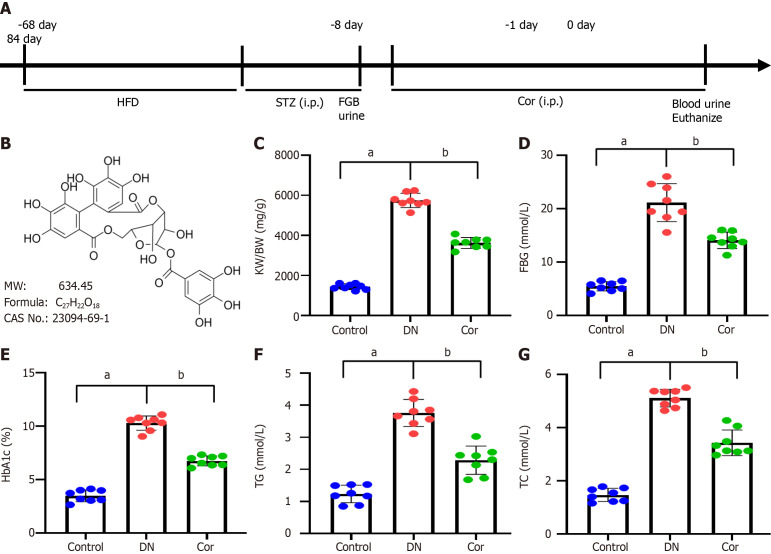
Streptozotocin and a high-fat diet were combined to generate DN mice models, which were then divided into either a Cor group or a DN group ( = 8 in each group). Mice in the Cor group were intraperitoneally injected with Cor (30 mg/kg/d) for 12 wk, and mice in the DN group were treated with saline. Biochemical analysis was used to measure the blood lipid profiles. Hematoxylin and eosin staining was used to detect pathological changes in kidney tissue. Immunohistochemistry and Western blotting were used to assess the protein expression of nephrin and podocin. Mouse podocyte cells (MPC5) were cultured and treated with glucose (5 mmol/L), Cor (50 μM), high glucose (HG) (30 mmol/L), and HG (30 mmol/L) plus Cor (50 μM). Real-time quantitative PCR and Western blotting were performed to examine the effects of Cor on podocyte autophagy.
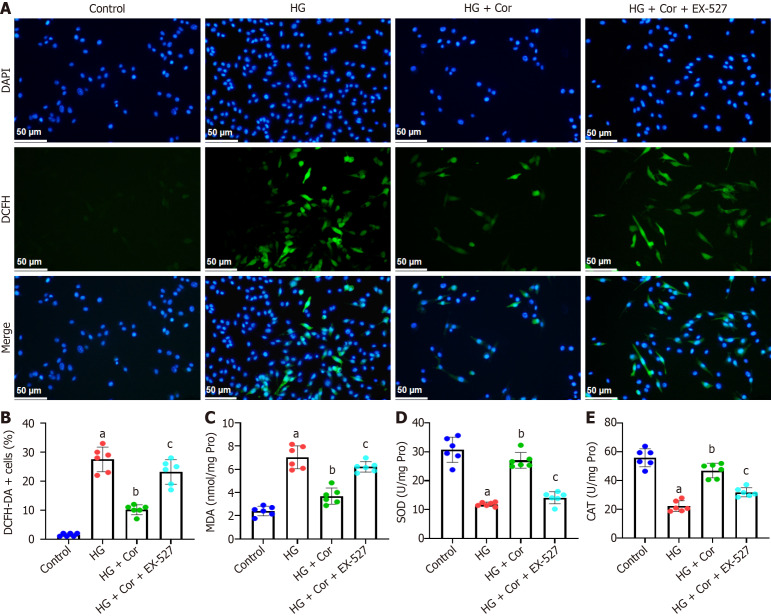
Compared with the control group, the DN mice models had increased fasting blood glucose, glycosylated hemoglobin, triglycerides, and total cholesterol, decreased nephrin and podocin expression, increased apoptosis rate, elevated inflammatory cytokines, and enhanced oxidative stress. All of the conditions mentioned above were alleviated after intervention with Cor. In addition, Cor therapy improved SIRT1 and AMPK expression ( < 0.001), inhibited reactive oxygen species and oxidative stress, and elevated autophagy in HG-induced podocytes ( < 0.01).
Cor alleviates podocyte injury by regulating autophagy the SIRT1-AMPK pathway, thereby exerting its protective impact on renal function in DN mice.
糖尿病肾病(DN)是糖尿病最常见的慢性微血管并发症,足细胞损伤和功能障碍与DN的发生发展密切相关。研究表明,柯里拉京(Cor)具有肝脏保护、抗炎、抗菌、抗氧化、抗高血压、抗糖尿病和抗肿瘤活性。
探讨Cor对DN小鼠足细胞损伤的保护作用及其潜在机制。
联合链脲佐菌素和高脂饮食建立DN小鼠模型,然后将其分为Cor组和DN组(每组n = 8)。Cor组小鼠腹腔注射Cor(30 mg/kg/d),持续12周,DN组小鼠用生理盐水处理。采用生化分析检测血脂水平。苏木精-伊红染色用于检测肾组织的病理变化。免疫组织化学和蛋白质印迹法用于评估nephrin和podocin的蛋白表达。培养小鼠足细胞(MPC5),并用葡萄糖(5 mmol/L)、Cor(50 μM)、高糖(HG)(30 mmol/L)和HG(30 mmol/L)加Cor(50 μM)进行处理。采用实时定量PCR和蛋白质印迹法检测Cor对足细胞自噬的影响。
与对照组相比,DN小鼠模型空腹血糖、糖化血红蛋白、甘油三酯和总胆固醇升高,nephrin和podocin表达降低,凋亡率增加,炎性细胞因子升高,氧化应激增强。Cor干预后,上述所有情况均得到缓解。此外,Cor治疗可改善SIRT1和AMPK表达(P < 0.001),抑制活性氧和氧化应激,并提高HG诱导的足细胞中的自噬水平(P < 0.01)。
Cor通过调节自噬 SIRT1-AMPK途径减轻足细胞损伤,从而对DN小鼠的肾功能发挥保护作用。