Xu Feng, Ye Zi, Tao Shuo, Liu Wangshu, Su Jianbing, Fang Xingxing, Wang Xueqin
Department of Endocrinology and Neurosurgery, the First People's Hospital of Nantong, Nantong, China.
Department of Nephrology, the First People's Hospital of Nantong, Nantong, China.
Ann Transl Med. 2020 Sep;8(18):1154. doi: 10.21037/atm-20-5811.
Diabetic nephropathy (DN) is one of the common chronic microvascular complications of diabetes, and podocyte injury and dysfunction are strictly related to the pathogenesis of DN. Studies have shown that ligustilide (LIG) has anti-inflammatory, antioxidant, and anti-apoptotic activities. This study was designed to investigate the therapeutic effect of LIG in DN rats and their mechanisms.
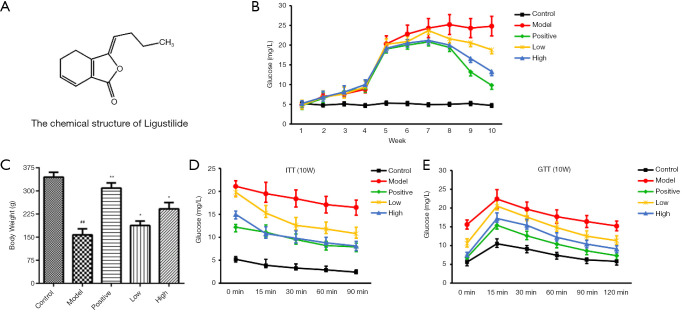
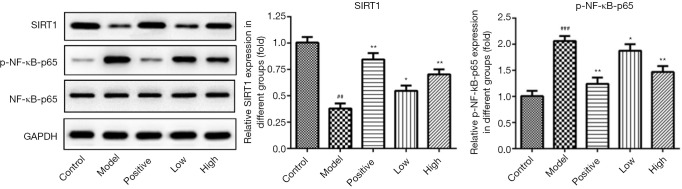
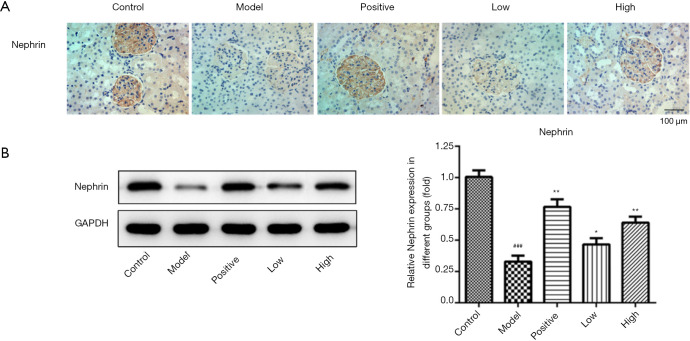
DN rat models (n=10) were induced by streptozotocin (STZ) combined with a high-fat diet. Rats in the LIG group were intragastrically administered with LIG daily for eight weeks, and animals in the positive control group were treated with Losartan potassium. The body weight and blood glucose were checked weekly during the treatment. The pathological changes of kidney tissue were observed with hematoxylin and eosin (HE) staining. Blood lipid profiles and renal function-related markers, including total cholesterol (TC), triglyceride (TG), low-density lipoprotein cholesterol (LDL-C), high-density lipoprotein cholesterol (HDL-C), blood urea nitrogen (BUN), and serum creatinine (Scr) were monitored using a biochemical analyzer. The protein expression of nephrin was determined by immunohistochemistry and Western blotting. Finally, Western blot was used to determine the protein expression of Sirtuin 1 (SIRT1) and nuclear factor-kappa B (NF-κB).
Compared with the healthy control group, rats in the DN group have slower weight gain, increased blood sugar level, renal lesions, and impaired renal function, along with decreased nephrin expression, abnormally activated NF-κB, and inhibited SIRT1 protein expression. All the above conditions were improved after intervention with either losartan potassium or LIG.
LIG attenuates podocyte injury by regulating the SIRT1/NF-κB signaling pathway and thereby exerts its protective effect on renal function in DN rats.
糖尿病肾病(DN)是糖尿病常见的慢性微血管并发症之一,足细胞损伤和功能障碍与DN的发病机制密切相关。研究表明,川芎嗪(LIG)具有抗炎、抗氧化和抗凋亡活性。本研究旨在探讨LIG对DN大鼠的治疗作用及其机制。
采用链脲佐菌素(STZ)联合高脂饮食诱导DN大鼠模型(n = 10)。LIG组大鼠每日灌胃给予LIG,持续8周,阳性对照组动物给予氯沙坦钾治疗。治疗期间每周检查体重和血糖。用苏木精-伊红(HE)染色观察肾组织的病理变化。使用生化分析仪监测血脂谱和肾功能相关指标,包括总胆固醇(TC)、甘油三酯(TG)、低密度脂蛋白胆固醇(LDL-C)、高密度脂蛋白胆固醇(HDL-C)、血尿素氮(BUN)和血清肌酐(Scr)。通过免疫组织化学和蛋白质印迹法测定nephrin的蛋白表达。最后,用蛋白质印迹法测定沉默调节蛋白1(SIRT1)和核因子-κB(NF-κB)的蛋白表达。
与健康对照组相比,DN组大鼠体重增加缓慢,血糖水平升高,肾脏病变,肾功能受损,同时nephrin表达降低,NF-κB异常激活,SIRT1蛋白表达受到抑制。氯沙坦钾或LIG干预后,上述所有情况均得到改善。
LIG通过调节SIRT1/NF-κB信号通路减轻足细胞损伤,从而对DN大鼠的肾功能发挥保护作用。