Habibou Hama Hamadou, Abdoulahi Mahamane Idi Issa, Khalid Ikhiri
Department of Chemistry Faculty of Science and Technology Abdou Moumouni University, BP 10662, Niamey, Niger.
Department of Organic Chemistry Faculty of Science University of Yaoundé I, P.O. Box 812, Yaoundé, Cameroon.
J Trop Med. 2024 Sep 6;2024:1330063. doi: 10.1155/2024/1330063. eCollection 2024.
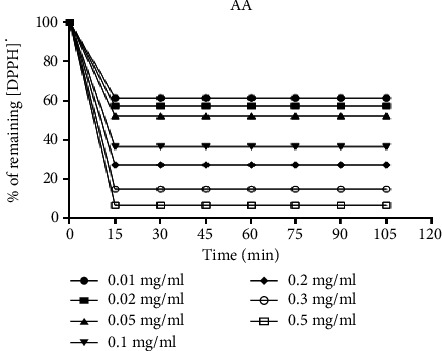
(Fabaceae) is a medicinal plant from the traditional pharmacopeia of Niger used against gastrointestinal disorders and dysentery. This study was designed to assess the anti-, antioxidant activities, and oral acute toxicity of extract root barks of . The crude extracts were prepared by maceration using methanol, ethanol, dichloromethane, water-ethanol (30/70 v/v), and methanol-dichloromethane (1/1 v/v). The anti- activity was performed using the microdilution method coupled with the resazurin-based assay. The antioxidant activity was evaluated by the DPPH (2, 2-diphényl-1-picrylhydrazyl), ABTS 2, 2'-azino-bis (3-ethylbenzothiazoline-6-sulfonic acid), and HO assays. The oral acute toxicity was assessed following the Organization for Economic Cooperation and Development (OECD) guidelines. The extracts displayed activity against the with Minimum Inhibitory Concentrations (MICs) from 500 to 1000 g/mL. The methanolic crude extract of shows good antioxidant activity with the radicals DPPH and ABTS with inhibitory concentration 50 (IC) at 228 and 191 g/mL, respectively. The lethal dose 50 (LD) of extract was up to 2000 mg/kg of body weight, and no signs of toxicity were observed. These findings supported the use of in the traditional treatment of gastrointestinal disorders.
(豆科)是一种来自尼日尔传统药典的药用植物,用于治疗胃肠道疾病和痢疾。本研究旨在评估[植物名称]根皮提取物的抗菌、抗氧化活性及口服急性毒性。通过用甲醇、乙醇、二氯甲烷、水 - 乙醇(30/70 v/v)和甲醇 - 二氯甲烷(1/1 v/v)浸渍来制备粗提取物。抗菌活性采用微量稀释法结合基于刃天青的测定法进行。抗氧化活性通过DPPH(2, 2 - 二苯基 - 1 - 苦基肼)、ABTS 2, 2'- 偶氮 - 双(3 - 乙基苯并噻唑啉 - 6 - 磺酸)和HO测定法进行评估。口服急性毒性按照经济合作与发展组织(OECD)指南进行评估。提取物对[细菌名称]显示出抗菌活性,最低抑菌浓度(MICs)为500至1000 g/mL。[植物名称]的甲醇粗提取物对DPPH和ABTS自由基显示出良好的抗氧化活性,其半数抑制浓度(IC₅₀)分别为228和191 g/mL。提取物的半数致死剂量(LD₅₀)高达2000 mg/kg体重,且未观察到毒性迹象。这些发现支持了[植物名称]在传统胃肠道疾病治疗中的应用。