Takahashi Hideto, Yasumura Seiji, Takahashi Kunihiko, Ohira Tetsuya, Shimura Hiroki, Ohto Hitoshi, Suzuki Satoru, Suzuki Shinichi, Ishikawa Tetsuo, Suzuki Satoshi, Ma Enbo, Nagao Masanori, Yokoya Susumu, Kamiya Kenji
Teikyo Heisei University, Tokyo, Japan.
Radiation Medical Science Center for the Fukushima Health Management Survey, Fukushima Medical University, Fukushima, Japan.
EClinicalMedicine. 2024 Aug 26;75:102722. doi: 10.1016/j.eclinm.2024.102722. eCollection 2024 Sep.
Thyroid ultrasound examinations using a cohort study design (from the Fukushima Health Management Survey [FHMS]) were conducted after the nuclear power plant accident caused by the Great East Japan Earthquake in 2011. This study investigated the association between radiation exposure and the detection of thyroid cancer in children and adolescents.
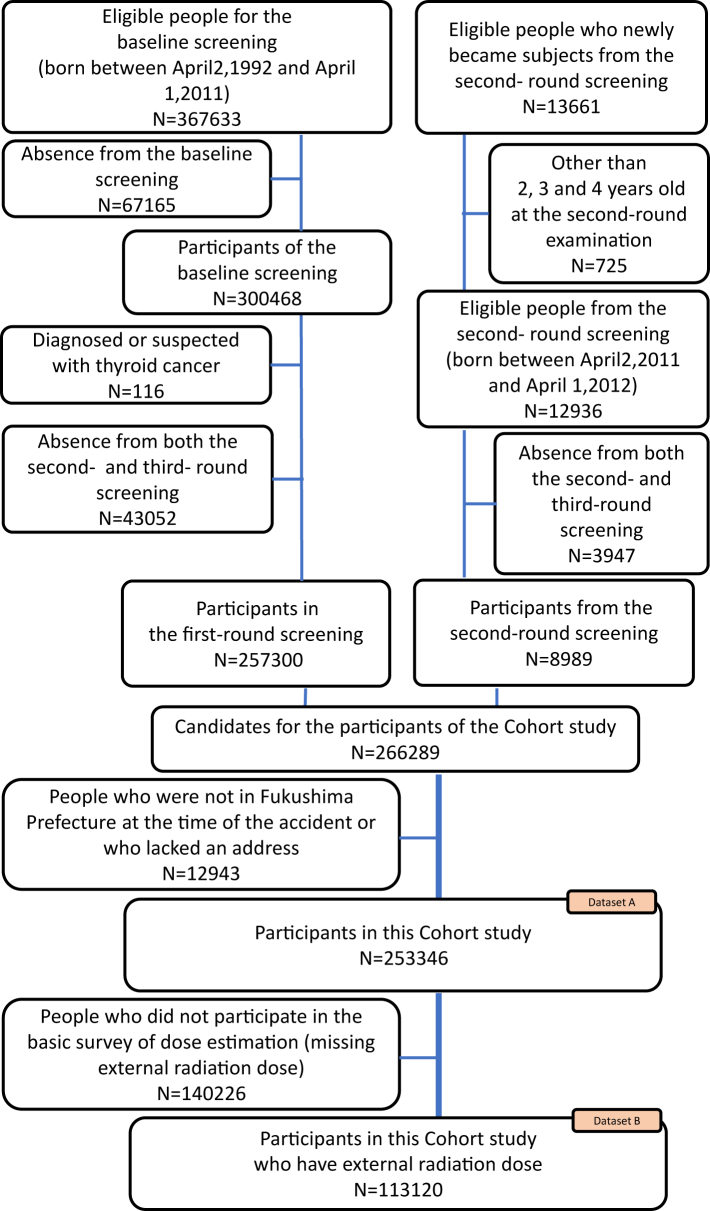
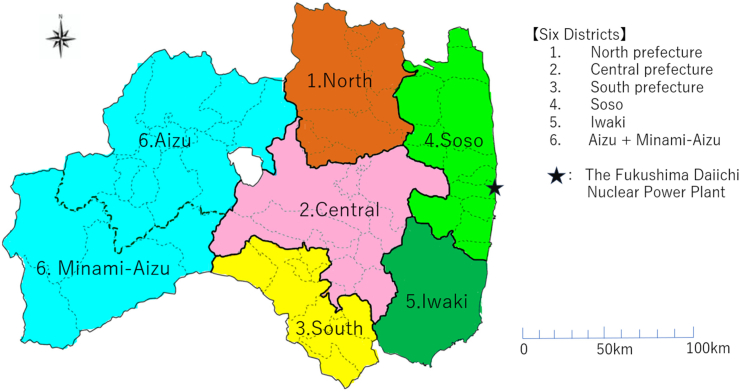
The cohort study has been conducted in Fukushima prefecture in Japan since 2011. The primary outcome was the external dose. We enrolled 253346 examinees who lived in Fukushima at the time of the accident (Dataset A), including 113120 examinees who had data on external radiation exposure (ERE) (Dataset B). The median dose in the examinee's district was used for missing dose. The association between ERE and detection of thyroid cancer or suspected thyroid cancer was analyzed using Poisson regressions with two types of explanatory variables: sex, age, overweight status, and district (Model 1), and past medical history, family history of thyroid cancer, frequency of seafood consumption, and frequency of seaweed consumption in addition to Model 1 (Model 2).
During the second and third rounds of examinations, a total of 97 thyroid patients were detected, for a detection rate of 10.328 [ ] (95% confidence interval: 8.464-12.602 [ ]). Multivariate Poisson regression showed that the detection rate ratio of the ERE (1+ mSv) to <1 (mSv) was 1.577 (0.715-3.394) in Model 1 and 1.596 (0.726-3.512) in Model 2, for Dataset A; and 1.677 (0.746-3.773) in Model 1 and 1.669 (0.743-3.748) in Model 2, for Dataset B.
Our study showed no association between radiation exposure with extremely low dose which were more than 99.9% of all the exposure was less than 5 mSv, and thyroid cancer detection, when the follow-up period was an average of 3.7 years at the present, using the cohort study design.
The National Health Fund for Children and Adults Affected by Nuclear Incidents in Japan.
在2011年东日本大地震引发核电站事故后,采用队列研究设计(来自福岛健康管理调查[FHMS])对甲状腺进行了超声检查。本研究调查了辐射暴露与儿童及青少年甲状腺癌检出之间的关联。
自2011年起在日本福岛县开展队列研究。主要结局是外照射剂量。我们纳入了事故发生时居住在福岛的253346名受检者(数据集A),其中包括113120名有外照射辐射暴露(ERE)数据的受检者(数据集B)。受检者所在地区的中位剂量用于缺失剂量。使用泊松回归分析ERE与甲状腺癌或疑似甲状腺癌检出之间的关联,解释变量有两种类型:性别、年龄、超重状况和地区(模型1),以及除模型1的变量外,既往病史、甲状腺癌家族史、海鲜食用频率和海藻食用频率(模型2)。
在第二轮和第三轮检查中,共检测出97例甲状腺患者,检出率为10.328[ ](95%置信区间:8.464 - 12.602[ ])。多变量泊松回归显示,对于数据集A,ERE(1 + 毫希伏)与<1(毫希伏)的检出率比在模型1中为1.577(0.715 - 3.394),在模型2中为1.596(0.726 - 3.512);对于数据集B,在模型1中为1.677(0.746 - 3.773),在模型2中为1.669(0.743 - 3.748)。
我们的研究表明,在目前平均随访期为3.7年的情况下,采用队列研究设计,极低剂量辐射暴露(所有暴露中超过99.9%小于5毫希伏)与甲状腺癌检出之间无关联。
日本国家儿童和成人核事故健康基金。