Radiation Medical Science Center for the Fukushima Health Management Survey, Fukushima, Japan.
J Epidemiol. 2012;22(5):375-83. doi: 10.2188/jea.je20120105. Epub 2012 Aug 25.
The accidents that occurred at the Fukushima Daiichi Nuclear Power Plant after the Great East Japan Earthquake on 11 March 2011 have resulted in long-term, ongoing anxiety among the residents of Fukushima, Japan. Soon after the disaster, Fukushima Prefecture launched the Fukushima Health Management Survey to investigate long-term low-dose radiation exposure caused by the accident. Fukushima Medical University took the lead in planning and implementing this survey. The primary purposes of this survey are to monitor the long-term health of residents, promote their future well-being, and confirm whether long-term low-dose radiation exposure has health effects. This report describes the rationale and implementation of the Fukushima Health Management Survey.
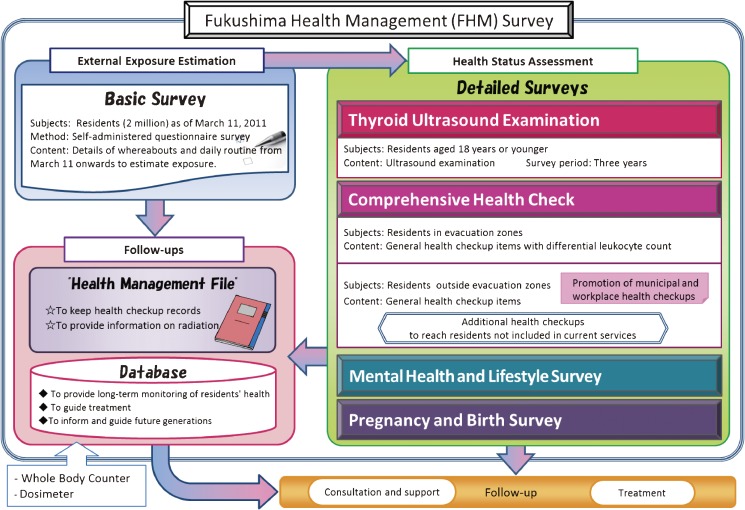
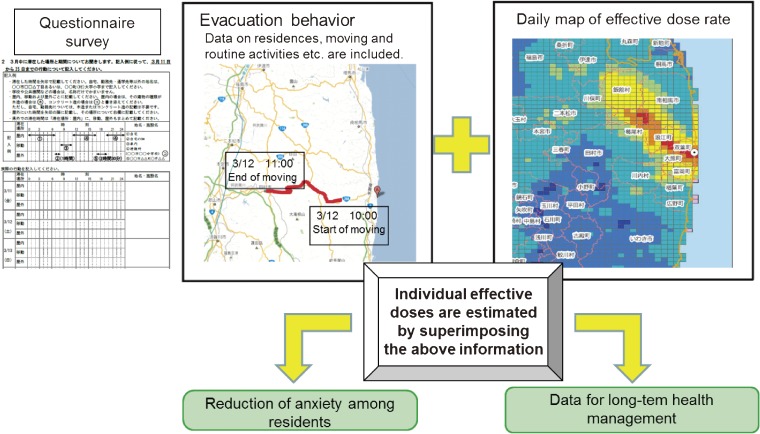
This cohort study enrolled all people living in Fukushima Prefecture after the earthquake and comprises a basic survey and 4 detailed surveys. The basic survey is to estimate levels of external radiation exposure among all 2.05 million residents. It should be noted that internal radiation levels were estimated by Fukushima Prefecture using whole-body counters. The detailed surveys comprise a thyroid ultrasound examination for all Fukushima children aged 18 years or younger, a comprehensive health check for all residents from the evacuation zones, an assessment of mental health and lifestyles of all residents from the evacuation zones, and recording of all pregnancies and births among all women in the prefecture who were pregnant on 11 March. All data have been entered into a database and will be used to support the residents and analyze the health effects of radiation.
The low response rate (<30%) to the basic survey complicates the estimation of health effects. There have been no cases of malignancy to date among 38 114 children who received thyroid ultrasound examinations. The importance of mental health care was revealed by the mental health and lifestyle survey and the pregnancy and birth survey. This long-term large-scale epidemiologic study is expected to provide valuable data in the investigation of the health effects of low-dose radiation and disaster-related stress.
2011 年 3 月 11 日东日本大地震后,福岛第一核电站发生事故,导致日本福岛县居民长期持续感到焦虑。灾难发生后不久,福岛县就启动了福岛健康管理调查,以调查事故造成的长期低剂量辐射暴露。福岛医科大学率先规划并实施了这项调查。该调查的主要目的是监测居民的长期健康状况,促进他们的未来福祉,并确认长期低剂量辐射暴露是否对健康有影响。本报告介绍了福岛健康管理调查的基本原理和实施情况。
这项队列研究纳入了地震后居住在福岛县的所有人,包括基本调查和 4 项详细调查。基本调查旨在估算所有 205 万居民的外照射水平。需要注意的是,福岛县使用全身计数器估算内照射水平。详细调查包括对所有 18 岁以下的福岛儿童进行甲状腺超声检查,对所有撤离区居民进行全面健康检查,评估所有撤离区居民的心理健康和生活方式,以及记录福岛县所有在 3 月 11 日怀孕的妇女的所有妊娠和分娩情况。所有数据均已输入数据库,将用于支持居民,并分析辐射对健康的影响。
基本调查的低应答率(<30%)使健康影响的估计变得复杂。截至目前,在接受甲状腺超声检查的 38114 名儿童中,尚未发现恶性肿瘤病例。心理健康和生活方式调查以及妊娠和分娩调查揭示了心理健康护理的重要性。这项长期的大规模流行病学研究有望提供有价值的数据,以调查低剂量辐射和与灾害相关的应激对健康的影响。