Bayisa Gobena Dirirsa, Ayana Mekonen, Mekonnen Boja, Hordofa Tilahun, Dinka Megersa Olumana
Adama Science and Technology University, Department of Water Resources Engineering, Adama, Ethiopia.
Ethiopian Institute of Agricultural Research, Melkassa Research Center, Adama, Ethiopia.
Heliyon. 2024 Aug 27;10(17):e36969. doi: 10.1016/j.heliyon.2024.e36969. eCollection 2024 Sep 15.
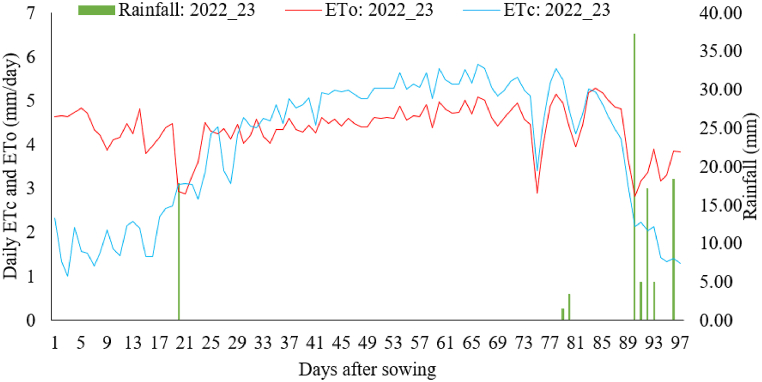
In view of the changing climate and growing global food demand, efficient water management is crucial for sustainable agriculture. Accurate measurement of evapotranspiration is essential for determining crop water demand and consequently for designing and managing irrigation systems. This study, conducted at Melkassa Agricultural Research Center in Ethiopia, utilized a drainage lysimeter to investigate the water requirements and crop coefficients of the Kingbird wheat variety during the December to March cropping season in 2021/22 and 2022/23. The experiment involved planting Kingbird wheat both inside and outside the lysimeter and irrigating using a watering can. Neutron probe measurement monitored the water balance in the soil. The study determined an average crop evapotranspiration of 427.28 mm and a reference evapotranspiration of 471.30 mm indicating a water requirement of 4273 m³ to fully grow wheat on a hectare of land. The derived average crop coefficient values were 0.43, 0.93, 1.15, and 0.30 for the initial, mid-season, and end growth stages, respectively. Furthermore, a fifth-order polynomial function was developed to predict crop coefficient values based on days after sowing. The findings provide valuable insights for enhancing the design and management of irrigated wheat production in the region. The specific crop coefficient values determined for different growth stages are crucial for optimizing irrigation scheduling and improving water-use efficiency, contributing to sustainable wheat production in semi-arid environment.
鉴于气候变化和全球粮食需求不断增长,高效的水资源管理对可持续农业至关重要。准确测量蒸散量对于确定作物需水量,进而设计和管理灌溉系统至关重要。本研究在埃塞俄比亚的梅尔卡萨农业研究中心进行,利用排水蒸渗仪调查了2021/22年和2022/23年12月至3月种植季节金莺小麦品种的需水量和作物系数。实验包括在蒸渗仪内外种植金莺小麦,并使用喷壶进行灌溉。中子探针测量监测了土壤中的水平衡。该研究确定平均作物蒸散量为427.28毫米,参考蒸散量为471.30毫米,这表明在一公顷土地上完全种植小麦需要4273立方米的水。得出的初始、中期和末期生长阶段的平均作物系数值分别为0.43、0.93和1.15,末期为0.30。此外,还开发了一个五次多项式函数,根据播种后天数预测作物系数值。这些发现为改进该地区灌溉小麦生产的设计和管理提供了有价值的见解。为不同生长阶段确定的特定作物系数值对于优化灌溉计划和提高用水效率至关重要,有助于半干旱环境下的可持续小麦生产。