Kho Pik Fang, Stell Laurel, Jimenez Shirin, Zanetti Daniela, Panyard Daniel J, Watson Kathleen L, Sarraju Ashish, Chen Ming-Li, Lind Lars, Petrie John R, Chan Khin N, Fonda Holly, Kent Kyla, Myers Jonathan N, Palaniappan Latha, Abbasi Fahim, Assimes Themistocles L
Department of Medicine, Division of Cardiovascular Medicine, Stanford University School of Medicine, Stanford, CA, USA.
VA Palo Alto Healthcare System, Palo Alto, CA, USA.
medRxiv. 2024 Sep 7:2024.09.06.24313199. doi: 10.1101/2024.09.06.24313199.
South Asians (SAs) may possess a unique predisposition to insulin resistance (IR). We explored this possibility by investigating the relationship between 'gold standard' measures of adiposity, fitness, selected proteomic biomarkers, and insulin sensitivity among a cohort of SAs and Europeans (EURs).
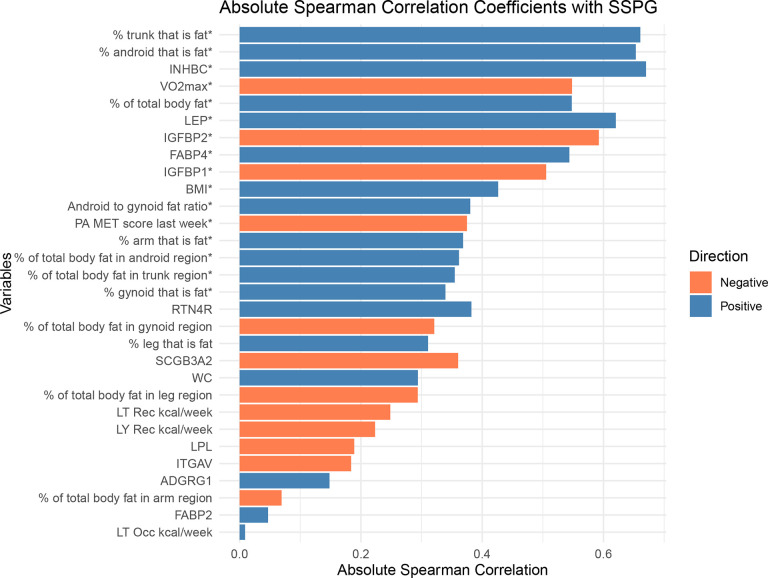
A total of 46 SAs and 41 EURs completed 'conventional' (lifestyle questionnaires, standard physical exam) as well as 'gold standard' (dual energy X-ray absorptiometry scan, cardiopulmonary exercise test, and insulin suppression test) assessments of adiposity, fitness, and insulin sensitivity. In a subset of 28 SAs and 36 EURs, we also measured the blood-levels of eleven IR-related proteins. We conducted Spearman correlation to identify correlates of steady-state plasma glucose (SSPG) derived from the insulin suppression test, followed by multivariable linear regression analyses of SSPG, adjusting for age, sex and ancestral group.
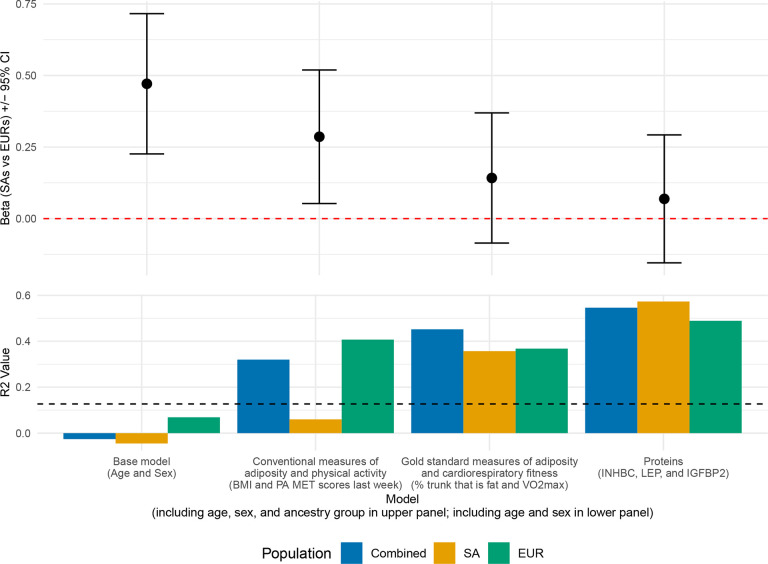
Sixteen of 30 measures significantly associated with SSPG, including one conventional and eight gold standard measures of adiposity, one conventional and one gold standard measure of fitness, and five proteins. Multivariable regressions revealed that gold standard measures and plasma proteins attenuated ancestral group differences in IR, suggesting their potential utility in assessing IR, especially among SAs.
Ancestral group differences in IR may be explained by accurate measures of adiposity and fitness, with specific proteins possibly serving as useful surrogates for these measures, particularly for SAs.
南亚人(SAs)可能具有独特的胰岛素抵抗(IR)易感性。我们通过研究一组南亚人和欧洲人(EURs)中肥胖、健康状况、选定的蛋白质组学生物标志物与胰岛素敏感性的“金标准”测量之间的关系,来探讨这种可能性。
共有46名南亚人和41名欧洲人完成了对肥胖、健康状况和胰岛素敏感性的“常规”(生活方式问卷、标准体格检查)以及“金标准”(双能X线吸收法扫描、心肺运动试验和胰岛素抑制试验)评估。在28名南亚人和36名欧洲人的子集中,我们还测量了11种与IR相关蛋白质的血液水平。我们进行Spearman相关性分析以确定胰岛素抑制试验得出的稳态血浆葡萄糖(SSPG)的相关因素,随后对SSPG进行多变量线性回归分析,并对年龄、性别和祖先群体进行校正。
30项测量中有16项与SSPG显著相关,包括一项肥胖的常规测量和八项金标准测量、一项健康状况的常规测量和一项金标准测量以及五种蛋白质。多变量回归显示,金标准测量和血浆蛋白减弱了祖先群体在IR方面的差异,表明它们在评估IR方面具有潜在效用,尤其是在南亚人中。
IR的祖先群体差异可能由肥胖和健康状况的准确测量来解释,特定蛋白质可能作为这些测量的有用替代指标,特别是对于南亚人。