• 文献检索
  • 文档翻译
  • 深度研究
  • 学术资讯
  • Suppr Zotero 插件Zotero 插件
  • 邀请有礼
  • 套餐&价格
  • 历史记录
应用&插件
Suppr Zotero 插件Zotero 插件浏览器插件Mac 客户端Windows 客户端微信小程序
定价
高级版会员购买积分包购买API积分包
服务
文献检索文档翻译深度研究API 文档MCP 服务
关于我们
关于 Suppr公司介绍联系我们用户协议隐私条款
关注我们

Suppr 超能文献

核心技术专利:CN118964589B侵权必究
粤ICP备2023148730 号-1Suppr @ 2026

文献检索

告别复杂PubMed语法,用中文像聊天一样搜索,搜遍4000万医学文献。AI智能推荐,让科研检索更轻松。

立即免费搜索

文件翻译

保留排版,准确专业,支持PDF/Word/PPT等文件格式,支持 12+语言互译。

免费翻译文档

深度研究

AI帮你快速写综述,25分钟生成高质量综述,智能提取关键信息,辅助科研写作。

立即免费体验

唐氏综合征相关先天性心脏缺陷的全基因组关联研究。

Genome-wide association studies of Down syndrome associated congenital heart defects.

作者信息

Feldman Elizabeth R, Li Yunqi, Cutler David J, Rosser Tracie C, Wechsler Stephanie B, Sanclemente Lauren, Rachubinski Angela L, Elliott Natalina, Vyas Paresh, Roberts Irene, Rabin Karen R, Wagner Michael, Gelb Bruce D, Espinosa Joaquin M, Lupo Philip J, de Smith Adam J, Sherman Stephanie L, Leslie Elizabeth J

机构信息

Department of Human Genetics, Emory University School of Medicine, Atlanta, GA, 30322.

Center for Genetic Epidemiology, Keck School of Medicine of University of Southern California, Los Angeles, CA.

出版信息

medRxiv. 2024 Sep 6:2024.09.06.24313183. doi: 10.1101/2024.09.06.24313183.

DOI:10.1101/2024.09.06.24313183
PMID:39281767
原文链接:https://pmc.ncbi.nlm.nih.gov/articles/PMC11398599/
Abstract

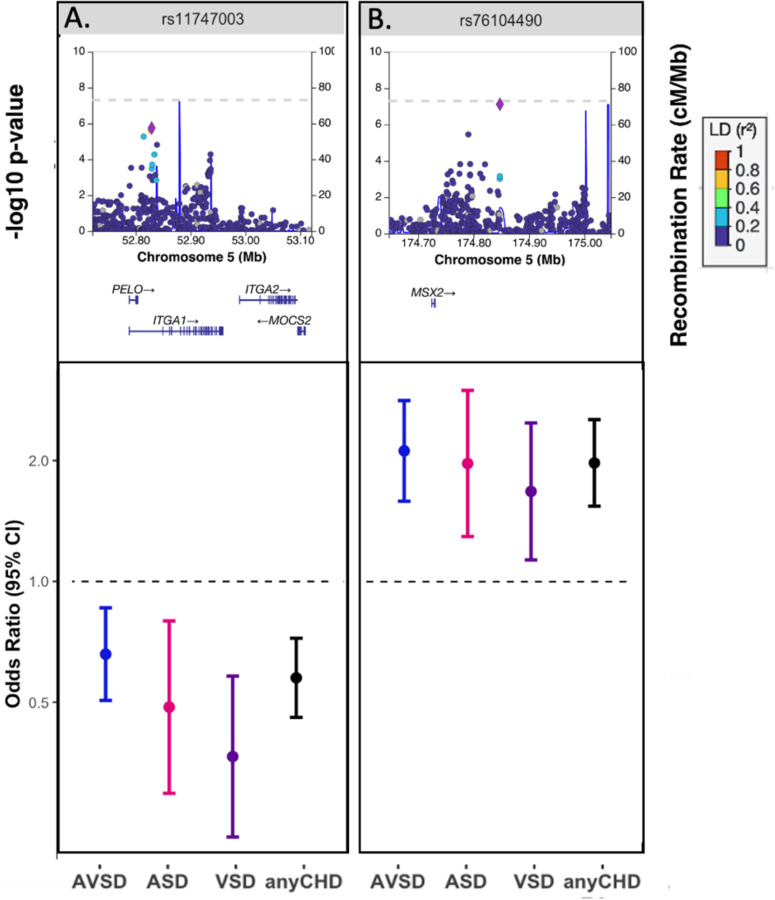
Congenital heart defects (CHDs) are the most common structural birth defect and are present in 40-50% of children born with Down syndrome (DS). To characterize the genetic architecture of DS-associated CHD, we sequenced genomes of a multiethnic group of children with DS and a CHD (n=886: atrioventricular septal defects (AVSD), n=438; atrial septal defects (ASD), n=122; ventricular septal defects (VSD), n=170; other types of CHD, n=156) and DS with a structurally normal heart (DS+NH, n=572). We performed four GWAS for common variants (MAF>0.05) comparing DS with CHD, stratified by CHD-subtype, to DS+NH controls. Although no SNP achieved genome-wide significance, multiple loci in each analysis achieved suggestive significance (p<2×10). Of these, the 1p35.1 locus (near ) was specifically associated with ASD risk and the 5q35.2 locus (near ) was associated with any type of CHD. Each of the suggestive loci contained one or more plausible candidate genes expressed in the developing heart. While no SNP replicated (p<2×10) in an independent cohort of DS+CHD (DS+CHD: n=229; DS+NH: n=197), most SNPs that were suggestive in our GWASs remained suggestive when meta-analyzed with the GWASs from the replication cohort. These results build on previous work to identify genetic modifiers of DS-associated CHD.

摘要

先天性心脏病(CHD)是最常见的结构性出生缺陷,在唐氏综合征(DS)患儿中,40%-50%存在该疾病。为了描述与DS相关的CHD的遗传结构,我们对一组多民族的患有DS和CHD的儿童(n=886:房室间隔缺损(AVSD),n=438;房间隔缺损(ASD),n=122;室间隔缺损(VSD),n=170;其他类型的CHD,n=156)以及心脏结构正常的DS患儿(DS+NH,n=572)的基因组进行了测序。我们针对常见变异(MAF>0.05)进行了四项全基因组关联研究(GWAS),将患有CHD的DS患儿按CHD亚型分层后与DS+NH对照组进行比较。尽管没有单核苷酸多态性(SNP)达到全基因组显著性水平,但每项分析中的多个位点达到了提示性显著性水平(p<2×10)。其中,1p35.1位点(靠近 )与ASD风险特异性相关,5q35.2位点(靠近 )与任何类型的CHD相关。每个提示性位点都包含一个或多个在发育中的心脏中表达的合理候选基因。虽然没有SNP在一个独立的DS+CHD队列(DS+CHD:n=229;DS+NH:n=197)中得到重复验证(p<2×10),但在我们的GWAS中具有提示性的大多数SNP在与复制队列的GWAS进行荟萃分析时仍具有提示性。这些结果建立在先前工作的基础上,以确定与DS相关的CHD的遗传修饰因子。
https://cdn.ncbi.nlm.nih.gov/pmc/blobs/3883/11398599/588deebb1059/nihpp-2024.09.06.24313183v1-f0004.jpg
https://cdn.ncbi.nlm.nih.gov/pmc/blobs/3883/11398599/7d8da7947e3d/nihpp-2024.09.06.24313183v1-f0001.jpg
https://cdn.ncbi.nlm.nih.gov/pmc/blobs/3883/11398599/317962120a76/nihpp-2024.09.06.24313183v1-f0002.jpg
https://cdn.ncbi.nlm.nih.gov/pmc/blobs/3883/11398599/eec0866b85a3/nihpp-2024.09.06.24313183v1-f0003.jpg
https://cdn.ncbi.nlm.nih.gov/pmc/blobs/3883/11398599/588deebb1059/nihpp-2024.09.06.24313183v1-f0004.jpg
https://cdn.ncbi.nlm.nih.gov/pmc/blobs/3883/11398599/7d8da7947e3d/nihpp-2024.09.06.24313183v1-f0001.jpg
https://cdn.ncbi.nlm.nih.gov/pmc/blobs/3883/11398599/317962120a76/nihpp-2024.09.06.24313183v1-f0002.jpg
https://cdn.ncbi.nlm.nih.gov/pmc/blobs/3883/11398599/eec0866b85a3/nihpp-2024.09.06.24313183v1-f0003.jpg
https://cdn.ncbi.nlm.nih.gov/pmc/blobs/3883/11398599/588deebb1059/nihpp-2024.09.06.24313183v1-f0004.jpg

相似文献

1
Genome-wide association studies of Down syndrome associated congenital heart defects.唐氏综合征相关先天性心脏缺陷的全基因组关联研究。
medRxiv. 2024 Sep 6:2024.09.06.24313183. doi: 10.1101/2024.09.06.24313183.
2
Genome-Wide Association Studies of Down Syndrome Associated Congenital Heart Defects Suggests a Genetically Heterogeneous Risk for CHD in DS.唐氏综合征相关先天性心脏病的全基因组关联研究表明,唐氏综合征患者患先天性心脏病存在基因异质性风险。
Genet Epidemiol. 2025 Jun;49(4):e70010. doi: 10.1002/gepi.70010.
3
Sex differences for major congenital heart defects in Down Syndrome: A population based study.唐氏综合征主要先天性心脏缺陷的性别差异:一项基于人群的研究。
Eur J Med Genet. 2018 Sep;61(9):546-550. doi: 10.1016/j.ejmg.2018.05.013. Epub 2018 May 9.
4
Survival analysis of Down syndrome with congenital heart disease: a 5-years registry at QSNICH.唐氏综合征合并先天性心脏病的生存分析:QSNICH的5年登记研究
J Med Assoc Thai. 2014 Jun;97 Suppl 6:S108-14.
5
The complex SNP and CNV genetic architecture of the increased risk of congenital heart defects in Down syndrome.唐氏综合征先天性心脏缺陷风险增加的复杂 SNP 和 CNV 遗传结构。
Genome Res. 2013 Sep;23(9):1410-21. doi: 10.1101/gr.147991.112. Epub 2013 Jun 19.
6
Maternal risk factors for congenital heart defects in infants with Down syndrome from Western Mexico.墨西哥西部地区唐氏综合征患儿先天性心脏病的母体危险因素
Am J Med Genet A. 2019 Sep;179(9):1857-1865. doi: 10.1002/ajmg.a.61300. Epub 2019 Jul 19.
7
Down syndrome and associated atrioventricular septal defects in a nationwide Norwegian cohort: Prevalence, time trends, and outcomes.在挪威全国性队列中,唐氏综合征与相关的房室间隔缺损:患病率、时间趋势和结局。
Acta Obstet Gynecol Scand. 2024 Oct;103(10):2024-2030. doi: 10.1111/aogs.14932. Epub 2024 Aug 5.
8
Spectrum of congenital heart defects associated with Down Syndrome in high consanguineous Omani population.阿曼高近亲结婚人群中与唐氏综合征相关的先天性心脏缺陷谱。
Indian Pediatr. 2003 May;40(5):398-403.
9
Congenital Heart Defect and Pulmonary Hypertension in Children With Down Syndrome: Clinical Profile Over Two Decades.唐氏综合征患儿的先天性心脏病与肺动脉高压:二十年临床概况
Cureus. 2021 Feb 7;13(2):e13212. doi: 10.7759/cureus.13212.
10
An Analysis of Hospital Mortality After Cardiac Operations in Children With Down Syndrome.唐氏综合征患儿心脏手术后的医院死亡率分析。
Semin Thorac Cardiovasc Surg. 2020;32(4):947-957. doi: 10.1053/j.semtcvs.2020.06.037. Epub 2020 Jul 2.

本文引用的文献

1
Epigenomic signature of major congenital heart defects in newborns with Down syndrome.唐氏综合征新生儿中主要先天性心脏缺陷的表观基因组特征。
Hum Genomics. 2023 Oct 6;17(1):92. doi: 10.1186/s40246-023-00540-1.
2
Neuron navigator 3 (NAV3) is required for heart development in zebrafish.神经元导航器 3(NAV3)是斑马鱼心脏发育所必需的。
Fish Physiol Biochem. 2022 Feb;48(1):173-183. doi: 10.1007/s10695-022-01049-5. Epub 2022 Jan 18.
3
A change of heart: new roles for cilia in cardiac development and disease.心动改变:纤毛在心脏发育和疾病中的新作用。
Nat Rev Cardiol. 2022 Apr;19(4):211-227. doi: 10.1038/s41569-021-00635-z. Epub 2021 Dec 3.
4
The Role of Centrosome Distal Appendage Proteins (DAPs) in Nephronophthisis and Ciliogenesis.中心体远端附属蛋白(DAPs)在肾单位纤毛病和纤毛发生中的作用。
Int J Mol Sci. 2021 Nov 12;22(22):12253. doi: 10.3390/ijms222212253.
5
A ciliopathy complex builds distal appendages to initiate ciliogenesis.纤毛病复合物构建远端附属物以启动纤毛发生。
J Cell Biol. 2021 Sep 6;220(9). doi: 10.1083/jcb.202011133. Epub 2021 Jul 9.
6
Congenital heart disease risk loci identified by genome-wide association study in European patients.全基因组关联研究在欧洲患者中鉴定出的先天性心脏病风险基因座。
J Clin Invest. 2021 Jan 19;131(2). doi: 10.1172/JCI141837.
7
Epigenomic and Transcriptomic Dynamics During Human Heart Organogenesis.人类心脏发生过程中的表观基因组和转录组动态
Circ Res. 2020 Oct 9;127(9):e184-e209. doi: 10.1161/CIRCRESAHA.120.316704. Epub 2020 Aug 9.
8
Primary cilia regulate hematopoietic stem and progenitor cell specification through Notch signaling in zebrafish.初级纤毛通过 Notch 信号调节斑马鱼造血干/祖细胞的特化。
Nat Commun. 2019 Apr 23;10(1):1839. doi: 10.1038/s41467-019-09403-7.
9
Microtubule asters anchored by FSD1 control axoneme assembly and ciliogenesis.FSD1 锚定的微管星体控制轴丝组装和纤毛发生。
Nat Commun. 2018 Dec 11;9(1):5277. doi: 10.1038/s41467-018-07664-2.
10
Analysis of Copy Number Variants on Chromosome 21 in Down Syndrome-Associated Congenital Heart Defects.唐氏综合征相关先天性心脏病中21号染色体拷贝数变异的分析
G3 (Bethesda). 2018 Jan 4;8(1):105-111. doi: 10.1534/g3.117.300366.