
非小细胞肺癌免疫治疗后出现混合反应的疾病进展
Progressive Disease with Mixed Response After Immunotherapy in Non-Small Cell Lung Cancer.
作者信息
Lv Juncai, Yan Weiwei, Zhang Ran, Chen Xi, Ren Ziyuan, Chen Dawei, Yu Jinming
机构信息
Department of Radiation Oncology and Shandong Provincial Key Laboratory of Precision Oncology, Shandong Cancer Hospital and Institute, Shandong First Medical University and Shandong Academy of Medical Sciences, Jinan, Shandong, People's Republic of China.
Cheeloo College of Medicine, Shandong University Cancer Center, Jinan, Shandong, People's Republic of China.
出版信息
J Inflamm Res. 2024 Sep 11;17:6317-6327. doi: 10.2147/JIR.S477244. eCollection 2024.
PURPOSE
There exists a dearth of research concerning non-small cell lung cancer (NSCLC) patients experiencing overall progressive disease concomitant with shrinking lesions after immunotherapy. This is a special type of mixed response. We aim to evaluate the clinical characteristics and treatment options of these patients during immunotherapy.
PATIENTS AND METHODS
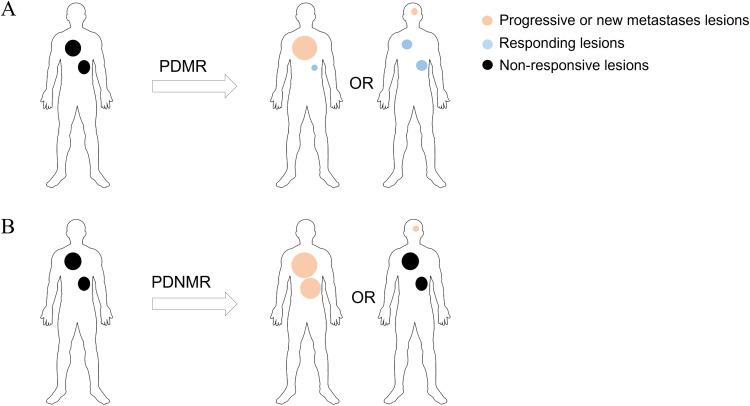
We categorized patients into two groups: Progressive Disease with Mixed Responses (PDMR) (n = 31) and Progressive Disease with None Mixed Responses (PDNMR) (n = 144), depending on whether at least one target lesion had shrunk by ≥30% at the point of overall progression. Computed tomography scans and magnetic resonance imaging were utilized to evaluate the clinicopathological significance of these patients, and a multivariate analysis was conducted to scrutinize the clinical characteristics and prognosis-influencing factors in these patients.
RESULTS
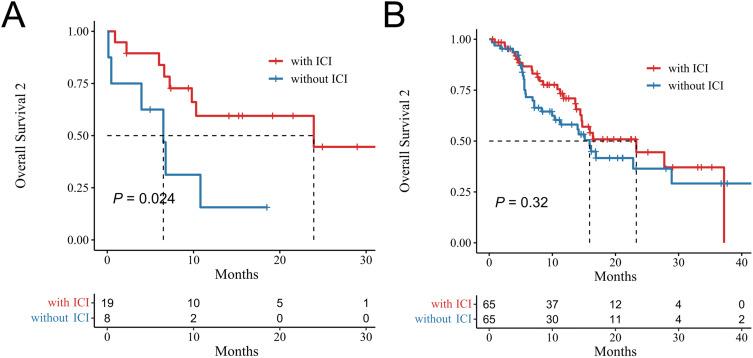
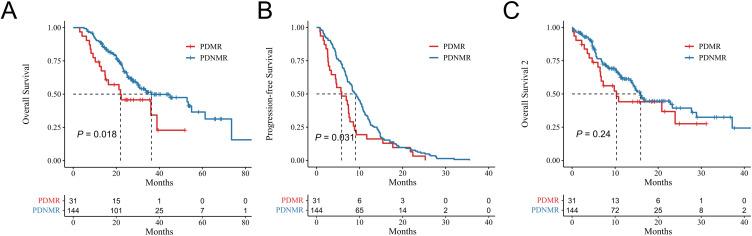
Patients in the PDMR group had worse staging and a greater proportion of previous radiotherapy. The median overall survival (mOS 22 vs 36.4 months; 0.019) and median progression-free survival (mPFS 5.83 vs 9.03 months; 0.031) of the PDMR group were shorter than PDNMR group. Longer subsequent OS with continued immunotherapy after PDMR compared with patients who do not continue with immunization after PDMR (mOS 23.9 vs 6.5 months; = 0.024).
CONCLUSION
PDMR was primarily observed in stage IV patients and previously irradiated patients. OS and PFS were inferior in patients with PDMR compared to patients with PDNMR. The continuation of immunotherapy in PDMR patients could extend their survival.
目的
关于非小细胞肺癌(NSCLC)患者在免疫治疗后出现整体疾病进展同时病变缩小的研究匮乏。这是一种特殊类型的混合反应。我们旨在评估这些患者在免疫治疗期间的临床特征和治疗选择。
患者与方法
根据在整体疾病进展时至少有一个靶病灶缩小≥30%,将患者分为两组:混合反应性疾病进展(PDMR)组(n = 31)和无混合反应性疾病进展(PDNMR)组(n = 144)。利用计算机断层扫描和磁共振成像评估这些患者的临床病理意义,并进行多因素分析以审查这些患者的临床特征和预后影响因素。
结果
PDMR组患者分期更差,既往接受放疗的比例更高。PDMR组的中位总生存期(mOS 22对36.4个月;P = 0.019)和中位无进展生存期(mPFS 5.83对9.03个月;P = 0.031)均短于PDNMR组。与PDMR后不继续免疫治疗的患者相比,PDMR后继续免疫治疗的患者后续总生存期更长(mOS 23.9对6.5个月;P = 0.024)。
结论
PDMR主要见于IV期患者和既往接受过放疗的患者。与PDNMR患者相比,PDMR患者的总生存期和无进展生存期较差。PDMR患者继续免疫治疗可延长生存期。
 Zotero 插件