Yuan Yue, Ye Xiangyu, Cui Jian, Zhang Junyang, Wang Zhaoxiang
Zhejiang Lab, Hangzhou, China.
Key Laboratory for Biomedical Engineering of Ministry of Education, College of Biomedical Engineering and Instrument Science, Zhejiang University, Hangzhou, China.
Front Comput Neurosci. 2024 Aug 30;18:1388224. doi: 10.3389/fncom.2024.1388224. eCollection 2024.
Electrical stimulation of the brain has shown promising prospects in treating various brain diseases. Although biphasic pulse stimulation remains the predominant clinical approach, there has been increasing interest in exploring alternative stimulation waveforms, such as sinusoidal stimulation, to improve the effectiveness of brain stimulation and to expand its application to a wider range of brain disorders. Despite this growing attention, the effects of sinusoidal stimulation on neurons, especially on their nonlinear firing characteristics, remains unclear.
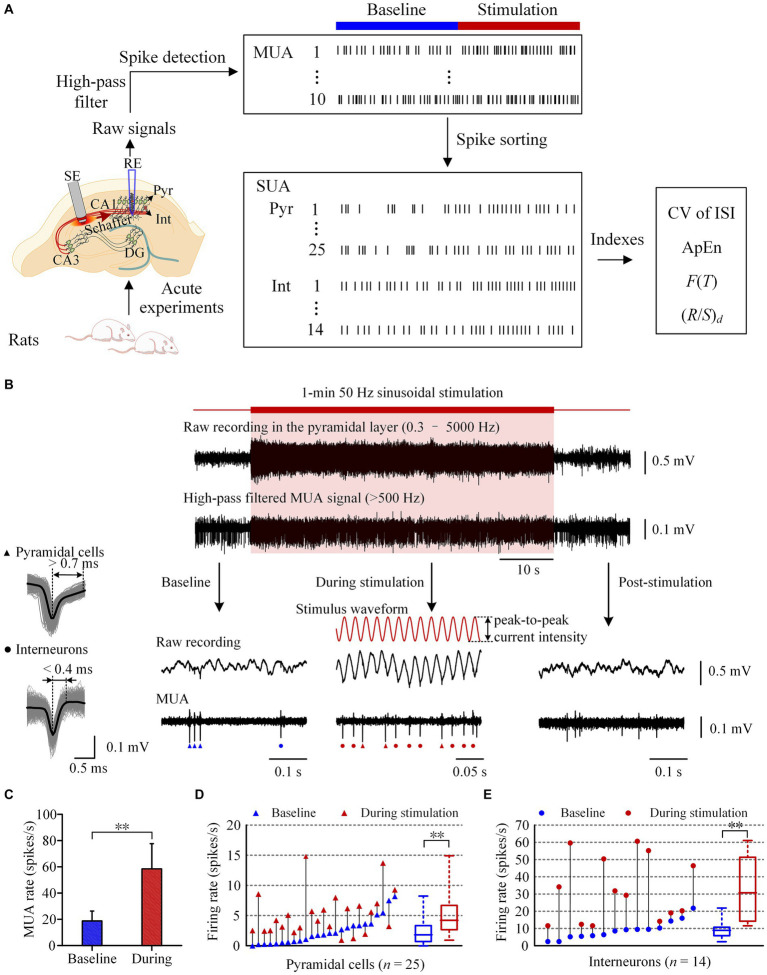
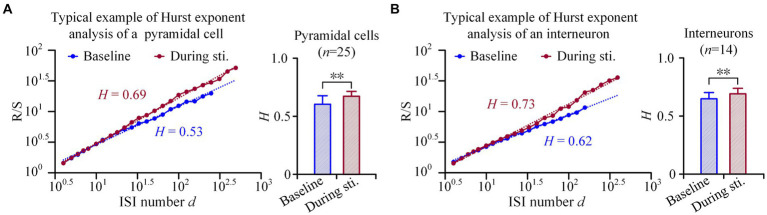
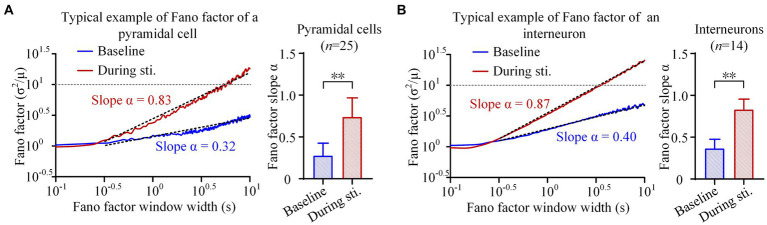
To address the question, 50 Hz sinusoidal stimulation was applied on Schaffer collaterals of the rat hippocampal CA1 region . Single unit activity of both pyramidal cells and interneurons in the downstream CA1 region was recorded and analyzed. Two fractal indexes, namely the Fano factor and Hurst exponent, were used to evaluate changes in the long-range correlations, a manifestation of nonlinear dynamics, in spike sequences of neuronal firing.
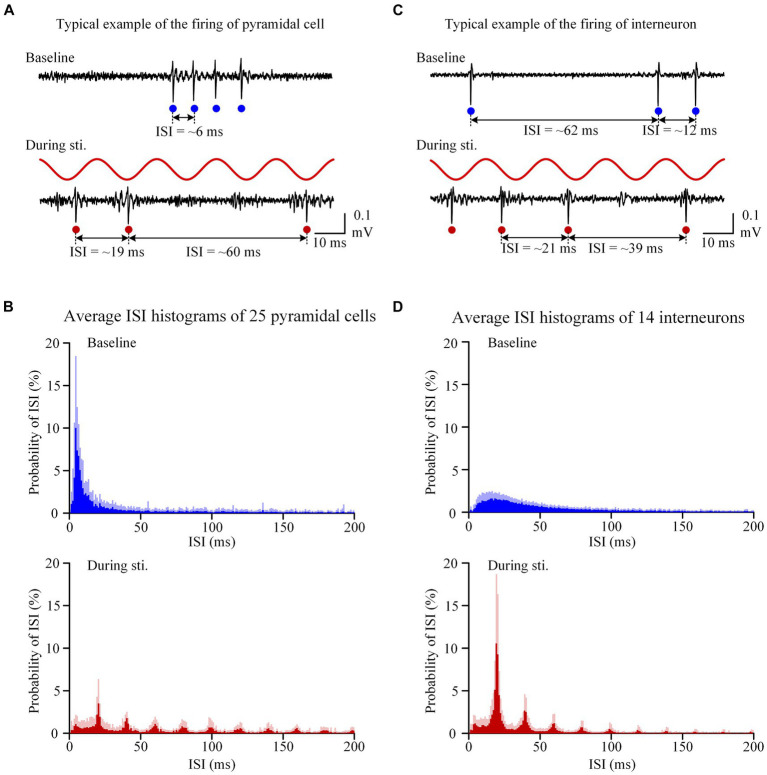
The results demonstrate that sinusoidal electrical stimulation increased the firing rates of both pyramidal cells and interneurons, as well as altered their firing to stimulation-related patterns. Importantly, the sinusoidal stimulation increased, rather than decreased the scaling exponents of both Fano factor and Hurst exponent, indicating an increase in the long-range correlations of both pyramidal cells and interneurons.
The results firstly reported that periodic sinusoidal stimulation without long-range correlations can increase the long-range correlations of neurons in the downstream post-synaptic area. These results provide new nonlinear mechanisms of brain sinusoidal stimulation and facilitate the development of new stimulation modes.
脑电刺激在治疗各种脑部疾病方面已显示出广阔前景。尽管双相脉冲刺激仍是主要的临床方法,但人们对探索替代刺激波形(如正弦刺激)的兴趣与日俱增,以期提高脑刺激的有效性,并将其应用范围扩大到更广泛的脑部疾病。尽管受到越来越多的关注,但正弦刺激对神经元的影响,尤其是对其非线性放电特性的影响仍不清楚。
为解决该问题,对大鼠海马CA1区的Schaffer侧支施加50Hz正弦刺激。记录并分析下游CA1区锥体细胞和中间神经元的单单位活动。使用两个分形指数,即法诺因子和赫斯特指数,来评估神经元放电尖峰序列中长程相关性(非线性动力学的一种表现)的变化。
结果表明,正弦电刺激提高了锥体细胞和中间神经元的放电率,并改变了它们与刺激相关的放电模式。重要的是,正弦刺激增加而非降低了法诺因子和赫斯特指数的标度指数,表明锥体细胞和中间神经元的长程相关性均增加。
结果首次报道了无长程相关性的周期性正弦刺激可增加下游突触后区域神经元的长程相关性。这些结果为脑正弦刺激提供了新的非线性机制,并促进了新刺激模式的发展。