Fitzmaurice Dylan, Amador Anthony, Starr Tahj, Hocky Glen M, Rojas Enrique R
Department of Biology, New York University, New York, New York, 10003, USA.
Department of Chemistry and Simons Center for Computational Physical Chemistry, New York University, New York, New York, 10003, USA.
bioRxiv. 2024 Sep 3:2024.09.02.610904. doi: 10.1101/2024.09.02.610904.
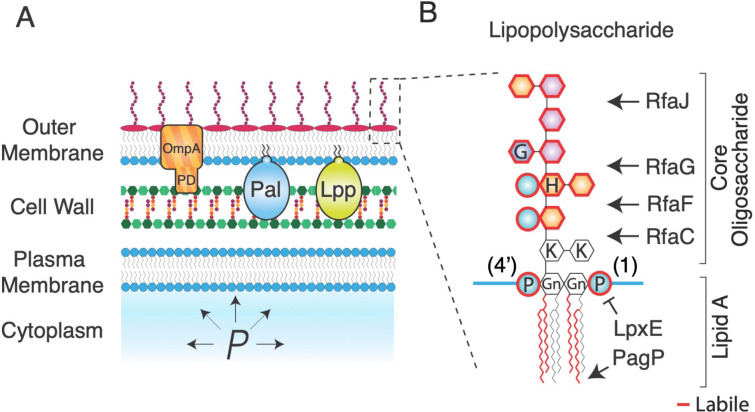
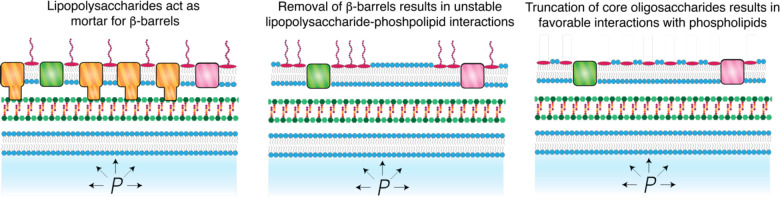
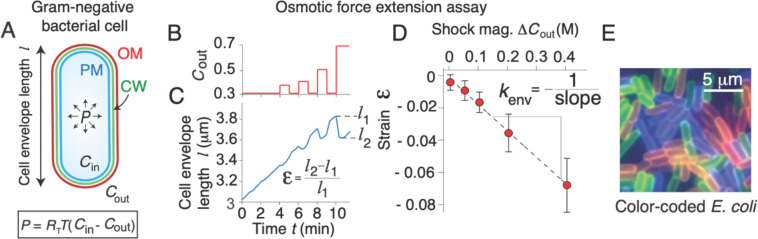
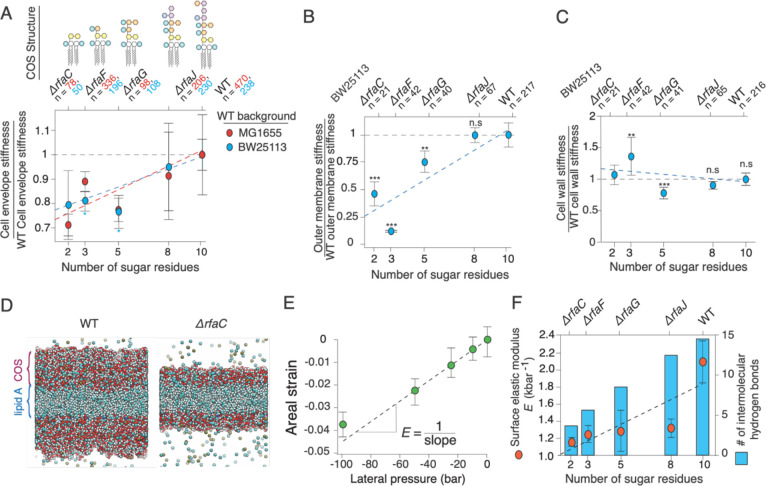
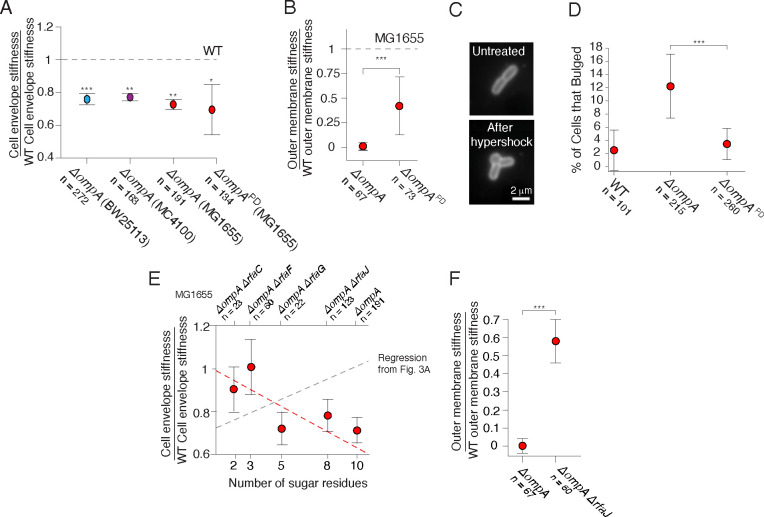
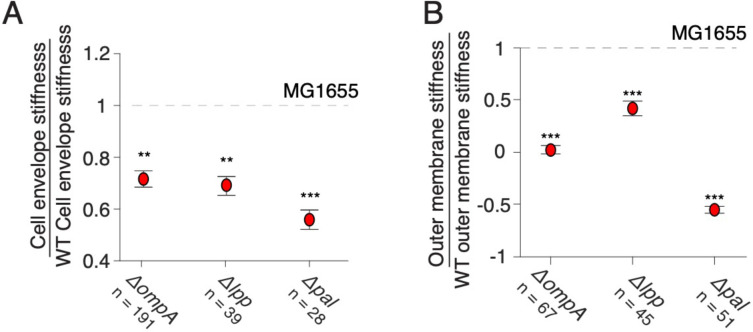
The outer membrane is the defining structure of Gram-negative bacteria. We previously demonstrated that it is critical for the mechanical integrity of the cell envelope and therefore to the robustness of the bacterial cell as a whole. Here, to determine the key molecules and moieties within the outer membrane that underlie its contribution to cell envelope mechanics, we measured cell-envelope stiffness across several sets of mutants with altered outer-membrane sugar content, protein content, and electric charge. To decouple outer membrane stiffness from total cell envelope stiffness, we developed a novel microfluidics-based "osmotic force extension" assay. In tandem, we developed a simple method to increase throughput of microfluidics experiments by performing them on color-coded pools of mutants. Using as a model Gram-negative bacterium, we found that truncating the core oligosaccharide, deleting the β-barrel protein OmpA, or deleting lipoprotein outer membrane-cell wall linkers all had the same modest, convergent effect on total cell-envelope stiffness but had large, varying effects on the ability of the cell wall to transfer tension to the outer membrane during large hyperosmotic shocks. Surprisingly, altering lipid A charge had little effect on the mechanical properties of the envelope. Importantly, the presence or absence of OmpA determined whether truncating the core oligosaccharide decreased or increased envelope stiffness (respectively), revealing sign epistasis between these components. Based on these data we propose a specific structural model in which the chemical interactions between lipopolysaccharides, β-barrel proteins, and phospholipids coordinately determine cell envelope stiffness, and the ability of the outer membrane to functionally share mechanical loads with the cell wall.
The outer membrane is the defining cellular structure of Gram-negative bacteria, a group that contains many important pathogens like , , and . One role of the outer membrane is to block the uptake of small molecules like antibiotics. However, it is becoming increasingly clear that it also functions as a structural exoskeleton that is critical for the cell's ability to cope with internal and external mechanical forces. Here, we carefully dissect the molecular basis for the load-bearing capacity of the outer membrane by screening a set of mutants with a new cell biophysics assay.
外膜是革兰氏阴性菌的标志性结构。我们之前证明,它对于细胞壁的机械完整性至关重要,因此对于整个细菌细胞的稳健性也至关重要。在此,为了确定外膜中对其细胞壁力学贡献起基础作用的关键分子和部分,我们测量了几组外膜糖含量、蛋白质含量和电荷改变的突变体的细胞壁刚度。为了将外膜刚度与总细胞壁刚度解耦,我们开发了一种基于微流控的新型“渗透力扩展”测定法。同时,我们开发了一种简单方法,通过在颜色编码的突变体库上进行微流控实验来提高通量。以 作为革兰氏阴性菌模型,我们发现截断核心寡糖、删除β桶蛋白OmpA或删除脂蛋白外膜 - 细胞壁连接体对总细胞壁刚度都有相同的适度、趋同的影响,但在大的高渗冲击期间对细胞壁将张力传递到外膜的能力有很大的、不同的影响。令人惊讶的是,改变脂质A电荷对包膜的力学性能影响很小。重要的是,OmpA的存在与否决定了截断核心寡糖是降低还是增加包膜刚度(分别),揭示了这些成分之间的符号上位性。基于这些数据,我们提出了一个特定的结构模型,其中脂多糖、β桶蛋白和磷脂之间的化学相互作用协同决定细胞壁刚度,以及外膜与细胞壁在功能上分担机械负荷的能力。
外膜是革兰氏阴性菌的标志性细胞结构,该类细菌包含许多重要病原体,如 、 和 。外膜的一个作用是阻止抗生素等小分子的摄取。然而,越来越清楚的是,它还作为一种结构外骨骼发挥作用,对于细胞应对内部和外部机械力的能力至关重要。在此,我们通过一种新的细胞生物物理学测定法筛选一组突变体,仔细剖析外膜承载能力的分子基础。