Gowin Joshua L, Stoddard Joel, Doykos Ted K, Sammel Mary D, Bernert Rebecca A
Department of Radiology, University of Colorado Anschutz Medical Campus, Aurora.
Department of Psychiatry, University of Colorado Anschutz Medical Campus, Aurora.
JAMA Netw Open. 2024 Sep 3;7(9):e2433734. doi: 10.1001/jamanetworkopen.2024.33734.
Suicide is a leading cause of death among adolescents, who demonstrate high rates of sleep disturbance. Poor sleep appears to confer risk for suicide, but longitudinal investigation of suicidal behaviors remains rare, particularly in the transition from childhood to early adolescence.
To evaluate sleep disturbances in preadolescent children (aged 9 and 10 years) in association with longitudinal risk for suicidal ideation and suicide attempts at the 2-year follow-up.
DESIGN, SETTING, AND PARTICIPANTS: This cohort study used data from the Adolescent Brain Cognitive Development Study between June 2016 and January 2021. This dataset included children aged 9 or 10 years at baseline and their parents or caregivers who were recruited at 21 sites across the US. Data were analyzed July 2023 to June 2024.
The Sleep Disturbance Scale for Children, a 26-item parent-reported inventory, was administered at baseline, generating a total score and 6 subscales. Central covariates included the Child Behavior Checklist Anxiety and Depression subscale and demographic variables.
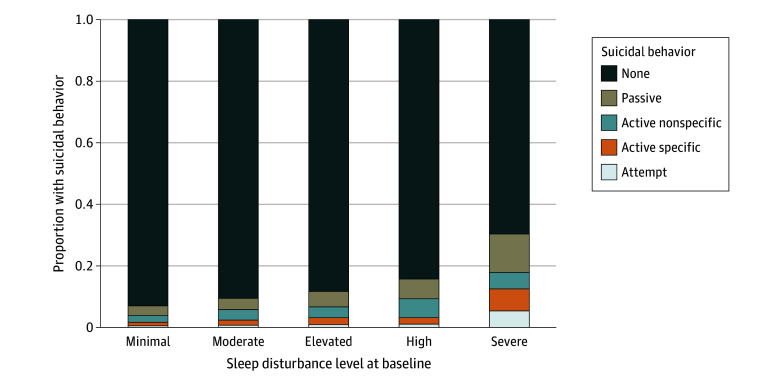
The computerized Kiddie Schedule for Affective Disorders and Schizophrenia (K-SADS-COMP) assessed parent- and youth-reported suicidal behaviors and outcomes (none; passive, active nonspecific, and active specific suicidal ideation; and suicide attempt) at the 2-year follow-up. Sleep disturbance was further grouped by symptom severity (minimal, moderate, elevated, high, and severe).
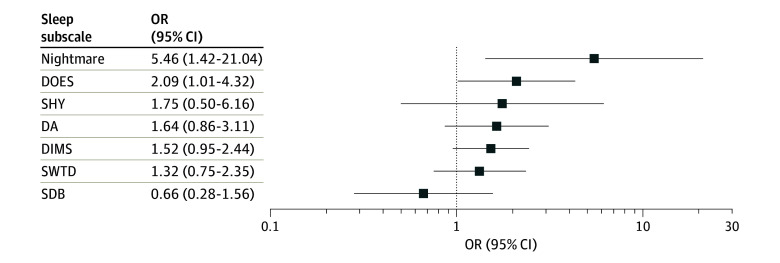
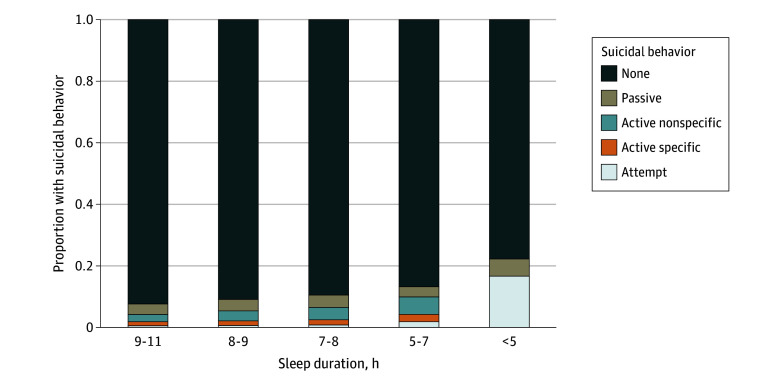
Of the 10 136 youths who reported no baseline suicidal ideation or behavior, 8807 youths (mean [SD] age, 9.9 [0.6] years; 4507 males [51.2%]; 197 Asian individuals [2.2%], 1273 Black individuals [14.5%], and 5775 White individuals [65.6%]) completed the K-SADS-COMP assessment at the 2-year follow-up and were included in the analysis. At the follow-up, 8044 participants (91.3%) had no suicidal behavior, 317 (3.6%) had passive suicidal ideation, 258 (2.9%) had active nonspecific suicidal ideation, 130 (1.5%) had active specific suicidal ideation, and 58 (0.7%) had a first-time suicide attempt. Baseline sleep disturbance was associated with increased incidence risk for suicidal behavior at age 12 years (odds ratio, 2.68; 95% CI, 1.44-4.98; P = .002), adjusting for covariates. Individual subscales or items demonstrating associations with risk included disorders of excessive somnolence and frequency of nightmares.
Results of this longitudinal cohort study revealed that disturbed sleep at age 10 years was associated with risk for suicidal thoughts and behaviors in the next 2 years. The findings highlight the potential importance of sleep as a visible risk factor and intervention target in the prevention of youth suicide.
自杀是青少年死亡的主要原因之一,青少年睡眠障碍发生率很高。睡眠不佳似乎会增加自杀风险,但对自杀行为的纵向调查仍然很少,尤其是在从童年到青春期早期的过渡阶段。
评估青春期前儿童(9岁和10岁)的睡眠障碍与2年随访时自杀意念和自杀未遂的纵向风险之间的关系。
设计、设置和参与者:这项队列研究使用了2016年6月至2021年1月期间青少年大脑认知发展研究的数据。该数据集包括基线时9岁或10岁的儿童及其在美国21个地点招募的父母或照顾者。数据于2023年7月至2024年6月进行分析。
在基线时使用儿童睡眠障碍量表,这是一份由家长报告的包含26个条目的问卷,得出总分和6个分量表。核心协变量包括儿童行为检查表中的焦虑和抑郁分量表以及人口统计学变量。
在2年随访时,使用计算机化的儿童情感障碍和精神分裂症量表(K-SADS-COMP)评估家长和青少年报告的自杀行为和结局(无;被动、主动非特异性和主动特异性自杀意念;以及自杀未遂)。睡眠障碍进一步按症状严重程度分组(轻微、中度、升高、高和严重)。
在10136名报告基线时无自杀意念或行为的青少年中,8807名青少年(平均[标准差]年龄,9.9[0.6]岁;4507名男性[51.2%];197名亚洲人[2.2%],1273名黑人[14.5%],5775名白人[65.6%])在2年随访时完成了K-SADS-COMP评估并纳入分析。随访时,8044名参与者(91.3%)无自杀行为,317名(3.6%)有被动自杀意念,258名(2.9%)有主动非特异性自杀意念,130名(1.5%)有主动特异性自杀意念,58名(0.7%)有首次自杀未遂。调整协变量后,基线睡眠障碍与12岁时自杀行为的发病风险增加相关(优势比,2.68;95%置信区间,1.44-4.98;P = 0.002)。显示与风险相关的各个分量表或条目包括过度嗜睡障碍和噩梦频率。
这项纵向队列研究的结果显示,10岁时睡眠障碍与未来2年的自杀念头和行为风险相关。这些发现凸显了睡眠作为预防青少年自杀中一个明显的风险因素和干预靶点的潜在重要性。