Yoo-Jeong Moka, Weinstein Andrea M, Ware Deanna, Brennan-Ing Mark, Shoptaw Steven, Teplin Linda A, Haberlen Sabina A, Friedman M Reuel, Plankey Michael W
School of Nursing, Bouvé College of Health Sciences, Northeastern University, Boston, MA, USA.
Department of Psychiatry, University of Pittsburgh, Pittsburgh, PA, USA.
AIDS Behav. 2025 Jan;29(1):198-210. doi: 10.1007/s10461-024-04501-0. Epub 2024 Sep 16.
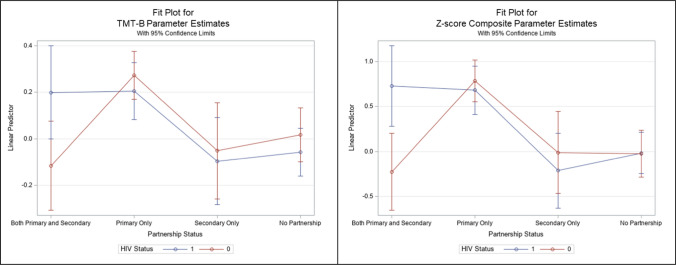
Partnership status among sexual minority men (SMM) is a potentially important yet underexplored predictor of cognitive functioning. Using data from the understanding patterns of healthy aging among men who have sex with men substudy of the Multicenter AIDS Cohort Study, we assessed the associations of partnership status and quality with cognitive performance in middle-aged and older SMM, adjusting for sociodemographic and clinical covariates. Partnership status was classified into four types: "only a primary partnership," "only a secondary partnership," "both a primary and secondary relationship," and "neither a primary nor secondary relationship." Partnership quality was assessed based on perceived support or strain from partners. Cognitive performance was evaluated using the z-scores on the Symbol Digit Modalities Test (SDMT), Trail Making Test Parts A (TMT-A) and B (TMT-B), and a composite Z-score that summed the SDMT, TMT-A, and TMT-B z-scores. Among 1067 participants (median age 60, 85.7% college educated), having a primary partner was associated with better cognitive performance (Z-score composite = 0.41 [95% CI 0.12-0.70]), TMT-A ( = 0.16 [95% CI 0.02-0.30]), and TMT-B ( = 0.19 [95% CI 0.06-0.33]). Support from secondary partners was also linked to better cognition. Additionally, there was a significant interaction between partnership and HIV status, indicating that SMM with HIV and both primary and secondary partners showed better cognitive outcomes than unpartnered SMM with HIV. These findings suggest that having a primary partner and receiving support from secondary partners may contribute to better cognitive health among middle-aged and older SMM, especially those with HIV.
性少数男性(SMM)中的伴侣关系状况是认知功能一个潜在重要但未充分探索的预测因素。利用多中心艾滋病队列研究中男男性行为者健康老龄化理解模式子研究的数据,我们评估了伴侣关系状况和质量与中老年SMM认知表现之间的关联,并对社会人口学和临床协变量进行了调整。伴侣关系状况分为四种类型:“只有主要伴侣关系”、“只有次要伴侣关系”、“既有主要伴侣关系又有次要伴侣关系”以及“既无主要伴侣关系也无次要伴侣关系”。伴侣关系质量是根据对伴侣支持或压力感受来评估的。认知表现通过符号数字模态测验(SDMT)、连线测验A部分(TMT - A)和B部分(TMT - B)的z分数以及将SDMT、TMT - A和TMT - B的z分数相加得到的综合z分数来评估。在1067名参与者(中位年龄60岁,85.7%受过大学教育)中,有主要伴侣与更好的认知表现相关(综合z分数 = 0.41 [95%置信区间0.12 - 0.70])、TMT - A( = 0.16 [95%置信区间0.02 - 0.30])和TMT - B( = 0.19 [95%置信区间0.06 - 0.33])。来自次要伴侣的支持也与更好的认知相关。此外,伴侣关系和HIV感染状况之间存在显著交互作用,表明有HIV感染且既有主要伴侣又有次要伴侣的SMM比无伴侣的HIV感染SMM表现出更好的认知结果。这些发现表明,有主要伴侣以及获得次要伴侣的支持可能有助于中老年SMM,尤其是那些感染HIV的SMM保持更好的认知健康。