Hunan Provincial Key Laboratory of Regional Hereditary Birth Defect Prevention and Control, Changsha Hospital for Maternal & Child Health Care Affiliated to Hunan Normal University, Changsha, Hunan, 410000, China.
Institute of Reproduction and Stem Cell Engineering, School of Basic Medicine Science, Central South University, Changsha, Hunan, 410000, China.
Biol Res. 2024 Sep 16;57(1):66. doi: 10.1186/s40659-024-00546-6.
Spermatogonial stem cells (SSCs) are essential for the maintenance and initiation of male spermatogenesis. Despite the advances in understanding SSC biology in mouse models, the mechanisms underlying human SSC development remain elusive.
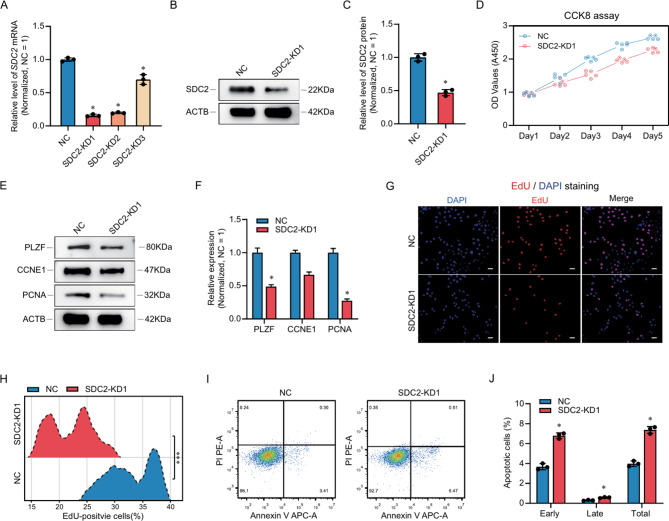
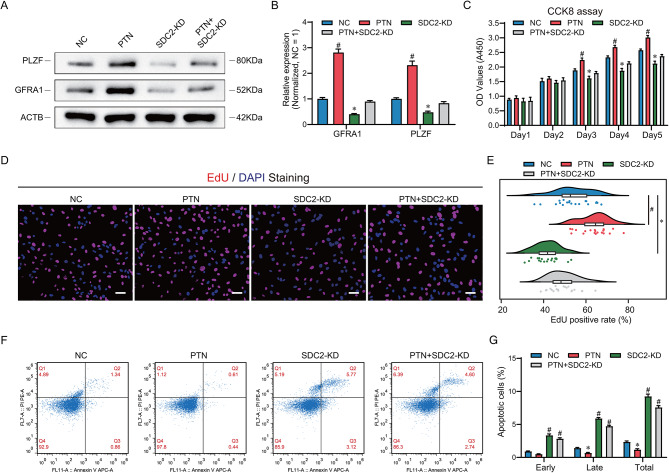
Here, we analyzed the signaling pathways involved in SSC regulation by testicular somatic cells using single-cell sequencing data (GEO datasets: GSE149512 and GSE112013) and identified that Leydig cells communicate with SSCs through pleiotrophin (PTN) and its receptor syndecan-2 (SDC2). Immunofluorescence, STRING prediction, and protein immunoprecipitation assays confirmed the interaction between PTN and SDC2 in spermatogonia, but their co-localization was observed only in approximately 50% of the cells. The knockdown of SDC2 in human SSC lines impaired cell proliferation, DNA synthesis, and the expression of PLZF, a key marker for SSC self-renewal. Transcriptome analysis revealed that SDC2 knockdown downregulated the expression of GFRA1, a crucial factor for SSC proliferation and self-renewal, and inhibited the HIF-1 signaling pathway. Exogenous PTN rescued the proliferation and GFRA1 expression in SDC2 knockdown SSC lines. In addition, we found downregulation of PTN and SDC2 as well as altered localization in non-obstructive azoospermia (NOA) patients, suggesting that downregulation of PTN and SDC2 may be associated with impaired spermatogenesis.
Our results uncover a novel mechanism of human SSC regulation by the testicular microenvironment and suggest a potential therapeutic target for male infertility.
精原干细胞(SSC)对于维持和启动男性精子发生至关重要。尽管在理解小鼠模型中的 SSC 生物学方面取得了进展,但人类 SSC 发育的机制仍难以捉摸。
在这里,我们使用单细胞测序数据(GEO 数据集:GSE149512 和 GSE112013)分析了睾丸体细胞中参与 SSC 调节的信号通路,确定了间质细胞通过外胚层蛋白(PTN)及其受体 syndecan-2(SDC2)与 SSC 进行通讯。免疫荧光、STRING 预测和蛋白质免疫沉淀实验证实了 PTN 和 SDC2 在精原细胞中的相互作用,但仅在大约 50%的细胞中观察到它们的共定位。在人 SSC 系中敲低 SDC2 会损害细胞增殖、DNA 合成以及 PLZF 的表达,PLZF 是 SSC 自我更新的关键标记物。转录组分析显示,SDC2 敲低下调了 GFRA1 的表达,GFRA1 是 SSC 增殖和自我更新的关键因素,并抑制了 HIF-1 信号通路。外源性 PTN 挽救了 SDC2 敲低 SSC 系的增殖和 GFRA1 表达。此外,我们发现非梗阻性无精子症(NOA)患者中 PTN 和 SDC2 的下调以及定位改变,表明 PTN 和 SDC2 的下调可能与精子发生受损有关。
我们的研究结果揭示了睾丸微环境调控人类 SSC 的新机制,并为男性不育症提供了潜在的治疗靶点。