Zahran Mohamed Aly, Manas-Ojeda Aroa, Navarro-Sánchez Mónica, Castillo-Gómez Esther, Olucha-Bordonau Francisco E
Unitat Predepartamental de Medicina, Facultat de Ciències de la Salut, Universitat Jaume I, Castellón de la Plana, Spain.
CIBERsam-ISCiii, Spain.
Heliyon. 2024 Aug 28;10(17):e36352. doi: 10.1016/j.heliyon.2024.e36352. eCollection 2024 Sep 15.
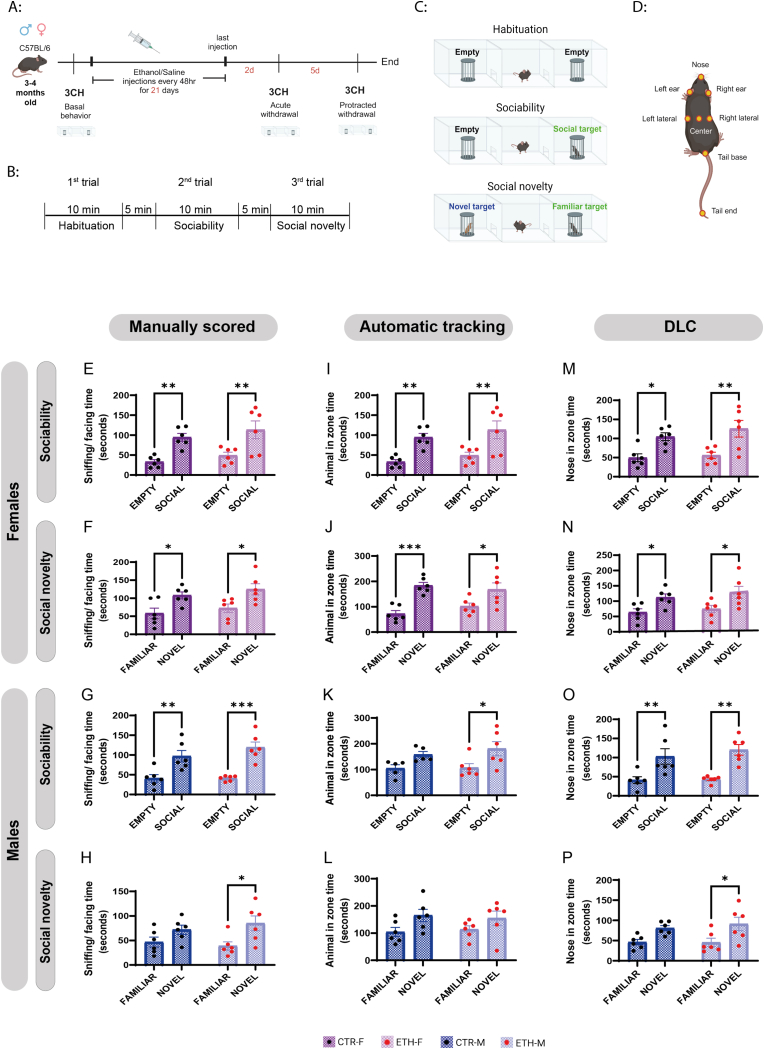
Alcohol consumption and withdrawal alter social behaviour in humans in a sex-dependent manner. The three-chamber test is a widely used paradigm to assess rodents' social behaviour, including sociability and social novelty. Automatic tracking systems are commonly used to score time spent with conspecifics, despite failing to score direct interaction time with conspecifics rather than time in the nearby zone. Thereby, the automatically scored results are usually inaccurate and need manual corrections.
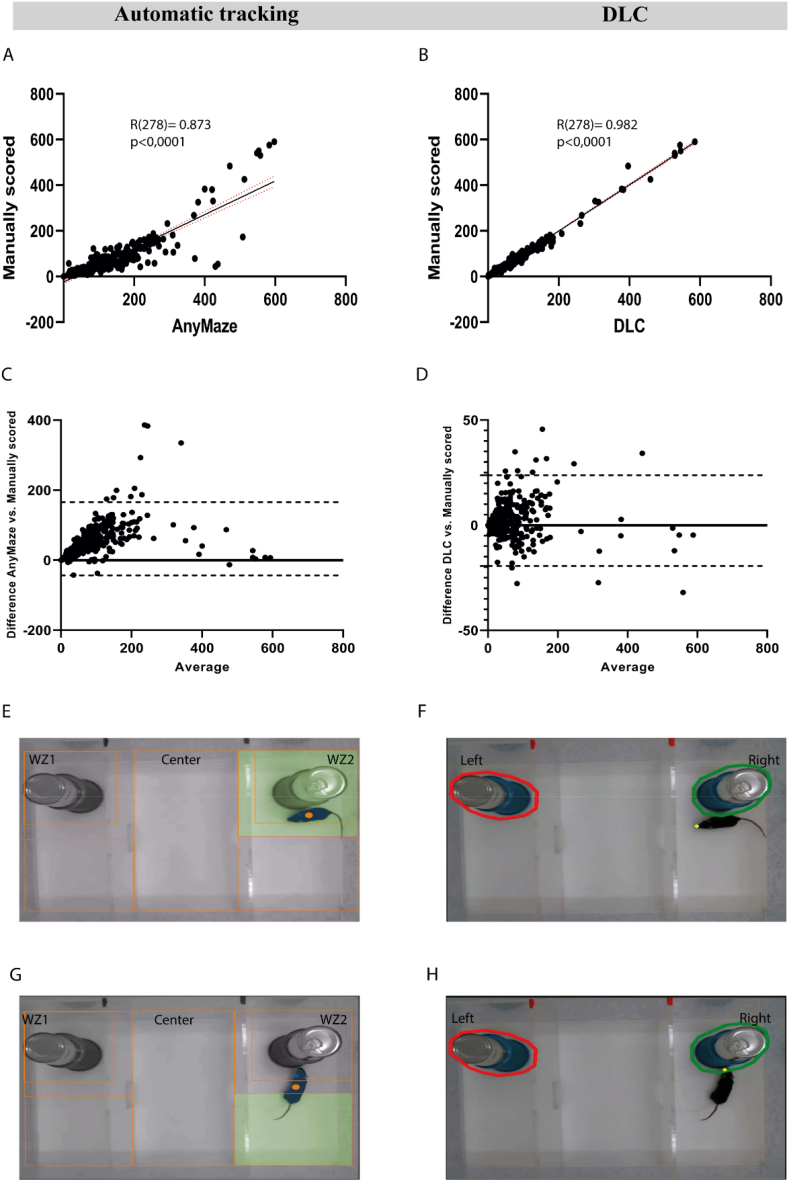
New advances in artificial intelligence (AI) have been used recently to analyze complex behaviours. DeepLabCat is a pose-estimation toolkit that allows the tracking of animal body parts. Thus, we used DeepLabCut, to introduce a scoring model of the three-chamber test to investigate alcohol withdrawal effects on social behaviour in mice considering sex and withdrawal periods. We have compared the results of two automatic pose estimation methods: automatic tracking (AnyMaze) and DeepLabCut considering the manual scoring method, the current gold standard.
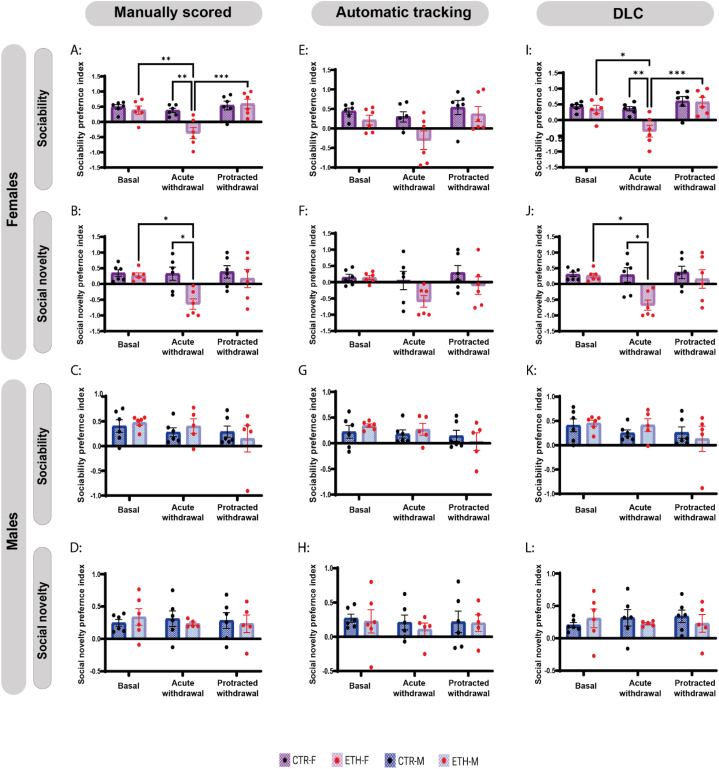
We have found that the automatic tracking method (AnyMaze) has failed to detect the significance of social deficits in female mice during acute withdrawal. However, tracking the animal's nose using DeepLabCut showed a significant social deficit in agreement with manual scoring. Interestingly, this social deficit was shown only in females during acute and recovered by the protracted withdrawal. DLC and manually scored results showed a higher Spearman correlation coefficient and a lower bias in the Bland-Altman analysis.
our approach helps improve the accuracy of scoring the three-chamber test while outperforming commercial automatic tracking systems.
饮酒及戒酒会以性别依赖的方式改变人类的社交行为。三室试验是一种广泛用于评估啮齿动物社交行为的范式,包括社交能力和社交新奇性。尽管自动跟踪系统无法对与同种个体的直接互动时间而非附近区域的时间进行评分,但仍普遍用于对与同种个体相处的时间进行评分。因此,自动评分结果通常不准确,需要人工校正。
人工智能(AI)的新进展最近已被用于分析复杂行为。DeepLabCat是一个姿势估计工具包,可用于跟踪动物身体部位。因此,我们使用DeepLabCut引入了一种三室试验评分模型,以研究戒酒对小鼠社交行为的影响,同时考虑性别和戒断期。我们将两种自动姿势估计方法的结果进行了比较:自动跟踪(AnyMaze)和DeepLabCut,并将其与人工评分方法(当前的金标准)进行了比较。
我们发现,自动跟踪方法(AnyMaze)未能检测到急性戒断期间雌性小鼠社交缺陷的显著性。然而,使用DeepLabCut跟踪动物的鼻子显示出与人工评分一致的显著社交缺陷。有趣的是,这种社交缺陷仅在急性戒断期间的雌性小鼠中出现,并在延长戒断期后恢复。DLC和人工评分结果在Bland-Altman分析中显示出更高的Spearman相关系数和更低的偏差。
我们的方法有助于提高三室试验评分的准确性,同时优于商业自动跟踪系统。