Eckstein Felix, Maschek Susanne, Wirth Wolfgang, Ladel Christoph, Bihlet Asger Reinstrup, Knight Chris, Somberg Kenneth, Zhao Luping
Research Program for Musculoskeletal Imaging, Center for Anatomy & Cell Biology, Paracelsus Medical University (PMU), Salzburg, Austria.
Ludwig Boltzmann Institute for Arthritis and Rehabilitation (LBIAR), Paracelsus Medical University (PMU), Salzburg, Austria.
Osteoarthr Cartil Open. 2024 Aug 23;6(4):100513. doi: 10.1016/j.ocarto.2024.100513. eCollection 2024 Dec.
Post-treatment cartilage morphometry in the FORWARD study was performed without blinding to MRI acquisition order, involving potential reader bias. Here we obtained unbiased estimates of cartilage change post-treatment, reading year (Y)2 and Y5 MRIs with blinding to time point. We studied whether post-treatment cartilage thickness change differed between sprifermin- and placebo-treated knees.
FORWARD was a 5-year randomized control trial in 549 knee osteoarthritis patients. Here, Y2/Y5 images were analyzed with blinding to relative temporal order and treatment group. Cartilage change during Y2→Y5 was obtained in 337 participants: n = 57 treated with placebo intra-articular injections every 6 months (q6M); n = 69 with 30 μg sprifermin every 12 months (q12 M), n = 67 with 30 μg q6M, n = 73 with 100 μg q12 M, and n = 71 with 100 μg q6M between baseline (BL) and 18 M. Total femorotibial joint (TFTJ) cartilage thickness was the primary analytic focus.
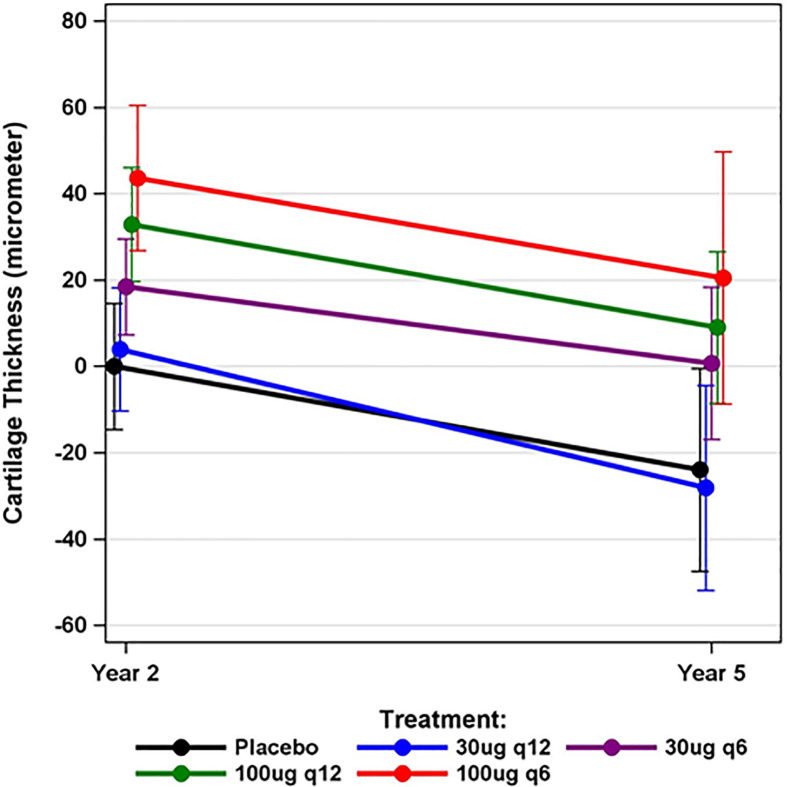
TFTJ cartilage thickness change during Y2→Y5 was -26μm (SD64; 95%CI -32,-19) across the cohort; no statistically significant difference (p = 0.80) was observed between Sprifermin treated or placebo arms (one-way ANOVA). All groups lost cartilage, but the treatment-related difference in cartilage thickness in Sprifermin arms relative to placebo at Y2 was maintained until Y5. Annualized cartilage change in placebo participants was -8.2 μm (SD21; 95%CI -14,-2.5) during Y2→Y5 vs. -5.4 μm (SD27; 95%CI -13,1.8) during BL→Y2; no significant difference was identified (-test).
FORWARD is the first study evaluating post-treatment benefits of a potential disease modifying osteoarthritis drug. Cartilage thickness gained with 100 μg sprifermin at Y2 is maintained to Y5 and thus appears viable and sustainable.This is a post-hoc analysis of the FORWARD trial: ClinicalTrials.gov Identifier: NCT01919164.
在FORWARD研究中,治疗后软骨形态测量是在未对MRI采集顺序设盲的情况下进行的,这可能存在阅片者偏倚。在此,我们获得了治疗后软骨变化的无偏估计值,对第2年(Y2)和第5年(Y5)的MRI进行阅片时对时间点设盲。我们研究了在接受司帕明和安慰剂治疗的膝关节之间,治疗后软骨厚度变化是否存在差异。
FORWARD是一项针对549例膝关节骨关节炎患者的为期5年的随机对照试验。在此,对Y2/Y5图像进行分析时对相对时间顺序和治疗组设盲。在337名参与者中获得了Y2至Y5期间的软骨变化情况:n = 57例每6个月接受一次安慰剂关节内注射(q6M);n = 69例每12个月接受30μg司帕明(q12M),n = 67例每6个月接受30μg,n = 73例每12个月接受100μg,以及n = 71例在基线(BL)至18个月期间每6个月接受100μg。总股胫关节(TFTJ)软骨厚度是主要分析重点。
在整个队列中,Y2至Y5期间TFTJ软骨厚度变化为-26μm(标准差64;95%置信区间-32,-19);在接受司帕明治疗组和安慰剂组之间未观察到统计学上的显著差异(p = 0.80)(单因素方差分析)。所有组均出现软骨丢失,但在Y2时,司帕明组相对于安慰剂组在软骨厚度上与治疗相关的差异一直维持到Y5。安慰剂组参与者在Y2至Y5期间的年化软骨变化为-8.2μm(标准差21;95%置信区间-14,-2.5),而在BL至Y2期间为-5.4μm(标准差27;95%置信区间-13,1.8);未发现显著差异(t检验)。
FORWARD是第一项评估一种潜在的改善骨关节炎疾病药物治疗后益处的研究。在Y2时使用100μg司帕明获得的软骨厚度维持到了Y5,因此似乎是可行且可持续的。这是对FORWARD试验的一项事后分析:ClinicalTrials.gov标识符:NCT01919164。