Center for Diagnostic and Health, Munich, Germany.
Technical University of Munich, Department Health and Sport Sciences, Germany.
Tunis Med. 2024 Sep 5;102(9):509-512. doi: 10.62438/tunismed.v102i9.5162.
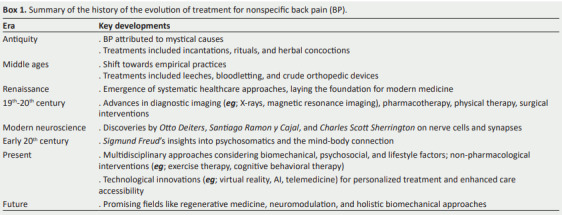
Unspecific back pain (UBP) has long puzzled medical professionals. Historically, back pain (BP) was often attributed to mystical causes, treated with incantations or herbal concoctions. The Middle Ages shifted towards empirical practices, though still intertwined with superstition, using methods like leeches and bloodletting. The Renaissance introduced systematic healthcare approaches, laying the foundation for modern medicine. The 20th century saw significant advancements with diagnostic imaging, pharmacotherapy, physical therapy, and surgical interventions, though UBP remained elusive. Recent decades have seen a paradigm shift towards multidisciplinary approaches, addressing BP's multifactorial nature through holistic methods considering biomechanical, psychosocial, and lifestyle factors. This shift integrates quantitative research with hermeneutic interpretation, emphasizing evidence-based guidelines. Non-pharmacological interventions such as exercise therapy, electrotherapy, cognitive behavioral therapy, and mindfulness-based stress reduction have gained prominence, empowering individuals in their recovery. Technological innovations like virtual reality and artificial intelligence offer personalized treatment plans, optimizing outcomes. The future of BP treatment holds promise with advancements in regenerative medicine, neuromodulation, telemedicine, and remote monitoring platforms, enhancing accessibility and continuity of care, especially in underserved communities. However, challenges such as the opioid epidemic and healthcare disparities remain, necessitating judicious prescribing practices and equitable resource distribution. The evolving treatment landscape for UBP reflects the dynamic interplay between scientific progress, clinical innovation, and societal needs, aiming to alleviate the burden of back pain and improve quality of life.
非特异性腰痛(UBP)长期以来一直困扰着医学专业人员。历史上,腰痛(BP)常归因于神秘原因,用咒语或草药混合物治疗。中世纪转向经验主义实践,尽管仍与迷信交织在一起,使用水蛭和放血等方法。文艺复兴时期引入了系统的医疗保健方法,为现代医学奠定了基础。20 世纪随着诊断成像、药物治疗、物理治疗和手术干预的显著进步,UBP 仍然难以捉摸。最近几十年,多学科方法发生了范式转变,通过综合考虑生物力学、心理社会和生活方式因素的整体方法来解决 BP 的多因素性质。这种转变将定量研究与解释学解释相结合,强调基于证据的指南。非药物干预,如运动疗法、电疗、认知行为疗法和正念减压,已经得到了重视,使个人能够在康复过程中获得力量。虚拟现实和人工智能等技术创新提供了个性化的治疗计划,优化了治疗效果。再生医学、神经调节、远程医疗和远程监测平台等方面的进步为 BP 治疗的未来带来了希望,增强了医疗服务的可及性和连续性,尤其是在服务不足的社区。然而,阿片类药物流行和医疗保健差距等挑战仍然存在,需要谨慎的处方实践和公平的资源分配。UBP 的治疗方法不断发展,反映了科学进步、临床创新和社会需求之间的动态相互作用,旨在减轻腰痛的负担,提高生活质量。