Stein Leah, Murugesan Karthikeyan, Reeser Julie W, Risch Zachary, Wing Michele R, Paruchuri Anoosha, Samorodnitsky Eric, Hoskins Emily L, Dao Thuy, Smith Amy, Le Dat, Babcook Melissa A, Chang Yi Seok, Avenarius Matthew R, Imam Muhammad, Freud Aharon G, Roychowdhury Sameek
Comprehensive Cancer Center and James Cancer Hospital, The Ohio State University, Columbus, OH, USA.
Biomedical Sciences Graduate Program, The Ohio State University, Columbus, OH, USA.
NPJ Precis Oncol. 2024 Sep 17;8(1):207. doi: 10.1038/s41698-024-00683-x.
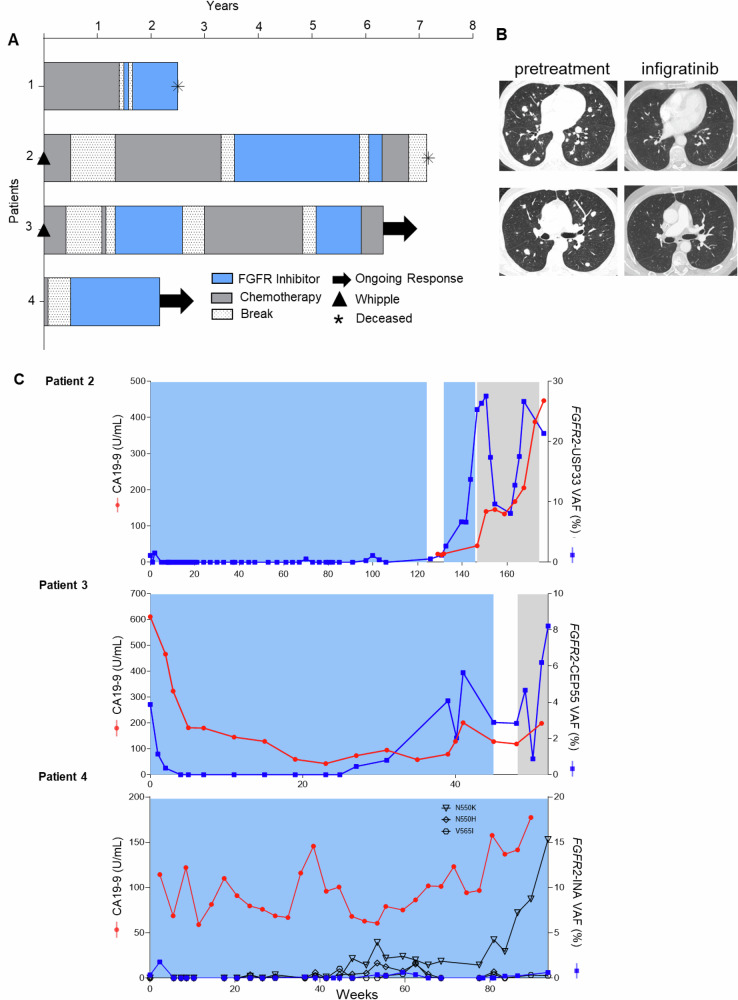
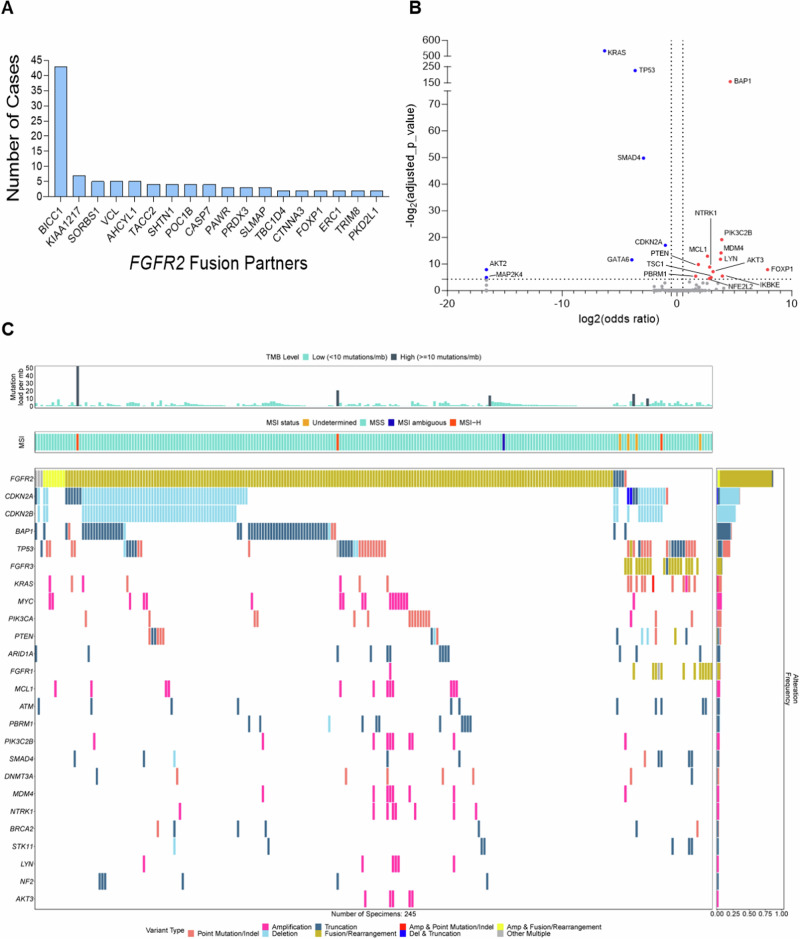
Genomic alterations in fibroblast growth factor receptor (FGFR) genes are present in a small number of metastatic pancreatic ductal adenocarcinomas (PDAC) and may represent an emerging subgroup of patients likely to benefit from FGFR targeted therapies. Here we present four FGFR2 fusion-positive metastatic PDAC patients who exhibited durable responses or disease control to FGFR kinase inhibitors. Utilizing our custom FGFR focused cell-free DNA assay, FGFR-Dx, we serially monitored variant allele fractions of FGFR2 fusions during FGFR inhibitor treatment and observed dynamic changes correlating with clinical responses. Genomic analysis of 30,229 comprehensively profiled pancreatic cancers revealed FGFR1-3 fusions in 245 cases, an incidence of 0.81%. FGFR fusions were generally mutually exclusive from other known oncogenes. Our findings provide clinical evidence for identifying and treating FGFR2 fusion-positive PDAC patients with FGFR targeted therapy.
成纤维细胞生长因子受体(FGFR)基因的基因组改变存在于少数转移性胰腺导管腺癌(PDAC)中,可能代表了一个可能从FGFR靶向治疗中获益的新兴患者亚组。在此,我们报告了4例FGFR2融合阳性的转移性PDAC患者,他们对FGFR激酶抑制剂表现出持久反应或疾病得到控制。利用我们定制的聚焦FGFR的游离DNA检测方法FGFR-Dx,我们在FGFR抑制剂治疗期间连续监测FGFR2融合的变异等位基因分数,并观察到与临床反应相关的动态变化。对30229例全面分析的胰腺癌进行基因组分析,发现245例存在FGFR1-3融合,发生率为0.81%。FGFR融合通常与其他已知致癌基因相互排斥。我们的研究结果为识别和治疗FGFR2融合阳性的PDAC患者提供了FGFR靶向治疗的临床证据。