Nuclear Medicine Unit, Department of Experimental and Clinical Medicine, "Mater Domini" University Hospital, "Magna Graecia" University, Catanzaro, Italy.
Medical Oncology Unit, "Mater Domini" University Hospital, Catanzaro, Italy.
Cancer Imaging. 2024 Sep 17;24(1):125. doi: 10.1186/s40644-024-00774-9.
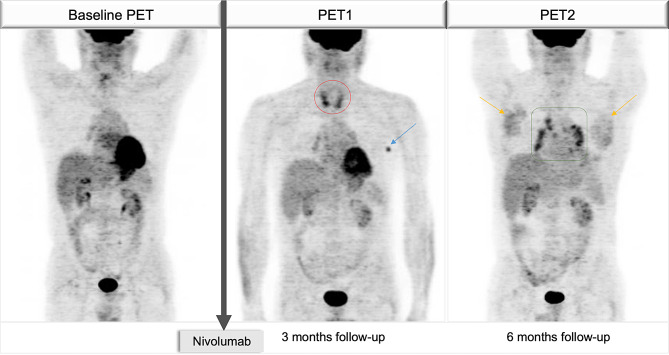
Direct comparisons between [F]FDG PET/CT findings and clinical occurrence of immune-related adverse events (irAEs) based on independent assessments of clinical and imaging features in patients receiving immune checkpoint inhibitors (ICIs) are missing. Our aim was to estimate sites, frequency, and timing of immune-related PET findings during ICIs treatment in patients with melanoma and NSCLC, and to assess their correlation with clinical irAEs. Prognostic implications of immune-related events were also investigated.
Fifty-one patients with melanoma (47%) or NSCLC (53%) undergoing multiple PET examinations during anti-PD1/PDL1 treatment were retrospectively included. Clinical irAEs were graded according to CTCAE v.5.0. Abnormal PET findings suggestive of immune activation were described by two readers blinded to the clinical data. Progression-free survival (PFS) and overall survival (OS) were analyzed with the Kaplan-Meier method in patients stratified according to the presence of irAEs, immune-related PET findings or both.
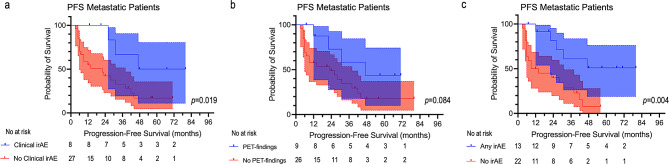
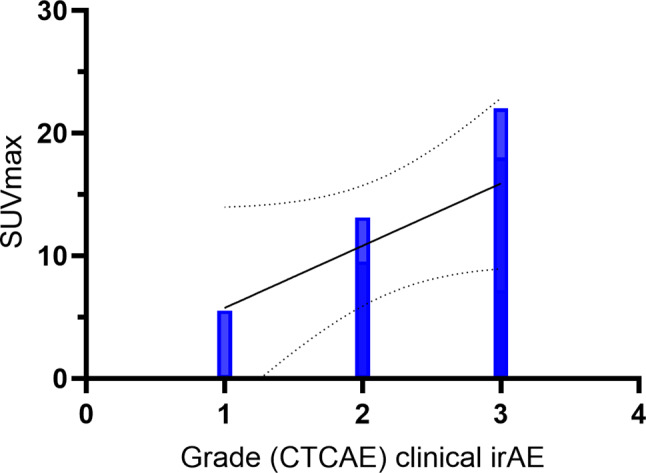
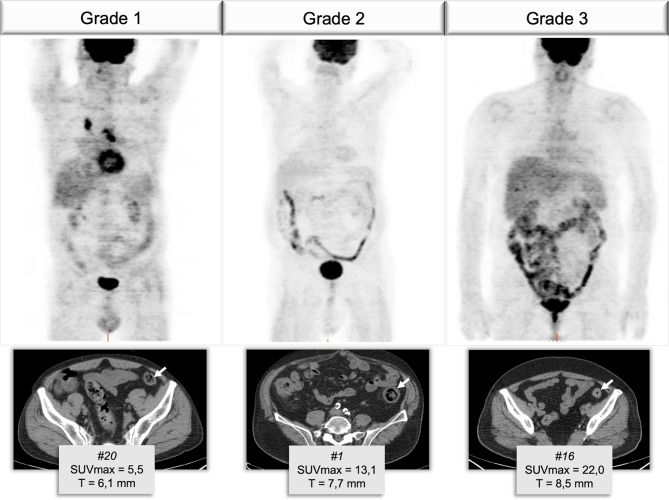
Twenty-one patients showed clinical irAEs only (n = 6), immune-related PET findings only (n = 6), or both (n = 9). In patients whose imaging findings corresponded to clinical irAEs (n = 7), a positive correlation between SUV and the severity of the clinical event was observed (r=0.763, p = 0.046). Clinical irAEs occurred more frequently in patients without macroscopic disease than in metastatic patients (55% vs. 23%, p = 0.039). Patients who developed clinical irAEs had a significantly longer PFS than patients who remained clinically asymptomatic, both in the overall cohort (p = 0.011) and in the subgroup of (n = 35) patients with metastatic disease (p = 0.019). The occurrence of immune-related PET findings significantly stratified PFS in the overall cohort (p = 0.040), and slightly missed statistical significance in patients with metastatic disease (p = 0.08). The best stratification of PFS was achieved when all patients who developed immune-related events, either clinically relevant or detected by PET only, were grouped together both in the overall cohort (p = 0.002) and in patients with metastatic disease (p = 0.004). In the whole sample, OS was longer in patients who developed any immune-related events (p = 0.032).
Patients with melanoma or NSCLC under ICI treatment can develop clinical irAEs, immune-related PET findings, or both. The occurrence of immune-related events has a prognostic impact. Combining clinical information with PET assessment improved outcome stratification.
基于独立评估接受免疫检查点抑制剂(ICI)治疗的患者的临床和影像学特征,目前尚缺乏[F]FDG PET/CT 结果与免疫相关不良事件(irAE)临床发生之间的直接比较。我们的目的是评估黑色素瘤和 NSCLC 患者在接受免疫治疗期间免疫相关的 PET 发现的部位、频率和时间,并评估其与临床 irAE 的相关性。还研究了免疫相关事件的预后意义。
回顾性纳入 51 例接受抗 PD1/PDL1 治疗期间多次 PET 检查的黑色素瘤(47%)或 NSCLC(53%)患者。根据 CTCAE v.5.0 对临床 irAE 进行分级。两位读者对临床数据进行盲法评估,描述提示免疫激活的异常 PET 发现。根据 irAE、免疫相关的 PET 发现或两者的存在,对患者进行分层,用 Kaplan-Meier 法分析无进展生存期(PFS)和总生存期(OS)。
21 例患者仅出现临床 irAE(n=6)、仅出现免疫相关的 PET 发现(n=6)或两者均有(n=9)。在影像学发现与临床 irAE 相符的患者(n=7)中,SUV 与临床事件严重程度之间存在正相关(r=0.763,p=0.046)。与有转移的患者相比,无肉眼疾病的患者更常出现临床 irAE(55% vs. 23%,p=0.039)。与临床无症状的患者相比,发生临床 irAE 的患者 PFS 明显更长,这在总体队列中(p=0.011)和有转移疾病的亚组患者中(n=35,p=0.019)均如此。免疫相关的 PET 发现的发生显著分层了总体队列中的 PFS(p=0.040),在有转移疾病的患者中则略低于统计学意义(p=0.08)。在所有出现免疫相关事件(临床相关或仅 PET 发现)的患者中,无论是否有临床意义,均将其分组,无论是在总体队列中(p=0.002)还是在有转移疾病的患者中(p=0.004),都可以最佳地分层 PFS。在整个样本中,发生任何免疫相关事件的患者 OS 更长(p=0.032)。
接受 ICI 治疗的黑色素瘤或 NSCLC 患者可出现临床 irAE、免疫相关的 PET 发现或两者均有。免疫相关事件的发生具有预后意义。将临床信息与 PET 评估相结合可改善预后分层。