Faculty of Medicine of the Hebrew University of Jerusalem, Jerusalem, Israel.
Braun School of Public Health, Hebrew University of Jerusalem, Jerusalem, Israel.
Isr J Health Policy Res. 2024 Sep 17;13(1):48. doi: 10.1186/s13584-024-00620-0.
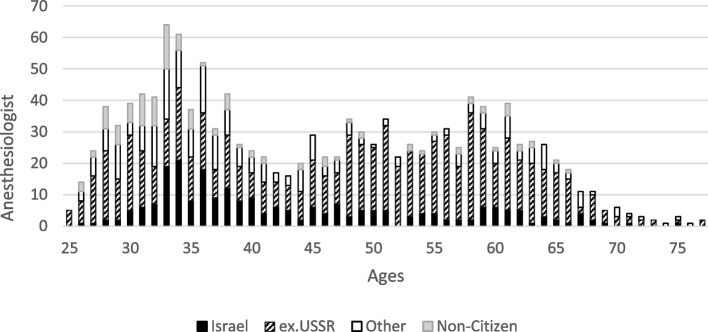
Anesthesiologists provide crucial anesthesiology services in the operating room and non-operating room locations. Combined with an aging and growing Israeli population, there is an increasing demand for anesthesiology services. A previous study performed in 2005 showed that most anesthesiologists are immigrant physicians with few Israeli medical school graduates. Since then, physician immigration decreased, many have retired and demand for anesthesia services has increased while insufficient numbers of new anesthesiologists were trained, leading to a shortage, limiting surgeries and other procedures in many hospitals. The present study examined the composition of the Israeli anesthesiology workforce in 2021and compared it to the 2005 workforce.
A cross-sectional survey of demographic and professional information about each Israeli hospital anesthesiologists was solicited from 34 anesthesiology department chairs responsible for 36 Israeli acute care hospitals.
There are 1313 anesthesiologists in the 36 hospitals, resulting in a ratio of 14.2 anesthesiologists per 100,000 population. 22.6% of anesthesiologists will reach retirement age over the next ten years. The proportion of female anesthesiologists was 28.7%. While Israeli medical school graduates increased to 18.1% from 12.2% in 2005, non-Israeli citizens and non-permanent residents comprised 8.5% of the workforce.
Despite growth in the ratio of anesthesiologists per population, a workforce shortage is expected to worsen over the next ten years due to retirements, shortened call hours, and the Yatziv reform which bans graduates of certain overseas medical schools from obtaining Israeli Medical Licenses. The current workforce has compensated for the existing shortage of anesthesiologists by enlisting non-Israeli trainees from overseas. Yet, it is crucial to maintain and enlarge the local Israeli workforce to forestall a worsening shortage.
麻醉师在手术室和非手术室提供重要的麻醉服务。随着以色列人口的老龄化和增长,对麻醉服务的需求不断增加。2005 年进行的一项先前研究表明,大多数麻醉师是移民医生,只有少数是以色列医学院的毕业生。自那时以来,医生移民减少,许多人已经退休,而麻醉服务的需求增加,同时没有培训足够数量的新麻醉师,导致短缺,限制了许多医院的手术和其他程序。本研究检查了 2021 年以色列麻醉师劳动力的构成,并将其与 2005 年的劳动力进行了比较。
从负责 36 家以色列急性护理医院的 34 名麻醉学系主任那里征集了关于每位以色列医院麻醉师的人口统计学和专业信息的横断面调查。
在 36 家医院中有 1313 名麻醉师,每 10 万人中有 14.2 名麻醉师,这一比例为 1313。在接下来的十年中,22.6%的麻醉师将达到退休年龄。女性麻醉师的比例为 28.7%。虽然以色列医学院的毕业生比例从 2005 年的 12.2%增加到 18.1%,但非以色列公民和非永久居民占劳动力的 8.5%。
尽管每人口麻醉师比例有所增加,但由于退休、缩短呼叫时间以及禁止某些海外医学院毕业生获得以色列医疗执照的 Yatziv 改革,预计未来十年劳动力短缺将恶化。当前的劳动力通过招募来自海外的非以色列受训人员来弥补现有的麻醉师短缺。然而,至关重要的是要维持和扩大当地的以色列劳动力,以防止短缺情况恶化。