Nuffield Department of Primary Care Health Sciences, University of Oxford, Oxford, UK.
Behavioural Insights Team, London, UK.
Int J Behav Nutr Phys Act. 2024 Sep 17;21(1):103. doi: 10.1186/s12966-024-01638-y.
As rates of obesity and overweight continue to increase in the UK, calorie labels have been introduced on menus as a policy option to provide information to consumers on the energy content of foods and to enable informed choices. This study tested whether the addition of calorie labels to items in a simulated food delivery platform may reduce the energy content of items selected.
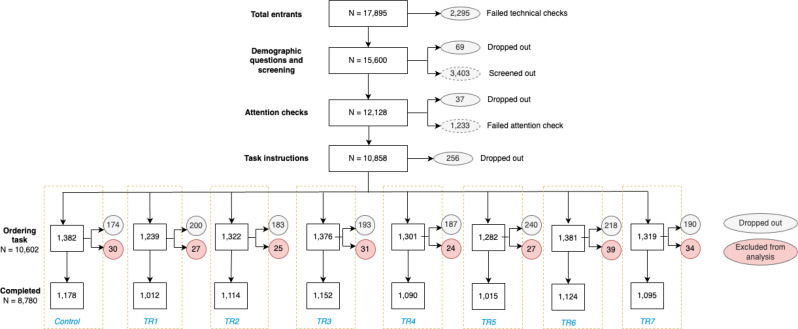
UK adults (n = 8,780) who used food delivery platforms were asked to use the simulated platform as they would in real life to order a meal for themselves. Participants were randomly allocated to a control condition (no calorie labels) or to one of seven intervention groups: (1) large size calorie labels adjacent to the price (LP), (2) large size label adjacent to the product name (LN), (3) small label adjacent to price (SP), (4) small label adjacent to product name (SN), (5) LP with a calorie label switch-off filter (LP + Off), (6) LP with a switch-on filter (LP + On), or, (7) LP with a summary label of the total basket energy content (LP + Sum). Regression analysis assessed the impact of calorie labels on energy content of foods selected compared to the control condition.
The mean energy selected in the control condition was 1408 kcal (95%CI: 93, 2719). There was a statistically significant reduction in mean energy selected in five of the seven intervention trial arms (LN labels (-60 kcal, 95%CI: -111, -6), SN (-73, 95%CI: -125, -19), LP + Off (-110, 95%CI: -161, -57), LP + On (-109, 95%CI: -159, -57), LP + Sum (-85 kcal, 95%CI: -137, -30). There was no evidence the other two conditions (LP (-33, 95%CI: -88, 24) and SP (-52, 95%CI: -105, 2)) differed from control. There was no evidence of an effect of any intervention when the analysis was restricted to participants who were overweight or obese.
Adding calorie labels to food items in a simulated online food delivery platform reduced the energy content of foods selected in five out of seven labelling scenarios. This study provides useful information to inform the implementation of these labels in a food delivery platform context.
随着英国肥胖和超重率的不断上升,卡路里标签已作为一种政策选择被引入菜单,为消费者提供有关食品能量含量的信息,并促进知情选择。本研究旨在测试在模拟食品配送平台上添加食品项目的卡路里标签是否可以减少所选项目的能量含量。
要求使用食品配送平台的英国成年人(n=8780)像在现实生活中一样使用模拟平台为自己点餐。参与者被随机分配到对照组(无卡路里标签)或七个干预组之一:(1)价格旁边的大尺寸卡路里标签(LP),(2)产品名称旁边的大尺寸标签(LN),(3)价格旁边的小标签(SP),(4)产品名称旁边的小标签(SN),(5)带有卡路里标签关闭过滤器的 LP(LP+Off),(6)带有打开过滤器的 LP(LP+On),或(7)带有总篮子能量含量摘要标签的 LP(LP+Sum)。回归分析评估了卡路里标签对与对照组相比所选食品能量含量的影响。
对照组选择的平均能量为 1408 千卡(95%CI:93,2719)。在七个干预试验组中的五个组中,所选的平均能量均有统计学显著降低(LN 标签(-60 千卡,95%CI:-111,-6),SN(-73 千卡,95%CI:-125,-19),LP+Off(-110 千卡,95%CI:-161,-57),LP+On(-109 千卡,95%CI:-159,-57),LP+Sum(-85 千卡,95%CI:-137,-30))。没有证据表明其他两种情况(LP(-33 千卡,95%CI:-88,24)和 SP(-52 千卡,95%CI:-105,2))与对照组不同。当分析仅限于超重或肥胖的参与者时,没有证据表明任何干预措施有效果。
在模拟在线食品配送平台上为食品项目添加卡路里标签可减少五种标签情景中所选食品的能量含量。本研究为在食品配送平台环境中实施这些标签提供了有用信息。