Ringelhan Marc, Schuehle Svenja, van de Klundert Maarten, Kotsiliti Elena, Plissonnier Marie-Laure, Faure-Dupuy Suzanne, Riedl Tobias, Lange Sebastian, Wisskirchen Karin, Thiele Frank, Cheng Cho-Chin, Yuan Detian, Leone Valentina, Schmidt Ronny, Hünergard Juliana, Geisler Fabian, Unger Kristian, Algül Hana, Schmid Roland M, Rad Roland, Wedemeyer Heiner, Levrero Massimo, Protzer Ulrike, Heikenwalder Mathias
Second Medical Department, University Hospital Rechts der Isar, Technical University of Munich, School of Medicine & Health, Munich, Germany.
German Centre for Infection Research (DZIF), Munich Partner Site, Munich, Germany.
JHEP Rep. 2024 Jun 6;6(10):101128. doi: 10.1016/j.jhepr.2024.101128. eCollection 2024 Oct.
BACKGROUND & AIMS: Although most hepatocellular carcinoma (HCC) cases are driven by hepatitis and cirrhosis, a subset of patients with chronic hepatitis B develop HCC in the absence of advanced liver disease, indicating the oncogenic potential of hepatitis B virus (HBV). We investigated the role of HBV transcripts and proteins on HCC development in the absence of inflammation in HBV-transgenic mice.
HBV-transgenic mice replicating HBV and expressing all HBV proteins from a single integrated 1.3-fold HBV genome in the presence or absence of wild-type HBx (HBV1.3/HBVxfs) were analyzed. Flow cytometry, molecular, histological and analyses using human cell lines were performed. Hepatocyte-specific Stat3- and Socs3-knockout was analyzed in HBV1.3 mice.
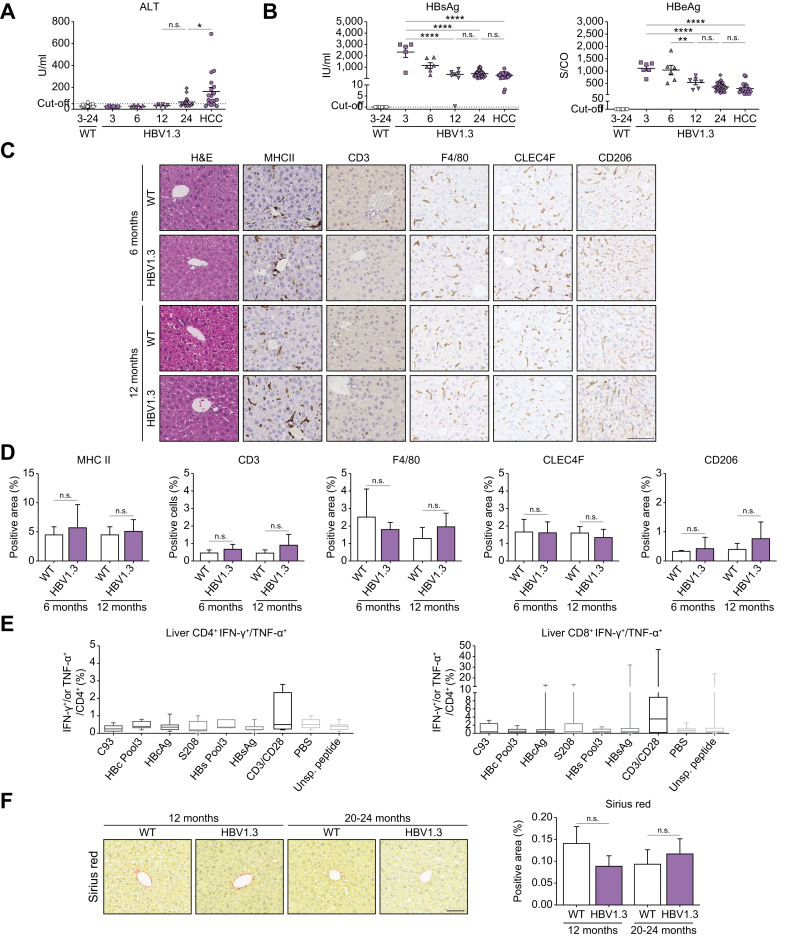
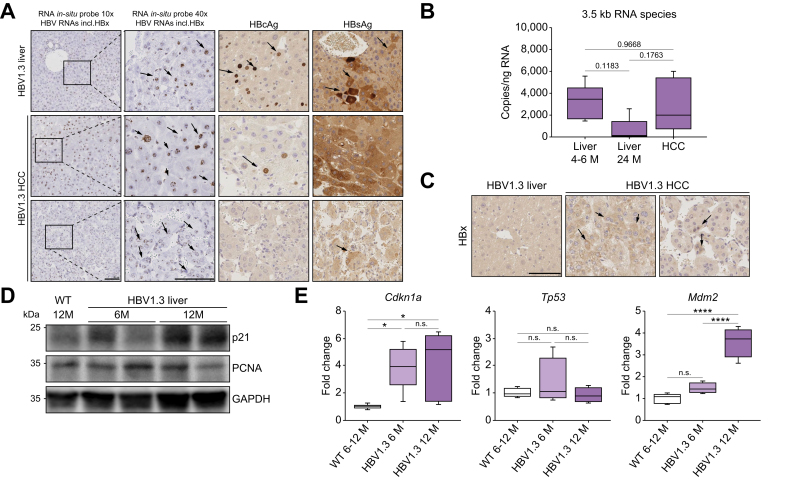
Approximately 38% of HBV1.3 mice developed liver tumors. Protein expression patterns, histology, and mutational landscape analyses indicated that tumors resembled human HCC. HBV1.3 mice showed no signs of active hepatitis, except STAT3 activation, up to the time point of HCC development. HBV-RNAs covering HBx sequence, 3.5-kb HBV RNA and HBx-protein were detected in HCC tissue. Interestingly, HBVxfs mice expressing all HBV proteins except a C-terminally truncated HBx (without the ability to bind DNA damage binding protein 1) showed reduced signs of DNA damage response and had a significantly reduced HCC incidence. Importantly, intercrossing HBV1.3 mice with a hepatocyte-specific STAT3-knockout abrogated HCC development.
Expression of HBV-proteins is sufficient to cause HCC in the absence of detectable inflammation. This indicates the oncogenic potential of HBV and in particular HBx. In our model, HBV-driven HCC was STAT3 dependent. Our study highlights the immediate oncogenic potential of HBV, challenging the idea of a benign highly replicative phase of HBV infection and indicating the necessity for an HBV 'cure'.
Although most HCC cases in patients with chronic HBV infection occur after a sequence of liver damage and fibrosis, a subset of patients develops HCC without any signs of advanced liver damage. We demonstrate that the expression of all viral transcripts in HBV-transgenic mice suffices to induce HCC development independent of inflammation and fibrosis. These data indicate the direct oncogenic effects of HBV and emphasize the idea of early antiviral treatment in the 'immune-tolerant' phase (HBeAg-positive chronic HBV infection).
虽然大多数肝细胞癌(HCC)病例由肝炎和肝硬化引起,但一部分慢性乙型肝炎患者在没有晚期肝病的情况下发生HCC,这表明乙型肝炎病毒(HBV)具有致癌潜力。我们研究了在无炎症的HBV转基因小鼠中,HBV转录本和蛋白在HCC发生中的作用。
分析了在存在或不存在野生型HBx(HBV1.3/HBVxfs)的情况下,从单个整合的1.3倍HBV基因组复制HBV并表达所有HBV蛋白的HBV转基因小鼠。使用人细胞系进行了流式细胞术、分子、组织学和分析。在HBV1.3小鼠中分析了肝细胞特异性Stat3和Socs3基因敲除情况。
约38%的HBV1.3小鼠发生肝肿瘤。蛋白质表达模式、组织学和突变图谱分析表明,肿瘤类似于人类HCC。直到HCC发生的时间点,HBV1.3小鼠除了STAT3激活外,没有活动性肝炎的迹象。在HCC组织中检测到覆盖HBx序列的HBV-RNAs、3.5 kb HBV RNA和HBx蛋白。有趣的是,表达除C末端截短的HBx(无结合DNA损伤结合蛋白1的能力)外的所有HBV蛋白的HBVxfs小鼠,DNA损伤反应迹象减少,HCC发病率显著降低。重要的是,将HBV1.3小鼠与肝细胞特异性STAT3基因敲除小鼠杂交可消除HCC的发生。
在没有可检测到的炎症的情况下,HBV蛋白的表达足以导致HCC。这表明HBV特别是HBx具有致癌潜力。在我们的模型中,HBV驱动的HCC是STAT3依赖性的。我们的研究突出了HBV的直接致癌潜力,挑战了HBV感染良性高复制阶段的观点,并表明了“治愈”HBV的必要性。
虽然慢性HBV感染患者的大多数HCC病例发生在一系列肝损伤和纤维化之后,但一部分患者在没有任何晚期肝损伤迹象的情况下发生HCC。我们证明,HBV转基因小鼠中所有病毒转录本的表达足以诱导HCC的发生,而与炎症和纤维化无关。这些数据表明了HBV的直接致癌作用,并强调了在“免疫耐受”期(HBeAg阳性慢性HBV感染)进行早期抗病毒治疗的观点。