The Third People's Hospital of Shenzhen, Shenzhen, China.
Shenzhen Research Center for Communicable Disease Diagnosis and Treatment, Chinese Academy of Medical Sciences, Shenzhen, China.
Front Public Health. 2024 Sep 3;12:1452233. doi: 10.3389/fpubh.2024.1452233. eCollection 2024.
Surveillance remains fundamental to understanding the changes in epidemiological patterns regarding post-COVID conditions and reinfections. Persistent symptoms and reinfection in previously infected individuals are increasing being reported in many countries, but their associations among general populations were seldomly reported. Understanding the association with persistent symptoms of COVID-19 reinfection is essential to develop strategies to mitigate the long-term health and socio-economic impacts of the post-COVID conditions. This study aimed to investigate the incidence of COVID-19 persistent symptoms among previously infected Chinese community residents and explore associations of specific COVID-19 persistent symptoms with reinfection and other factors.
A community-based survey was conducted in a southern city of China with about 20 million residents from August 3 to 24, 2023. Face-to-face questionnaires were distributed to a total of 1,485 residents to collect their information about COVID-19 infection, reinfection, specific ongoing persistent symptoms, and other COVID-19 related information. Multivariable logistic regression analysis was used to examine the association between specific persistent symptoms and reinfection of COVID-19, along with age, gender, and educational level.
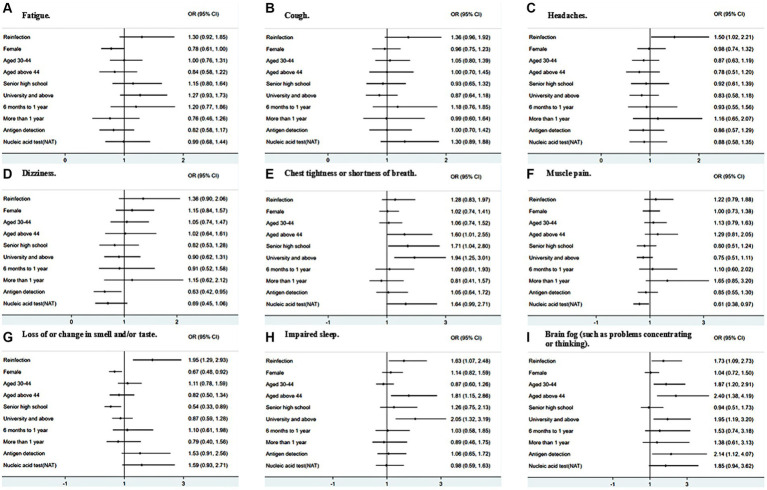
Of the 1,485 participants, 1,089 (73.3%) reported they had been infected with COVID-19. Among them, 89.1% reported having ongoing persistent symptoms and 14.2% reported had two or more times of infection. About 20% participants were infected 1 year or more since their initial infection. Fatigue, cough, and headaches were the top 3 symptoms being reported. Participants with reinfection were associated with a higher probability of reporting headaches (OR: 1.54, 95% CI: 1.06-2.25), loss of or change in smell and/or taste (OR: 1.90, 95% CI: 1.27-2.83), impaired sleep (OR: 1.55, 95% CI: 1.02-2.35), and brain fog (OR: 1.76, 95% CI: 1.12-2.76). Participants aged 45 and above and who had a bachelor's or higher degree were more likely to report chest tightness or shortness of breath, impaired sleep, and brain fog.
During the post-emergency period of COVID-19 pandemic, the incidence of ongoing persistent symptoms among Chinese residents remains high. Individuals whose initial infection was longer than 1 year have the highest probability of reporting having multiple symptoms. Reinfection may increase the risk of reporting headaches, loss of or change in smell and/or taste, impaired sleep, and brain fog. It is important to maintain routine syndromic surveillance among previously infected people and provide recommendations for clinical management of individuals with multiple ongoing symptoms.
监测对于了解新冠后状况和再感染的流行病学模式变化仍然至关重要。许多国家持续报告先前感染过的个体出现持续症状和再感染的情况越来越多,但一般人群中这些情况的关联很少有报道。了解与 COVID-19 再感染持续症状的关联对于制定减轻新冠后状况对长期健康和社会经济影响的策略至关重要。本研究旨在调查先前感染的中国社区居民中 COVID-19 持续症状的发生率,并探讨特定 COVID-19 持续症状与再感染和其他因素的关联。
2023 年 8 月 3 日至 24 日,在中国南方一个拥有约 2000 万居民的城市进行了一项基于社区的调查。通过面对面问卷向总共 1485 名居民收集他们关于 COVID-19 感染、再感染、特定持续症状和其他 COVID-19 相关信息的信息。多变量逻辑回归分析用于检查特定持续症状与 COVID-19 再感染之间的关联,以及年龄、性别和教育水平。
在 1485 名参与者中,有 1089 名(73.3%)报告曾感染过 COVID-19。其中,89.1%报告存在持续症状,14.2%报告有两次或多次感染。约 20%的参与者在初始感染后 1 年或更长时间感染。疲劳、咳嗽和头痛是报告最多的前 3 种症状。再感染者更有可能报告头痛(比值比[OR]:1.54,95%置信区间[CI]:1.06-2.25)、嗅觉和/或味觉丧失或改变(OR:1.90,95%CI:1.27-2.83)、睡眠障碍(OR:1.55,95%CI:1.02-2.35)和脑雾(OR:1.76,95%CI:1.12-2.76)。45 岁及以上和拥有学士或以上学位的参与者更有可能报告胸闷或呼吸急促、睡眠障碍和脑雾。
在新冠大流行的紧急阶段后,中国居民持续存在持续症状的发生率仍然很高。初始感染时间超过 1 年的个体报告出现多种症状的可能性最高。再感染可能会增加报告头痛、嗅觉和/或味觉丧失或改变、睡眠障碍和脑雾的风险。在先前感染的人群中保持常规症状监测并为有多种持续症状的个体提供临床管理建议非常重要。