Liang Yao, Xie Siwei, Zheng Xuqi, Wu Xinyu, Du Sijin, Jiang Yutong
Department of Rheumatology and Immunology, Third Affiliated Hospital of Sun Yat-Sen University, 600 Tianhe Road, Tianhe District, Guangzhou, China.
Johns Hopkins Bloomberg School of Public Health, Baltimore, MD, USA.
J Transl Med. 2024 Dec 24;22(1):1144. doi: 10.1186/s12967-024-05982-2.
Corona virus disease 2019 (COVID-19) reinfection, particularly short-term reinfection, poses challenges to the management of rheumatic diseases and may increase adverse clinical outcomes. This study aims to develop machine learning models to predict and identify the risk of short-term COVID-19 reinfection in patients with rheumatic diseases.
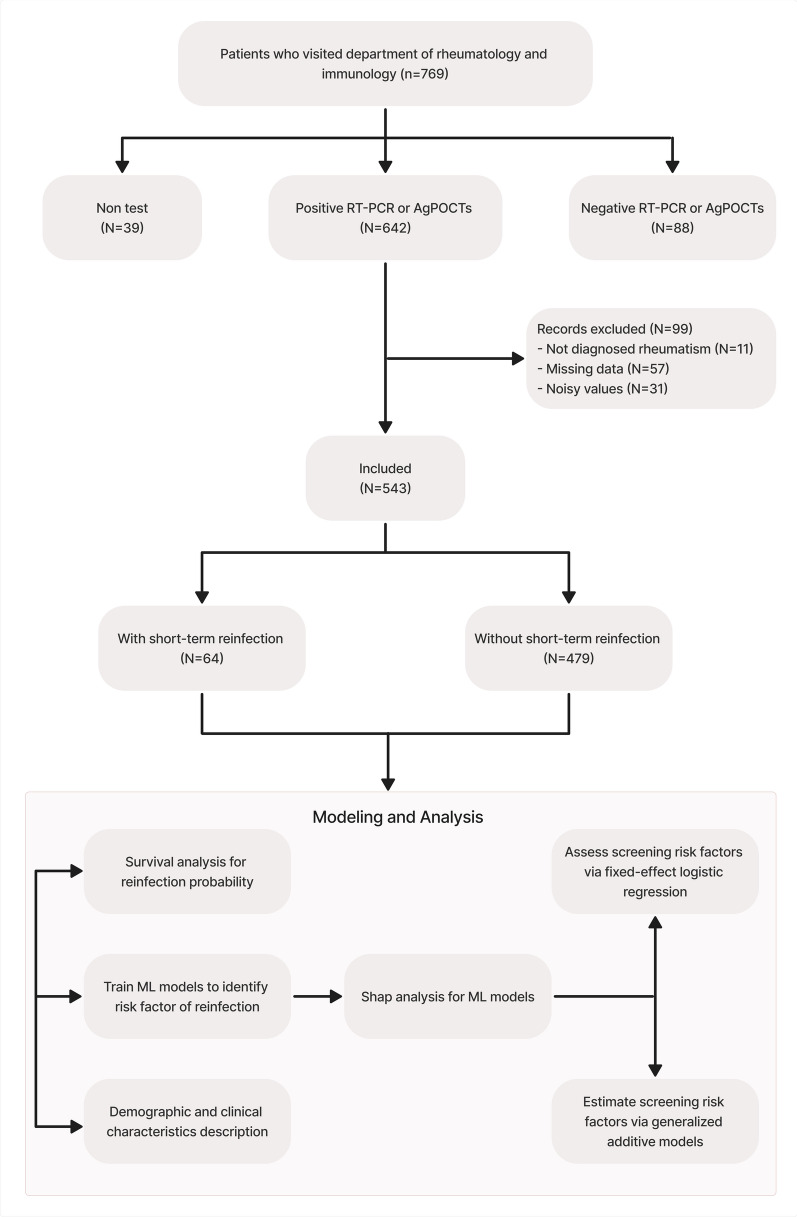
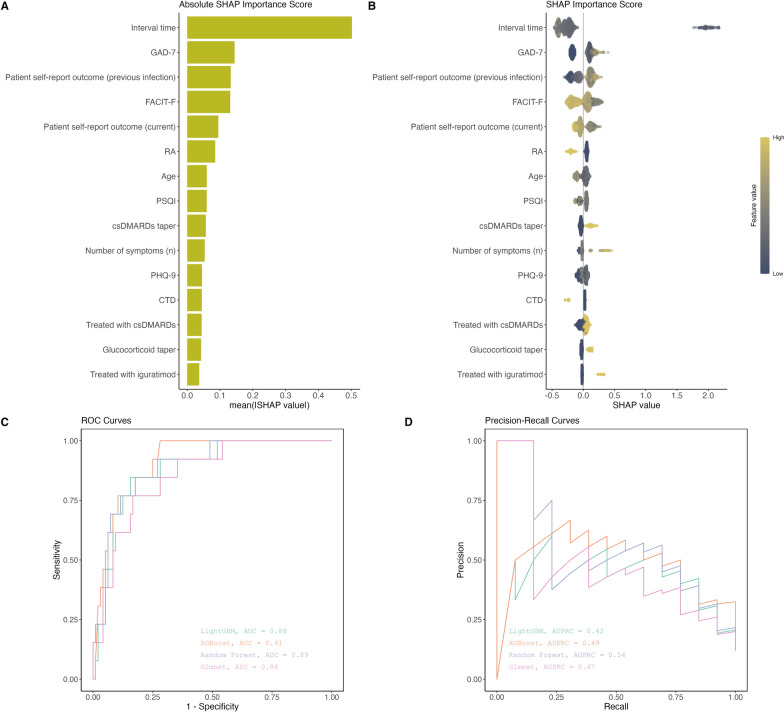
We developed four prediction models using explainable machine learning to assess the risk of short-term COVID-19 reinfection in 543 patients with rheumatic diseases. Psychological health was evaluated using the Functional Assessment of Chronic Illness Therapy Fatigue (FACIT-F) scale, the Patient Health Questionnaire-9 (PHQ-9), the Generalized Anxiety Disorder 7-item (GAD-7) questionnaire, and the Pittsburgh Sleep Quality Index (PSQI) scale. Health status and disease activity were assessed using the EuroQol-5 Dimension-3 Level (EQ-5D-3L) descriptive system and the Visual Analogue Score (VAS) scale. The model performance was assessed by Area Under the Receiver Operating Characteristic Curve (AUC), Area Under the Precision-Recall Curve (AUPRC), and the geometric mean of sensitivity and specificity (G-mean). SHapley Additive exPlanations (SHAP) analysis was used to interpret the contribution of each predictor to the model outcomes.
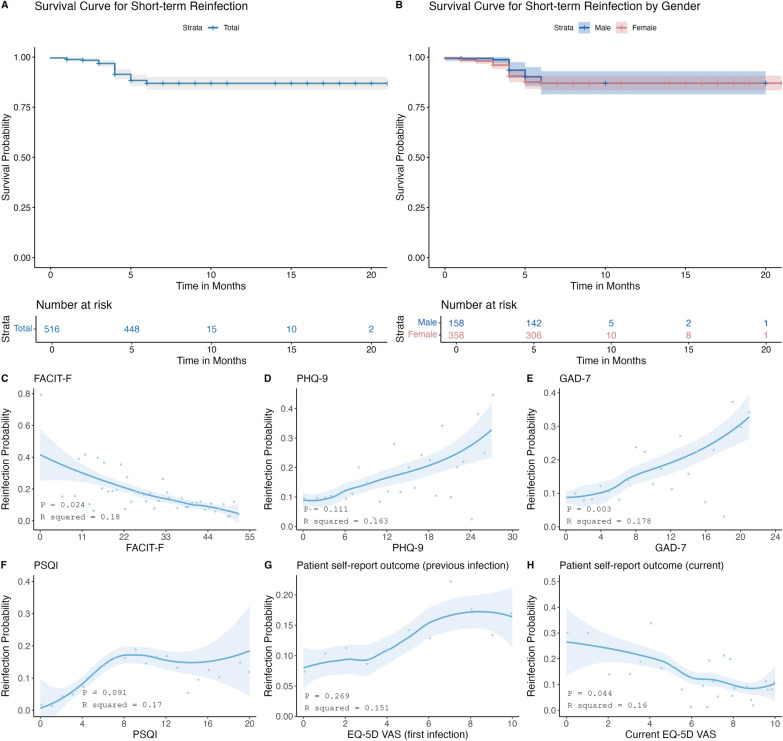
The eXtreme Gradient Boosting (XGBoost) model demonstrated superior performance with an AUC of 0.91 (95% CI 0.87-0.95). Significant factors of short-term reinfection included glucocorticoid taper (OR = 2.61, 95% CI 1.38-4.92), conventional synthetic disease-modifying antirheumatic drugs (csDMARDs) taper (OR = 2.97, 95% CI 1.90-4.64), the number of symptoms (OR = 1.24, 95% CI 1.08-1.42), and GAD-7 scores (OR = 1.07, 95% CI 1.02-1.13). FACIT-F scores were associated with a lower likelihood of short-term reinfection (OR = 0.95, 95% CI 0.93-0.96). Besides, we found that the GAD-7 score was one of the most important predictors.
We developed explainable machine learning models to predict the risk of short-term COVID-19 reinfection in patients with rheumatic diseases. SHAP analysis highlighted the importance of clinical and psychological factors. Factors included anxiety, fatigue, depression, poor sleep quality, high disease activity during initial infection, and the use of glucocorticoid taper were significant predictors. These findings underscore the need for targeted preventive measures in this patient population.
2019冠状病毒病(COVID-19)再感染,尤其是短期再感染,给风湿病的管理带来了挑战,并可能增加不良临床结局。本研究旨在开发机器学习模型,以预测和识别风湿病患者短期COVID-19再感染的风险。
我们使用可解释的机器学习开发了四个预测模型,以评估543例风湿病患者短期COVID-19再感染的风险。使用慢性病治疗功能评估疲劳(FACIT-F)量表、患者健康问卷9项(PHQ-9)、广泛性焦虑障碍7项(GAD-7)问卷和匹兹堡睡眠质量指数(PSQI)量表评估心理健康。使用欧洲五维健康量表3水平(EQ-5D-3L)描述系统和视觉模拟评分(VAS)量表评估健康状况和疾病活动度。通过受试者操作特征曲线下面积(AUC)、精确召回率曲线下面积(AUPRC)以及灵敏度和特异度的几何均值(G-均值)评估模型性能。使用SHapley加性解释(SHAP)分析来解释每个预测因子对模型结果的贡献。
极端梯度提升(XGBoost)模型表现出色,AUC为0.91(95%CI 0.87-0.95)。短期再感染的显著因素包括糖皮质激素减量(OR = 2.61,95%CI 1.38-4.92)、传统合成改善病情抗风湿药物(csDMARDs)减量(OR = 2.97,95%CI 1.90-4.64)、症状数量(OR = 1.24,95%CI 1.08-1.42)和GAD-7评分(OR = 1.07,95%CI 1.02-1.13)。FACIT-F评分与短期再感染的可能性较低相关(OR = 0.95,95%CI 0.93-0.96)。此外,我们发现GAD-7评分是最重要的预测因子之一。
我们开发了可解释的机器学习模型来预测风湿病患者短期COVID-19再感染的风险。SHAP分析突出了临床和心理因素的重要性。这些因素包括焦虑、疲劳、抑郁、睡眠质量差、初次感染时疾病活动度高以及糖皮质激素减量的使用,都是显著的预测因子。这些发现强调了在这一患者群体中采取针对性预防措施的必要性。