Gianferrari Giulia, Cuoghi Costantini Riccardo, Crippa Valeria, Carra Serena, Bonetto Valentina, Pansarasa Orietta, Cereda Cristina, Zucchi Elisabetta, Martinelli Ilaria, Simonini Cecilia, Vicini Roberto, Fini Nicola, Trojsi Francesca, Passaniti Carla, Ticozzi Nicola, Doretti Alberto, Diamanti Luca, Fiamingo Giuseppe, Conte Amelia, Dalla Bella Eleonora, D'Errico Eustachio, Scarian Eveljn, Pasetto Laura, Antoniani Francesco, Galli Veronica, Casarotto Elena, D'Amico Roberto, Poletti Angelo, Mandrioli Jessica
Department of Biomedical, Metabolic and Neural Sciences, University of Modena and Reggio Emilia, Modena 41121, Italy.
Department of Neurosciences, Azienda Ospedaliero Universitaria di Modena, Modena 41126, Italy.
Brain Commun. 2024 Sep 5;6(5):fcae304. doi: 10.1093/braincomms/fcae304. eCollection 2024.
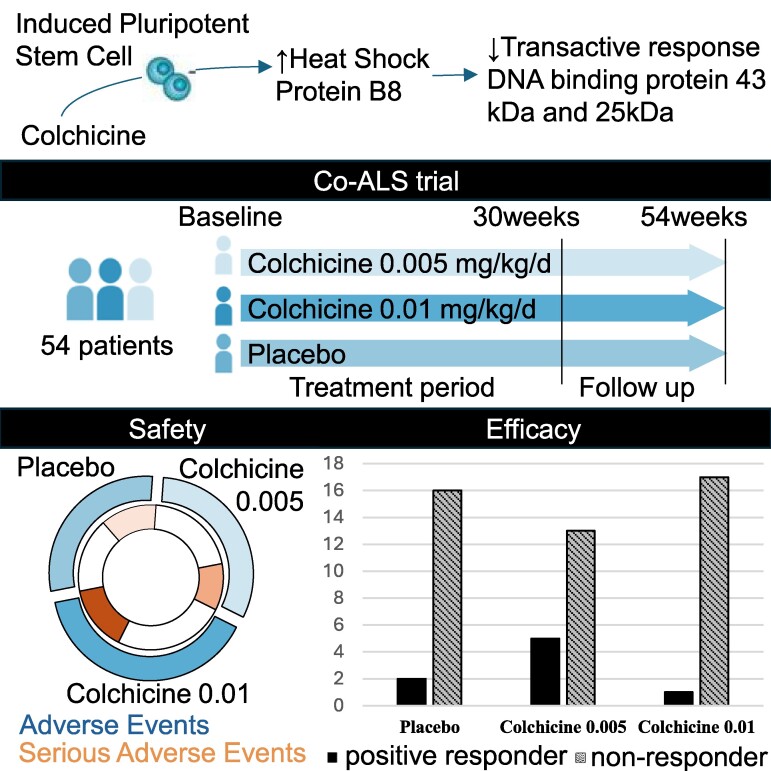
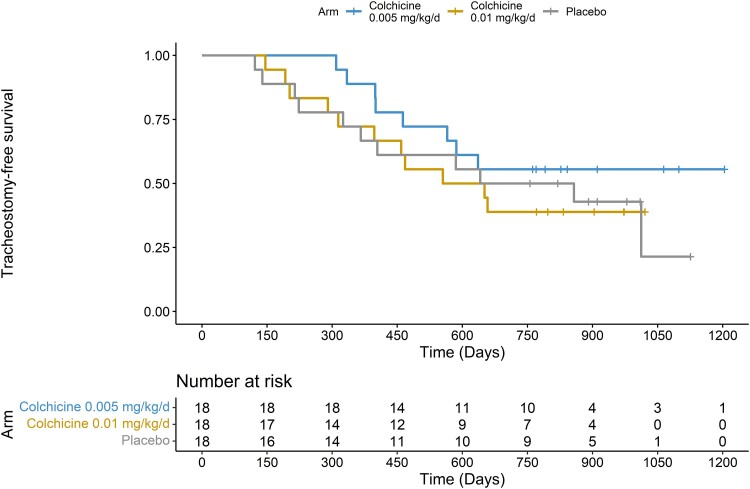
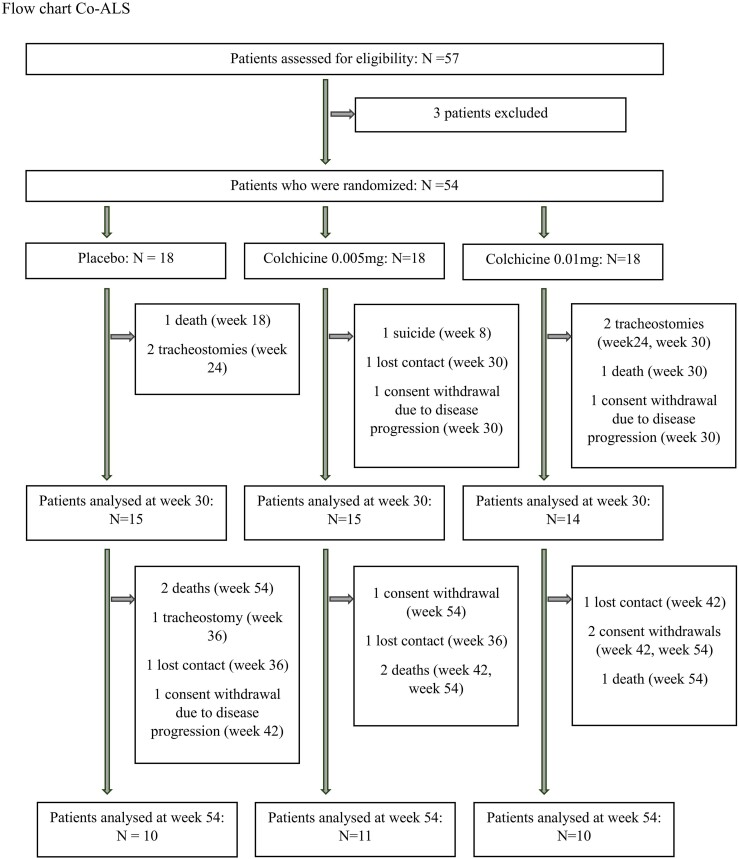
In preclinical studies, the anti-inflammatory drug colchicine, which has never been tested in amyotrophic lateral sclerosis, enhanced the expression of autophagy factors and inhibited accumulation of transactive response DNA-binding protein 43 kDa, a known histopathological marker of amyotrophic lateral sclerosis. This multicentre, randomized, double-blind trial enrolled patients with probable or definite amyotrophic lateral sclerosis who experienced symptom onset within the past 18 months. Patients were randomly assigned in a 1:1:1 ratio to receive colchicine at a dose of 0.005 mg/kg/day, 0.01 mg/kg/day or placebo for a treatment period of 30 weeks. The number of positive responders, defined as patients with a decrease lesser than 4 points in the Amyotrophic Lateral Sclerosis Functional Rating Scale-Revised total score during the 30-week treatment period, was the primary outcome. Disease progression, survival, safety and quality of life at the end of treatment were the secondary clinical outcomes. Secondary biological outcomes included changes from baseline to treatment end of stress granule and autophagy responses, transactive response DNA-binding protein 43 kDa, neurofilament accumulation and extracellular vesicle secretion, between the colchicine and placebo groups. Fifty-four patients were randomized to receive colchicine ( = 18 for each colchicine arm) or placebo ( = 18). The number of positive responders did not differ between the placebo and colchicine groups: 2 out of 18 patients (11.1%) in the placebo group, 5 out of 18 patients (27.8%) in the colchicine 0.005 mg/kg/day group (odds ratio = 3.1, 97.5% confidence interval 0.4-37.2, = 0.22) and 1 out of 18 patients (5.6%) in the colchicine 0.01 mg/kg/day group (odds ratio = 0.5, 97.5% confidence interval 0.01-10.2, = 0.55). During treatment, a slower Amyotrophic Lateral Sclerosis Functional Rating Scale-Revised decline was detected in patients receiving colchicine 0.005 mg/kg/day (mean difference = 0.53, 97.5% confidence interval 0.07-0.99, = 0.011). Eight patients experienced adverse events in placebo arm (44.4%), three in colchicine 0.005 mg/kg/day (16.7%) and seven in colchicine 0.01 mg/kg/day arm (35.9%). The differences in adverse events were not statistically significant. In conclusion, colchicine treatment was safe for amyotrophic lateral sclerosis patients. Further studies are required to better understand mechanisms of action and clinical effects of colchicine in this condition.
在临床前研究中,从未在肌萎缩侧索硬化症中进行过测试的抗炎药物秋水仙碱,增强了自噬因子的表达,并抑制了转录激活反应DNA结合蛋白43 kDa(一种已知的肌萎缩侧索硬化症组织病理学标志物)的积累。这项多中心、随机、双盲试验纳入了在过去18个月内出现症状的可能或确诊的肌萎缩侧索硬化症患者。患者按1:1:1的比例随机分配,接受剂量为0.005 mg/kg/天、0.01 mg/kg/天的秋水仙碱或安慰剂,治疗期为30周。主要结局是阳性反应者的数量,定义为在30周治疗期内肌萎缩侧索硬化症功能评定量表修订版总分下降少于4分的患者。治疗结束时的疾病进展、生存、安全性和生活质量是次要临床结局。次要生物学结局包括秋水仙碱组和安慰剂组之间从基线到治疗结束时应激颗粒和自噬反应、转录激活反应DNA结合蛋白43 kDa、神经丝积累和细胞外囊泡分泌的变化。54名患者被随机分配接受秋水仙碱(每个秋水仙碱组18名)或安慰剂(18名)。安慰剂组和秋水仙碱组之间的阳性反应者数量没有差异:安慰剂组18名患者中有2名(11.1%),秋水仙碱0.005 mg/kg/天组18名患者中有5名(27.8%)(优势比 = 3.1,97.5%置信区间0.4 - 37.2,P = 0.22),秋水仙碱0.01 mg/kg/天组18名患者中有1名(5.6%)(优势比 = 0.5,97.5%置信区间0.01 - 10.2,P = 0.55)。在治疗期间,接受0.005 mg/kg/天秋水仙碱的患者中,肌萎缩侧索硬化症功能评定量表修订版的下降速度较慢(平均差异 = 0.53,97.5%置信区间0.07 - 0.99,P = 0.011)。安慰剂组有8名患者发生不良事件(44.4%),秋水仙碱0.005 mg/kg/天组有3名(16.7%),秋水仙碱0.01 mg/kg/天组有7名(35.9%)。不良事件的差异无统计学意义。总之,秋水仙碱治疗对肌萎缩侧索硬化症患者是安全的。需要进一步研究以更好地了解秋水仙碱在这种情况下的作用机制和临床效果。