Laboratory of Experimental Biology, Dipartimento di Scienze Farmacologiche e Biomolecolari, Dipartimento di Eccellenza 2018-2027, Università degli studi di Milano, Milan, Italy.
Unit of Medical Genetics and Neurogenetics, Fondazione IRCCS Istituto Neurologico Carlo Besta, Milan, Italy.
Autophagy. 2023 Jun;19(6):1619-1641. doi: 10.1080/15548627.2022.2160564. Epub 2023 Jan 3.
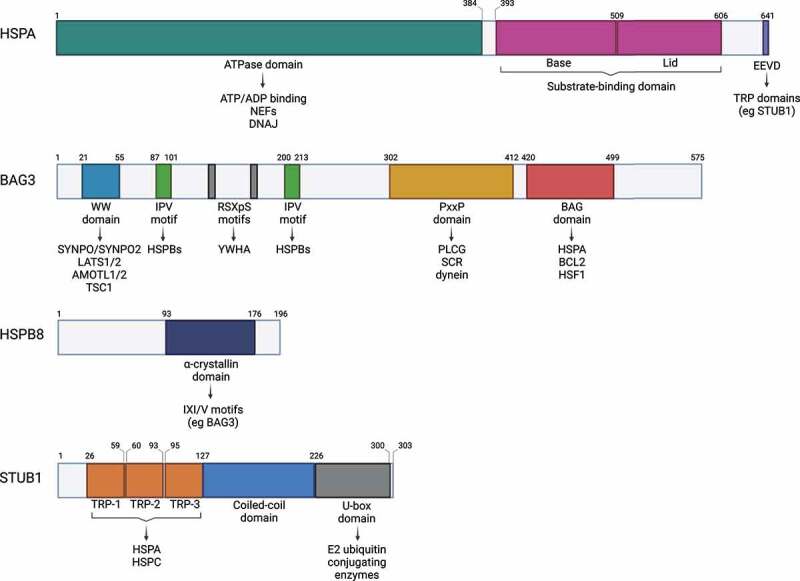
Each protein must be synthesized with the correct amino acid sequence, folded into its native structure, and transported to a relevant subcellular location and protein complex. If any of these steps fail, the cell has the capacity to break down aberrant proteins to maintain protein homeostasis (also called proteostasis). All cells possess a set of well-characterized protein quality control systems to minimize protein misfolding and the damage it might cause. Autophagy, a conserved pathway for the degradation of long-lived proteins, aggregates, and damaged organelles, was initially characterized as a bulk degradation pathway. However, it is now clear that autophagy also contributes to intracellular homeostasis by selectively degrading cargo material. One of the pathways involved in the selective removal of damaged and misfolded proteins is chaperone-assisted selective autophagy (CASA). The CASA complex is composed of three main proteins (HSPA, HSPB8 and BAG3), essential to maintain protein homeostasis in muscle and neuronal cells. A failure in the CASA complex, caused by mutations in the respective coding genes, can lead to (cardio)myopathies and neurodegenerative diseases. Here, we summarize our current understanding of the CASA complex and its dynamics. We also briefly discuss how CASA complex proteins are involved in disease and may represent an interesting therapeutic target. ALP: autophagy lysosomal pathway; ALS: amyotrophic lateral sclerosis; AMOTL1: angiomotin like 1; ARP2/3: actin related protein 2/3; BAG: BAG cochaperone; BAG3: BAG cochaperone 3; CASA: chaperone-assisted selective autophagy; CMA: chaperone-mediated autophagy; DNAJ/HSP40: DnaJ heat shock protein family (Hsp40); DRiPs: defective ribosomal products; EIF2A/eIF2α: eukaryotic translation initiation factor 2A; EIF2AK1/HRI: eukaryotic translation initiation factor 2 alpha kinase 1; GABARAP: GABA type A receptor-associated protein; HDAC6: histone deacetylase 6; HSP: heat shock protein; HSPA/HSP70: heat shock protein family A (Hsp70); HSP90: heat shock protein 90; HSPB8: heat shock protein family B (small) member 8; IPV: isoleucine-proline-valine; ISR: integrated stress response; KEAP1: kelch like ECH associated protein 1; LAMP2A: lysosomal associated membrane protein 2A; LATS1: large tumor suppressor kinase 1; LIR: LC3-interacting region; MAP1LC3/LC3: microtubule associated protein 1 light chain 3; MTOC: microtubule organizing center; MTOR: mechanistic target of rapamycin kinase; NFKB/NF-κB: nuclear factor kappa B; NFE2L2: NFE2 like bZIP transcription factor 2; PLCG/PLCγ: phospholipase C gamma; polyQ: polyglutamine; PQC: protein quality control; PxxP: proline-rich; RAN translation: repeat-associated non-AUG translation; SG: stress granule; SOD1: superoxide dismutase 1; SQSTM1/p62: sequestosome 1; STUB1/CHIP: STIP1 homology and U-box containing protein 1; STK: serine/threonine kinase; SYNPO: synaptopodin; TBP: TATA-box binding protein; TARDBP/TDP-43: TAR DNA binding protein; TFEB: transcription factor EB; TPR: tetratricopeptide repeats; TSC1: TSC complex subunit 1; UBA: ubiquitin associated; UPS: ubiquitin-proteasome system; WW: tryptophan-tryptophan; WWTR1: WW domain containing transcription regulator 1; YAP1: Yes1 associated transcriptional regulator.
每种蛋白质都必须具有正确的氨基酸序列,折叠成其天然结构,并运输到相关的亚细胞位置和蛋白质复合物。如果这些步骤中的任何一个失败,细胞就有能力分解异常蛋白质以维持蛋白质的内环境稳定(也称为蛋白质稳态)。所有细胞都具有一套特征明确的蛋白质质量控制系统,以最大限度地减少蛋白质错误折叠及其可能造成的损害。自噬是一种用于降解长寿蛋白质、聚集体和受损细胞器的保守途径,最初被描述为一种批量降解途径。然而,现在很清楚,自噬也通过选择性降解货物物质来有助于细胞内的内环境稳定。参与选择性去除受损和错误折叠蛋白质的途径之一是伴侣辅助的选择性自噬(CASA)。CASA 复合物由三种主要蛋白质(HSPA、HSPB8 和 BAG3)组成,对于维持肌肉和神经元细胞中的蛋白质内环境稳定至关重要。各自编码基因的突变会导致 CASA 复合物的功能障碍,从而导致(心脏)肌病和神经退行性疾病。在这里,我们总结了我们对 CASA 复合物及其动力学的当前理解。我们还简要讨论了 CASA 复合物蛋白如何参与疾病,以及它们可能成为一个有趣的治疗靶点。ALP:自噬溶酶体途径;ALS:肌萎缩侧索硬化症;AMOTL1:血管运动蛋白样 1;ARP2/3:肌动蛋白相关蛋白 2/3;BAG:BAG 伴侣蛋白;BAG3:BAG 伴侣蛋白 3;CASA:伴侣辅助的选择性自噬;CMA:伴侣介导的自噬;DNAJ/HSP40:DnaJ 热休克蛋白家族(Hsp40);DRiPs:有缺陷的核糖体产物;EIF2A/eIF2α:真核翻译起始因子 2A;EIF2AK1/HRI:真核翻译起始因子 2α激酶 1;GABARAP:GABA 型 A 受体相关蛋白;HDAC6:组蛋白去乙酰化酶 6;HSP:热休克蛋白;HSPA/HSP70:热休克蛋白家族 A(Hsp70);HSP90:热休克蛋白 90;HSPB8:热休克蛋白家族 B(小)成员 8;IPV:异亮氨酸-脯氨酸-缬氨酸;ISR:综合应激反应;KEAP1:kelch 样 ECH 相关蛋白 1;LAMP2A:溶酶体相关膜蛋白 2A;LATS1:大肿瘤抑制激酶 1;LIR:LC3 相互作用区域;MAP1LC3/LC3:微管相关蛋白 1 轻链 3;MTOC:微管组织中心;MTOR:雷帕霉素靶蛋白激酶;NFKB/NF-κB:核因子 kappa B;NFE2L2:NFE2 样 bZIP 转录因子 2;PLCγ:磷脂酶 Cγ;polyQ:多聚谷氨酰胺;PQC:蛋白质质量控制;PxxP:富含脯氨酸;RAN 翻译:重复相关的非 AUG 翻译;SG:应激颗粒;SOD1:超氧化物歧化酶 1;SQSTM1/p62:自噬体 1;STUB1/CHIP:STIP1 同源和 U 盒含有蛋白 1;STK:丝氨酸/苏氨酸激酶;SYNPO:突触蛋白;TBP:TATA 框结合蛋白;TARDBP/TDP-43:TAR DNA 结合蛋白;TFEB:转录因子 EB;TPR:四肽重复;TSC1:TSC 复合物亚基 1;UBA:泛素相关;UPS:泛素-蛋白酶体系统;WW:色氨酸-色氨酸;WWTR1:WW 结构域包含转录调节剂 1;YAP1:Yes1 相关转录调节剂。