Tsihlis George, Pirabhahar Kieren, Sciberras Frederika, Nicdao MaryAnn, Aw Laraine, Agoo Alvie, Lee Vincent, Li Jennifer, Kairaitis Lukas, Sud Kamal, Swinnen Jan, Chau Katrina
Western Renal Services (Western Sydney and Nepean Blue Mountains Local Health Districts), Sydney, New South Wales, Australia.
The Westmead Institute for Medical Research, Westmead, New South Wales, Australia.
Kidney Int Rep. 2024 Jul 10;9(9):2727-2738. doi: 10.1016/j.ekir.2024.07.004. eCollection 2024 Sep.
Internationally, peritoneal dialysis (PD) is increasingly being commenced within 2 weeks of catheter insertion. Studies are warranted to evaluate outcomes of this strategy.
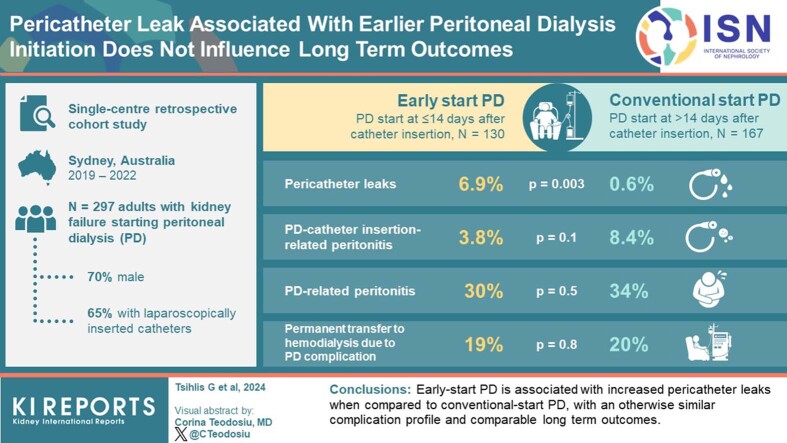
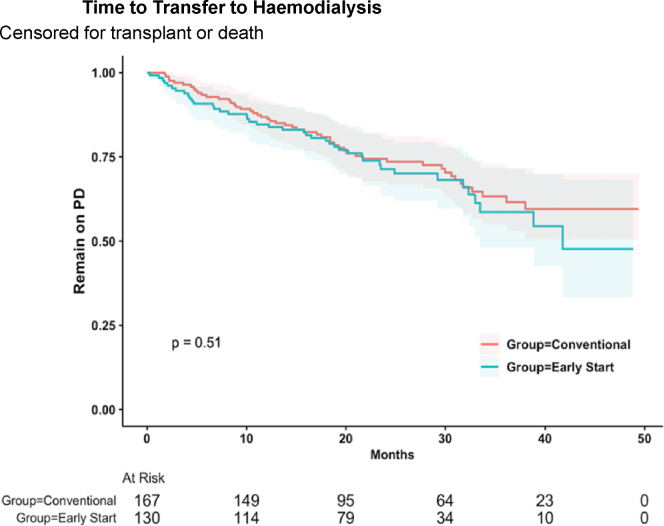
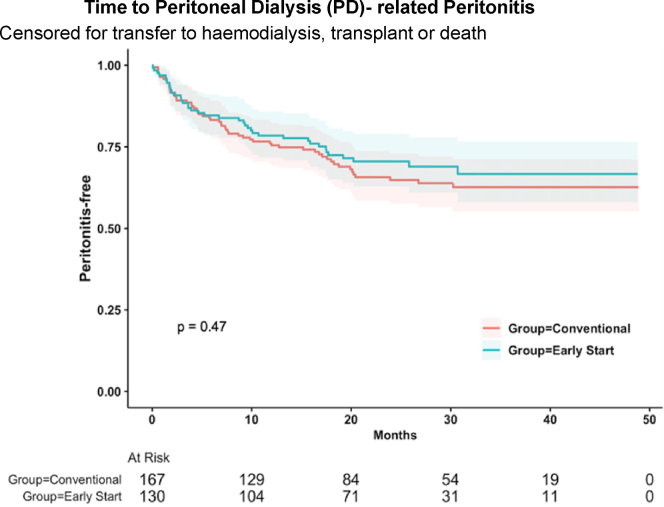
This study examines outcomes of early-start PD (ESPD) and conventional-start PD (CSPD), commencing at ≤14 days and >14 days after catheter insertion, respectively. All adults with kidney failure within a large metropolitan PD unit initiating PD through a new catheter, inserted using laparoscopic or modified Seldinger technique, between August 2019 and August 2022, were included in this retrospective observational study. Demographic data and episodes of infectious and mechanical complications were collected using electronic medical records. Analysis was conducted using analysis of variance and Chi-square testing. A -value < 0.05 was significant with Bonferroni correction performed where relevant. Kaplan-Meier and competing risks analyses were performed for time to PD-related peritonitis and transfer to hemodialysis.
A total of 297 patients (70% male, mean age 58.7 years) were included, with 130 (43.8%) patients undertaking ESPD. Most patients had laparoscopically inserted catheters (65.3%) and 65 patients (22.0%) received prior hemodialysis. When compared to CSPD, ESPD was associated with a higher number of pericatheter leaks (6.9% vs. 0.6%, = 0.003), with otherwise similar complication episodes and no significant difference with respect to time to PD-related peritonitis or transfer to hemodialysis. Catheter insertion technique or prior hemodialysis treatment did not significantly influence outcomes.
ESPD is associated with increased pericatheter leaks when compared to CSPD, with an otherwise similar complication profile.
在国际上,腹膜透析(PD)越来越多地在导管插入后2周内开始。有必要开展研究来评估这一策略的效果。
本研究考察了分别在导管插入后≤14天和>14天开始的早期开始腹膜透析(ESPD)和传统开始腹膜透析(CSPD)的效果。在2019年8月至2022年8月期间,在一个大型都市腹膜透析单位通过新导管开始腹膜透析的所有成年肾衰竭患者被纳入这项回顾性观察研究,这些导管采用腹腔镜或改良Seldinger技术插入。使用电子病历收集人口统计学数据以及感染和机械并发症的发作情况。采用方差分析和卡方检验进行分析。在相关情况下进行Bonferroni校正,P值<0.05具有显著性。对腹膜透析相关腹膜炎发生时间和转为血液透析进行了Kaplan-Meier分析和竞争风险分析。
共纳入297例患者(70%为男性,平均年龄58.7岁),其中130例(43.8%)患者进行了早期开始腹膜透析。大多数患者的导管通过腹腔镜插入(65.3%),65例(22.0%)患者曾接受过血液透析。与传统开始腹膜透析相比,早期开始腹膜透析与更多的导管周围渗漏相关(6.9%对0.6%,P = 0.003),在其他并发症发作方面相似,在腹膜透析相关腹膜炎发生时间或转为血液透析方面无显著差异。导管插入技术或先前的血液透析治疗对结果没有显著影响。
与传统开始腹膜透析相比,早期开始腹膜透析与更多的导管周围渗漏相关,在其他并发症方面情况相似。