Department of Medicine, Emory University, Atlanta, Georgia.
Emory Critical Care Center, Atlanta, Georgia.
JAMA Netw Open. 2024 Sep 3;7(9):e2434197. doi: 10.1001/jamanetworkopen.2024.34197.
Intravenous fluids are an essential part of treatment in sepsis, but there remains clinical equipoise on which type of crystalloid fluids to use in sepsis. A previously reported sepsis subphenotype (ie, group D) has demonstrated a substantial mortality benefit from balanced crystalloids compared with normal saline.
To test the hypothesis that targeting balanced crystalloids to patients with group D sepsis through an electronic health record (EHR) alert will reduce 30-day inpatient mortality.
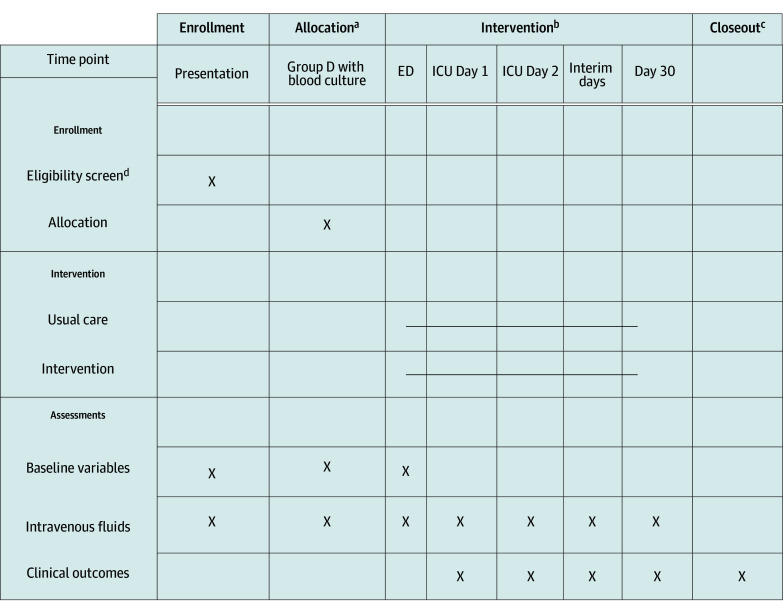
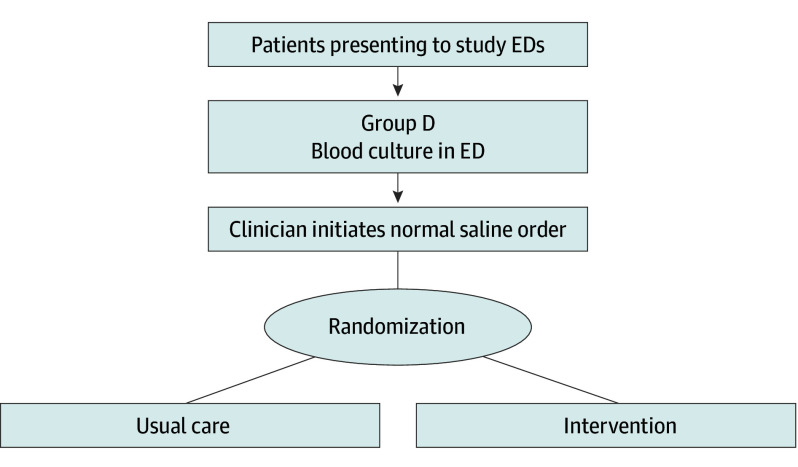
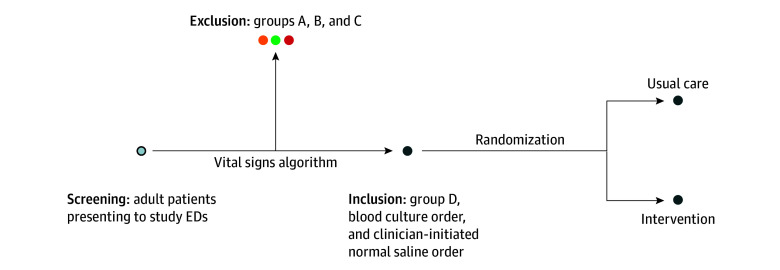
DESIGN, SETTING, AND PARTICIPANTS: The Precision Resuscitation With Crystalloids in Sepsis (PRECISE) trial is a parallel-group, multihospital, single-blind, pragmatic randomized clinical trial to be conducted at 6 hospitals in the Emory Healthcare system. Patients with suspicion of group D infection in whom a clinician initiates an order for normal saline in the emergency department (ED) or intensive care unit (ICU) will be randomized to usual care and intervention arms.
An EHR alert that appears in the ED and ICUs to nudge clinicians to use balanced crystalloids instead of normal saline.
The primary outcome is 30-day inpatient mortality. Secondary outcomes are ICU admission, in-hospital mortality, receipt of vasoactive drugs, receipt of new kidney replacement therapy, and receipt of mechanical ventilation (vasoactive drugs, kidney replacement therapy, and mechanical ventilation are counted if they occur after randomization and within the 30-day study period). Intention-to-treat analysis will be conducted.
The PRECISE trial may be one of the first precision medicine trials of crystalloid fluids in sepsis. Using routine vital signs (temperature, heart rate, respiratory rate, and blood pressure), available even in low-resource settings, a validated machine learning algorithm will prospectively identify and enroll patients with group D sepsis who may have a substantial mortality reduction from used of balanced crystalloids compared with normal saline.
On finalizing participant enrollment and analyzing the data, the study's findings will be shared with the public through publication in a peer-reviewed journal.
With use of a validated machine learning algorithm, precision resuscitation in sepsis could fundamentally redefine international standards for intravenous fluid resuscitation.
ClinicalTrials.gov Identifier: NCT06253585.
在脓毒症治疗中,静脉输液是必不可少的一部分,但在脓毒症中使用哪种晶体液仍存在临床平衡。先前报告的脓毒症亚表型(即 D 组)表明,与生理盐水相比,平衡晶体液可显著降低死亡率。
通过电子健康记录(EHR)警报,将平衡晶体液靶向 D 组脓毒症患者,检验这一假设,即是否可降低 30 天住院死亡率。
设计、地点和参与者:Precision Resuscitation With Crystalloids in Sepsis(PRECISE)试验是一项在埃默里医疗保健系统的 6 家医院进行的平行组、多医院、单盲、实用随机临床试验。急诊科(ED)或重症监护病房(ICU)的临床医生怀疑 D 组感染并开始下达生理盐水医嘱的患者,将被随机分配到常规护理和干预组。
EHR 警报会出现在 ED 和 ICU 中,提示临床医生使用平衡晶体液而不是生理盐水。
主要结局是 30 天住院死亡率。次要结局是 ICU 入住率、院内死亡率、血管活性药物使用、新的肾脏替代治疗和机械通气使用(如果在随机分组后和 30 天研究期间发生,则算作血管活性药物、肾脏替代治疗和机械通气)。将进行意向治疗分析。
PRECISE 试验可能是脓毒症晶体液类首个精准医学试验之一。使用常规生命体征(体温、心率、呼吸频率和血压),即使在资源有限的环境中也可获得,一种经过验证的机器学习算法将前瞻性地识别和招募 D 组脓毒症患者,与生理盐水相比,平衡晶体液可能会显著降低死亡率。
在最终确定参与者入组并分析数据后,研究结果将通过在同行评议期刊上发表文章向公众公布。
使用经过验证的机器学习算法,脓毒症的精准复苏可能从根本上重新定义国际静脉输液复苏标准。
ClinicalTrials.gov 标识符:NCT06253585。